








)
)
Virtual desktop infrastructure solutions now encompass more than traditional data-centre VDI. IT teams may compare customer-managed VDI, Desktop as a Service, fixed-price Cloud PCs and session-based application delivery within the same procurement process.
This guide compares ten relevant platforms, according to architecture, infrastructure responsibility, workload fit, management effort and published pricing. It also explains when a simpler application and desktop delivery model may meet the requirement without a full virtual machine for every user.
Virtual Desktop Infrastructure Solutions Compared
The table below separates the products by delivery model. This distinction matters because a dedicated virtual machine, a pooled desktop and a shared Windows session each create different cost, security and administration profiles.
|
Solution |
Category |
Deployment model |
Best fit |
Public pricing status |
|
Citrix DaaS and CVAD |
Enterprise VDI, DaaS and app delivery |
On-premises, cloud, hybrid |
Complex enterprise environments |
Quote and calculator |
|
Azure Virtual Desktop |
Cloud-hosted VDI and DaaS |
Microsoft Azure |
Microsoft-centred IT teams |
Azure consumption plus licensing |
|
Omnissa Horizon |
Enterprise VDI and hybrid desktop delivery |
On-premises, private cloud, public cloud |
Large hybrid estates |
Quote-based subscription |
|
Windows 365 |
Persistent Cloud PC |
Microsoft cloud |
Predictable one-user, one-desktop delivery |
From $28/user/month in the US |
|
Amazon WorkSpaces |
Managed DaaS |
AWS |
AWS estates and mixed usage patterns |
From $25/month in a published US example |
|
Dizzion Frame |
Multi-cloud DaaS and Cloud PC |
Public cloud, private cloud, hybrid |
Browser-first and multi-cloud delivery |
Quote-based |
|
Workspot |
Enterprise Cloud PC and DaaS |
Public cloud |
Distributed knowledge and power users |
Quote-based |
|
Parallels RAS |
VDI, RDSH and virtual app delivery |
On-premises, cloud, hybrid |
Mid-market, MSP and mixed delivery |
Quote-based concurrent licensing |
|
Inuvika OVD Enterprise |
App, shared desktop and VDI delivery |
On-premises or self-hosted cloud |
Windows and Linux application estates |
Quote-based concurrent subscription |
|
TSplus Remote Access |
Session-based alternative |
On-premises or cloud-hosted Windows servers |
SMB application and desktop publishing |
From $200 perpetual or $4.50/user/month yearly |
Prices for this VDI comparison were checked on 25 June 2026. Currency, region, configuration, taxes, infrastructure consumption and contract terms can change the final cost.
What Counts as a VDI Solution?
VDI
Traditional Virtual Desktop Infrastructure assigns a desktop operating system virtual machine to each user or user session. The virtual machine runs centrally, while a display protocol sends screen updates to the endpoint and returns keyboard, mouse and peripheral input.
However, buyers now use “VDI software” and “desktop virtualization solutions” as broader commercial categories.
Desktop virtualization
Consequently, the shortlist may include
- Desktop as a Service or DaaS, where a provider operates more of the control plane;
- Cloud PCs, which package a persistent desktop at a fixed monthly price;
- and session-based systems, where multiple users share a Windows Server host.
These models are related but not interchangeable. Dedicated VDI offers stronger workload isolation and personalisation. Pooled VDI improves utilisation. Session-based delivery can be more economical when users need the same applications and do not require an individual desktop virtual machine.
How Did We Compare Our Pick Of Solutions?
The best VDI solutions cannot be ranked by feature count alone. This comparison considers the architecture behind each service, the infrastructure that customers must operate, the available deployment locations, persistence options, application publishing, endpoint access, scaling model and licensing structure.
The evaluation also considers workload fit. Task workers, contractors, developers, graphics users and regulated teams rarely need the same setup and desktop design . IT teams should therefore shortlist architectures before comparing individual products.
1. Citrix DaaS and Virtual Apps and Desktops
Category: Enterprise VDI, DaaS and application delivery
Citrix combines virtual applications, dedicated or pooled desktops and hybrid deployment options within a mature enterprise platform. Citrix DaaS places the management plane in Citrix Cloud, while Citrix Virtual Apps and Desktops can support organisations that retain more components within their own environment.
Citrix is often adopted by large organisations with diverse application estates, demanding policies and specialist EUC administrators. Its breadth is valuable, but design, licensing and operational dependencies require careful governance. Price is also rapidly an issue.
Pros
- Broad virtual application and desktop delivery capabilities
- Strong support for hybrid and multi-resource-location designs
- Detailed policy, optimisation and monitoring options
Cons
- Greater architectural and administrative complexity than SMB-focused tools
- Infrastructure and Microsoft licensing remain separate cost areas
- Current commercial pricing normally requires a quote or calculator.
When to choose Citrix:
Choose Citrix when enterprise flexibility and granular control justify a larger management and licensing footprint.
2. Microsoft Azure Virtual Desktop
Category: Azure-hosted VDI and DaaS
Azure Virtual Desktop delivers full desktops and RemoteApp applications from Azure host pools. It supports personal desktops and pooled multi-session deployments, including Windows 11 Enterprise multi-session, which can reduce compute cost for standardised user groups.
Microsoft operates the brokering and gateway service, but the customer still manages session hosts, images, profiles, applications, identity, networking and Azure consumption. Azure Virtual Desktop therefore removes part of the traditional VDI control plane without becoming a fully hands-off service.
Pros
- Native integration with Azure, Microsoft Entra ID and Microsoft 365
- Personal and pooled desktops plus application publishing
- Eligible Microsoft licences can include user access rights.
Cons
- Requires Azure architecture, image and cost-management skills.
- Compute, storage, profiles, networking and supporting services are billed separately.
- Azure dependence may not suit multi-cloud or on-premises strategies.
Pricing:
There is no single desktop price. Eligible internal users may have access rights through existing Microsoft licences, while Azure infrastructure is consumption-based.
When to choose Azure Virtual Desktop:
Choose AVD when the organisation is committed to Azure and can actively manage capacity, images and cloud cost.
3. Omnissa Horizon
Category: Enterprise VDI and hybrid desktop delivery
Omnissa Horizon, formerly VMware Horizon, remains a major option for organisations operating virtual desktops across data centres and cloud environments. Horizon 8 supports customer-managed deployments, while Horizon cloud services extend management and orchestration options.
The platform fits organisations needing persistent or non-persistent desktops, application delivery and mature virtual desktop administration. It is particularly relevant where existing virtualisation skills and hybrid infrastructure remain important.
Pros
- Established enterprise VDI architecture
- Flexible on-premises and hybrid deployment patterns
- Supports advanced desktop and application use cases.
Cons
- Requires specialist infrastructure and EUC knowledge.
- Packaging and platform dependencies need close review during procurement.
- Public list pricing is not consistently displayed.
Pricing:
Omnissa offers subscription SaaS and term options, but buyers should request a current quote for the required edition, user metric and infrastructure design.
When to choose Omnissa Horizon:
Choose Horizon when the organisation needs enterprise VDI control across a hybrid estate and can support the operational stack.
4. Microsoft Windows 365
Category: Persistent Cloud PC
Windows 365 assigns each licensed user a persistent Cloud PC with a defined CPU, memory and storage configuration. Microsoft operates the desktop service, while IT manages access, policies, applications and endpoints through Microsoft tools, including Intune for enterprise scenarios.
This fixed-resource model is easier to budget than consumption-based VDI. It is less efficient when many assigned desktops remain unused, but it works well for employees who need a consistent Windows environment every day.
Pros
- Simple one-user, one-Cloud-PC model
- Predictable monthly pricing
- Close integration with Microsoft 365, Entra ID and Intune
Cons
- Fixed monthly cost continues even when a desktop is lightly used
- Less pooling flexibility than Azure Virtual Desktop
- Higher specifications increase per-user cost quickly.
Pricing:
Microsoft lists Windows 365 Business Basic at $28, Standard at $36 and Premium at $56 per user per month in the United States. These examples respectively provide 2 vCPU/4 GB, 2 vCPU/8 GB and 4 vCPU/16 GB configurations with 128 GB storage.
When to choose Windows 365:
Choose Windows 365 when predictable persistent desktops matter more than infrastructure-level optimisation.
5. Amazon WorkSpaces
Category: Managed Desktop as a Service
Amazon WorkSpaces provides persistent WorkSpaces Personal desktops and non-persistent WorkSpaces Pools. Customers can select monthly AlwaysOn billing or AutoStop metering for intermittent users, which makes the service adaptable to full-time and occasional access patterns.
AWS operates the service layer, while customers still design identity, network access, images, applications and governance. The strongest fit is usually an organisation already comfortable with AWS operations and regional cost modelling.
Pros
- Persistent and pooled desktop options
- Monthly and hourly charging models
- Windows and Linux desktop choices
Cons
- Pricing varies by region, bundle, storage and operating system.
- Directory, networking and resilience choices can add cost.
- AWS-specific administration may increase skills requirements.
Pricing:
AWS publishes a $25 monthly Windows Value example and a $44 monthly Windows Standard example in US regions. AutoStop combines a monthly base charge with hourly use; WorkSpaces Pools also include relevant instance and Windows access charges.
When to choose Amazon WorkSpaces:
Choose WorkSpaces when AWS alignment and flexible usage-based billing are priorities.
6. Dizzion Frame
Category: Multi-cloud DaaS and Cloud PC
Dizzion Frame delivers desktops and applications through a browser-first platform across AWS, Microsoft Azure, Google Cloud, IBM Cloud, Nutanix and hybrid environments. Dizzion also offers a persistent Cloud PC service with fixed monthly pricing.
Frame is attractive when cloud choice, rapid browser access and graphics-capable workloads matter. Organisations can use it for standard desktops, application streaming or demanding design and engineering scenarios, depending on the selected infrastructure.
Pros
- Broad public-cloud and private-cloud choice
- Browser-first access without a traditional client requirement
- Persistent, multi-session and application delivery options
Cons
- Multi-cloud flexibility can complicate cost comparison.
- Final performance depends on region and underlying instance selection.
- Public configuration prices are not consistently listed.
Pricing:
Dizzion advertises per-user, per-VM, usage-based and fixed-price models. A current quote will be required for a precise comparison.
When to choose Dizzion Frame:
Choose Frame when multi-cloud placement and browser-delivered desktops or graphics applications are central requirements.
7. Workspot Enterprise Desktop Cloud
Category: Enterprise Cloud PC and DaaS
Workspot provides cloud desktops and workstations through a SaaS control plane, with resources placed close to users in supported public-cloud regions. The service targets distributed enterprises, including organisations delivering higher-performance desktops to engineers and other power users.
Workspot separates the control plane from customer data-plane resources, allowing organisations to retain control over applications and corporate data. Its commercial model is positioned around managed deployment and predictable service delivery rather than a do-it-yourself VDI stack.
Pros
- Cloud-native management for geographically distributed desktops
- Suitable options for knowledge workers and high-performance workstations
- Flat-rate and usage-aligned commercial approaches are available.
Cons
- Best value is likely to appear at enterprise scale.
- Requires careful region, cloud and network design.
- Current pricing requires direct engagement.
When to choose Workspot:
Choose Workspot when a distributed enterprise wants managed Cloud PCs without operating a conventional VDI control plane.
8. Parallels RAS
Category: VDI, Remote Desktop Session Host and virtual application delivery
Parallels RAS manages virtual desktops, Remote Desktop Session Host workloads, remote PCs and published applications from one platform. It supports on-premises, cloud and hybrid infrastructure, with integrations for major hypervisors and cloud platforms.
The platform is a practical option for mid-market organisations, MSPs and IT teams that need more flexibility than basic RDS but less operational weight than a large enterprise suite. Concurrent licensing can also match environments where the total user population exceeds simultaneous demand.
Pros
- Combines VDI, RDSH and application publishing
- Built-in gateway, load balancing and multi-tenancy capabilities
- Concurrent-user licensing and 24/7 support
Cons
- The broad feature set still requires architecture planning
- Infrastructure and Microsoft licences remain separate
- No stable public list price for a representative deployment
When to choose Parallels RAS:
Choose Parallels RAS when one management layer must support several Windows delivery models across mixed infrastructure.
9. Inuvika OVD Enterprise
Category: Virtual applications, shared desktops and VDI
Inuvika OVD Enterprise publishes Windows and Linux applications, shared desktops and dedicated desktops through native clients or a web portal. A web-based administration console controls the environment, and the platform supports on-premises or self-hosted cloud deployment.
OVD Enterprise is particularly relevant where organisations want to combine Windows and Linux applications in one workspace or avoid some of the infrastructure dependencies associated with larger VDI suites.
Pros
- Windows and Linux application delivery in one user workspace
- Shared and dedicated desktop options
- Concurrent-user subscription and included two-factor authentication features
Cons
- Smaller ecosystem than Citrix, Microsoft or Omnissa
- Suitability for specialised peripherals should be validated in a pilot
- Public pricing requires a partner or vendor quote
When to choose Inuvika:
Choose OVD Enterprise when mixed operating-system application delivery and infrastructure control are more important than a hyperscale vendor ecosystem.
10. TSplus Remote Access – Alternative to VDI
Category: Session-based application and desktop delivery
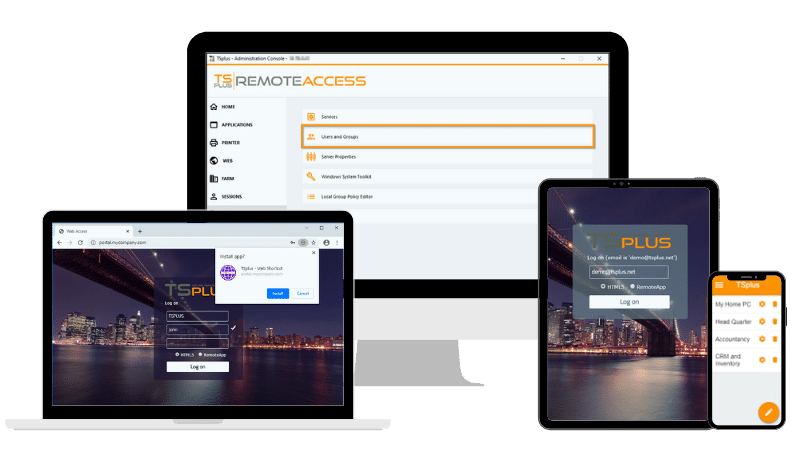
TSplus Remote Access publishes Windows applications or complete desktops from Windows hosts that the organisation controls. Multiple users can receive separate sessions from the same server, connecting through an HTML5 portal or RDP-compatible client.
This architecture does not assign a desktop virtual machine to every user. It therefore comes into its own as an alternative when business requirement is centralised application access, browser delivery or shared Windows desktops rather than dedicated VDI isolation alone.
Pros
- Simpler architecture for standard Windows applications and desktops
- Perpetual and subscription licensing
- HTML5 access, application assignment, gateway and farm options
- Suitable for on-premises servers or cloud-hosted Windows virtual machines
Cons
- Not a one-VM-per-user VDI platform
- Requires a supported Windows host and capacity planning
- Applications that require client Windows or strict per-user isolation may need another model
Pricing:
The hybrid licensing model offers clients and partners a broad range of possibilities. Perpetual pricing starts at $200 for Desktop Edition, $275 for Web Mobile Edition and $315 for Enterprise Edition for three users. Enterprise subscription pricing is $5 per user per month, or $4.50 billed yearly. Licensing and infrastructure should be assessed together.
When to choose TSplus Remote Access:
Choose TSplus when you need to simplify thing or needs affordable Windows application publishing and shared remote desktops without deploying a complete VDI stack.
Troubleshooting RDP or publishing apps for remote users? How about a guided demo of TSplus Remote Access ?
How Will You Choose the Right Virtual Desktop Architecture?
Session-based delivery
Start with the workload rather than the vendor. Task workers using a small set of standard applications may be well served by pooled or session-based delivery. Knowledge workers who need a consistent desktop may fit Windows 365, Amazon WorkSpaces Personal or another persistent Cloud PC.
Infrastructure requirements
Developers, engineers and graphics users need more careful testing. CPU, memory, GPU, storage latency, peripheral redirection and proximity to data can matter more than the management interface. A pilot should reproduce real files, meetings, printing and peak-hour concurrency.
Infrastructure strategy then narrows the field. Azure-first teams may prefer Azure Virtual Desktop or Windows 365. AWS teams may favour WorkSpaces. Hybrid enterprises may shortlist Citrix or Omnissa, while multi-cloud requirements may point towards Dizzion Frame or Workspot.
TCO and licensing
Finally, compare total cost of ownership rather than licence price alone. Include compute, storage, profile services, gateways, Microsoft licensing, monitoring, backup, resilience, security operations and administrator time.
VDI for the sake of it, or is there another way?
And wherever pertinent, evaluate whether VDI is the best solution. Alternatives may offer better potential.
Virtual Desktop Infrastructure Selection Checklist
Use this checklist before requesting final quotes or launching a proof of concept:
- Classify each user group by applications, hours, persistence and performance.
- Decide whether users need dedicated VMs, pooled VMs or shared sessions.
- Document identity, multi-factor authentication and conditional access requirements.
- Test latency from every major user location to the proposed hosting region.
- Validate application compatibility, image management and update processes.
- Test printers, scanners, USB devices, audio, video and multiple monitors.
- Size profile storage and define backup, recovery and disaster-recovery objectives.
- Model normal, peak and idle usage rather than using only monthly averages.
- Separate vendor licensing from cloud, Microsoft and operational costs.
- Run a pilot with representative users and measurable acceptance criteria.
A technically successful pilot should also be operationally sustainable. The chosen platform must fit the skills, staffing and support coverage available to the organisation.
In Conclusion: Which Virtual Desktop Infrastructure Solution Should You Choose?
The best virtual desktop infrastructure solution is the one whose architecture matches the workload. Citrix and Omnissa offer broad enterprise control. Azure Virtual Desktop provides flexible Microsoft cloud VDI, while Windows 365 packages a simpler persistent Cloud PC. Amazon WorkSpaces suits AWS-aligned teams, and Dizzion Frame or Workspot can address cloud-native and distributed requirements.
Parallels RAS and Inuvika OVD Enterprise cover mixed application and desktop delivery with less emphasis on a hyperscaler-only model. TSplus Remote Access is our practical alternative when users need centralised Windows applications or shared desktops but do not need an individual VM.
Remember these are overviews and each environment has its particular demands so it can be best not to begin with a feature checklist. Define isolation, persistence, application, location and management requirements first, then compare the platforms which implement the correct model.
TSplus makes remote access and app delivery simple for systems administration.
TSplus Remote Access Free Trial
Ultimate Citrix/RDS alternative for desktop/app access. Secure, cost-effective, on-premises/cloud
)
)
)
