









)
)
Digital workplace transformation is the coordinated redesign of how people use technology, information and business processes to complete their work. It connects employee experience with application access, security, support and IT operations.
Successful transformation does not begin with a product catalogue. It begins by identifying how work should function, where employees encounter friction and which technical changes will create measurable business value.
What Is Digital Workplace Transformation?
Digital workplace transformation is the broad process of improving how employees reach applications and workspaces , as well as how they communicate, collaborate, obtain support and complete business workflows. The transformation may involve new technology, but it also changes policies, responsibilities and working practices.
The objective is not simply to digitise an existing process. A transformed workplace should make work easier to complete, simpler to manage and more resilient when users, devices or locations change.
Digital workplace versus digital workspace
The digital workplace is the complete organisational environment in which digital work happens. It includes people, culture, management practices, processes, applications, infrastructure, security policies and physical working arrangements.
A digital workspace is more focused on the IT aspects. It is the user-facing environment through which employees access applications, desktops, data and services.
The relationship can be summarised as follows:
|
Entity |
Primary focus |
Typical elements |
|
Digital workplace |
How the organization operates |
People, culture, processes, policies and technology |
|
Digital workspace |
Where users access digital resources |
Applications, desktops, portals, files and support tools |
|
Digital workplace transformation |
How the organization improves the workplace |
Strategy, modernization, adoption, governance and measurement |
The digital workspace is therefore one component of the digital workplace. Improving the access portal alone does not transform the complete working environment.
Transforming in-office to remote or hybrid is more than deploying new tools
Replacing one application with another may be useful, but it is not necessarily transformation. Organizations often adopt new software while leaving unchanged their fragmented approval processes, duplicate data entries and inconsistent access rules.
A true workplace transformation examines the complete user journey. It asks how an employee starts a task, finds information, opens the required application, requests approval and receives technical support .
This wider view frees organizations from recreating old problems on newer platforms.
Why Do Organizations Transform the Digital Workplace?
Workplace modernization is often driven by several pressures at once. Employees expect dependable access across locations, IT teams need stronger control, managers want greater operational visibility, and executives need technology investments to produce measurable value.
A coherent digital workplace strategy can align these requirements instead of addressing each one with an isolated tool.
Reduce fragmentation and operational friction
Digital workplaces often develop gradually. One department adopts a cloud service, another depends on a legacy Windows application and a third relies on spreadsheets, email and informal workarounds.
Such fragmentation creates friction for users and IT teams. Employees may need several credentials, interfaces and support channels. Administrators must maintain overlapping systems with different security and reporting capabilities.
Transformation provides an opportunity to rationalise access and workflows. The organisation does not necessarily need to replace every system. Instead, it needs a clearer model for how users access the systems in place.
Support employee experience and business resilience
Digital employee experience describes how people perceive and use the technologies required for their work. Slow applications, repeated authentication, unreliable access and confusing support processes affect that experience directly.
Therefore, employee experience goes beyond human resources concerns. Indeed, persistent utilisation friction can increase support requests, delay customer service and reduce the value of software investments.
Thankfully, a well-designed workplace also improves resilience. In well-built conditions, employees can continue working when a site becomes unavailable teams move between locations or the organization adds new offices and external partners.
Modernise without discarding useful systems
Many organizations depend on stable Windows applications that remain essential to operations. Rebuilding every legacy application for the web may be expensive, risky or unnecessary.
Application publishing and browser-based access can extend the useful life of these systems. New and old applications remain centrally managed, while authorised users gain a more flexible way to reach them.
MediSolution provides an example of this gradual approach. The healthcare software provider used HTML5 application delivery to web-enable existing applications while preparing for wider cloud adoption. The transformation supported modernization without requiring an immediate rewrite of the full product portfolio.
Which Broad Steps Can You Take to Build a Digital Workplace Strategy?
A digital workplace strategy should define what the organization wants work to become. Technology choices follow from that objective.
The strategy should connect business priorities, employee needs, technical architecture and security requirements. Without this alignment, departments may implement separate projects which increase complexity instead of reducing it.
Start with employee and business needs
Begin by identifying the main groups who use the workplace. These may include office employees, remote workers, frontline staff, contractors, technicians, managers and external customers.
Each group may require a different combination of applications, devices and access methods. A finance employee may need several connected Windows applications, while a contractor may need temporary access to one published application.
User research does not need to become a lengthy consulting exercise. Interviews, support-ticket analysis and workflow observation can reveal common problems such as:
- Employees cannot find the correct application or document.
- Remote access performs differently from office access.
- New users wait too long for accounts and permissions.
- Legacy applications work only on specific devices.
- Support teams lack enough information to diagnose problems.
These findings help management distinguish genuine workplace needs from requests for fashionable technology.
Define ownership and measurable outcomes
Digital workplace transformation crosses departmental boundaries. IT may operate the platform, but human resources, security, finance, operations and department managers influence how it is used.
The organization should establish clear ownership for decisions about access, workflow design, data handling, employee communication and support.
It should also define intended outcomes before implementation. Examples include:
- reducing application launch time,
- shortening onboarding
- lowering avoidable support demand or
- improving service availability.
Clear outcomes protect the project from becoming an indefinite technology refresh.
Choose a phased transformation model
The whole workplace does not need to change at once. Large-scale replacement can create migration risk, overwhelm IT teams and users and consume resources before the organization has validated the design.
A phased model allows teams to begin with a high-value use case. The organization can modernise access to a critical application, improve one onboarding workflow or provide a consistent workspace to one department .
Lessons from the pilot or proof of concept (POC) will then shape the next phase. This approach turns transformation into a controlled improvement programme rather than a single disruptive event.
How Can You Modernize Application and Desktop Delivery?
Application access is a central part of the digital workplace. Employees cannot benefit from new collaboration or automation tools if essential business applications remain difficult to reach.
The architecture should support modern cloud services and established Windows applications without forcing every workload into the same delivery model.
Assess the existing application portfolio
An application inventory should identify who uses each application, where it runs, how sensitive its data is and which systems it depends on.
The assessment should separate applications into practical categories:
- Cloud and Software as a Service applications
- Internal web applications
- Published Windows applications
- Applications requiring a full remote desktop
- Local applications installed on managed devices
- Legacy systems awaiting replacement or modernization
This classification helps IT teams choose a suitable access method for each workload.
Match delivery methods to users and applications
A digital workplace may combine several delivery models.
Application publishing gives users access to selected Windows applications without exposing a complete desktop. It suits employees who need a focused set of business tools.
A remote desktop provides a centralised Windows environment. It may be appropriate for roles that use several connected applications, files and settings.
Browser access reduces dependency on a specific endpoint operating system. It can support employees using personal devices, temporary equipment or devices on which local installation is impractical.
The correct design does not maximise the number of available features. It gives each user enough access to complete the role without unnecessary complexity or privilege. TSplus Remote Access lets you choose from these options according to your needed configuration.
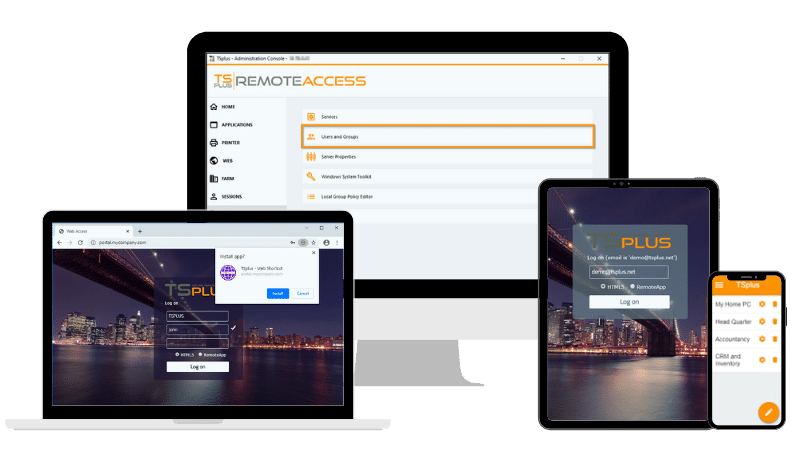
TSplus Remote Access Free Trial
Ultimate Citrix/RDS alternative for desktop/app access. Secure, cost-effective, on-premises/cloud
Make secure access consistent across locations
Employees should not need to relearn the workplace each time they move between an office, home or customer site. The applications, permissions and support path should remain recognizable.
Consistency does not mean ignoring context. Security teams may apply stronger verification to unknown devices, unusual locations or privileged resources. The visible workflow should nevertheless remain understandable.
Longdendale High School illustrates this need for consistency. The school replaced fragmented access methods with centralized application and resource delivery for staff and students. Different user groups received access suited to their roles while the IT team retained centralized control.
Why wait to modernise access to existing Windows applications without rebuilding your entire IT environment.
What Makes Security and Governance Part of the Design?
Security should shape the digital workplace architecture from the beginning. Adding controls after deployment often creates gaps, duplicated tools and a frustrating user experience.
A secure workplace establishes how identity, devices, applications and data interact under defined policies.
Apply identity-based access controls
Multi-factor authentication should protect sensitive and remote access. A password alone should not provide access to critical applications or administrative functions.
Least privilege limits users to the applications and resources required for their roles. Group-based assignments can simplify administration and make access easier to review.
Zero Trust principles add continuous context to the decision. The organisation verifies the user, device and requested resource instead of assuming that a connection is trustworthy because it originates from an internal network.
Zero Trust Architecture supports authorised access to applications, services and data across on-premises and cloud environments according to organisational policy.
Protect devices, sessions and business data
Device requirements should reflect the sensitivity of the work. Some users may work safely through a browser on an approved personal device, while regulated or privileged roles may require organisation-managed endpoints.
Administrators should also review:
- Operating system and application updates
- Endpoint protection
- Session encryption
- Clipboard and file-transfer permissions
- Printing and local drive redirection
- Login and session logs
- Data retention and privacy requirements
Centralized application delivery can reduce local data storage, but it does not remove the need for endpoint and identity controls.
Create governance employees can follow
Governance defines who may approve access, how applications are introduced, what data may be shared and how exceptions are handled.
Policies should be concise enough for employees and managers to understand. A rule that is technically complete but operationally impossible may encourage users to find unsanctioned alternatives.
IT and security teams should therefore test policies against real workflows. Strong governance should make the approved method clearer and easier than the workaround.
How Can You Prepare People for Workplace Modernization?
Leveraging the participation of employees and other users can make or break the change:
Employees will experience this transformation through changed interfaces, processes and expectations. Even a technically successful deployment can fail because users do not understand why it was introduced or how it helps them.
This is why change management should begin during design rather than shortly before launch and why beta testing can be worth more than any other lever.
Involve users before deployment
Representatives from affected roles should test early versions of the digital workspace. Their feedback can reveal missing applications, unclear terminology and workflow assumptions that technical teams may not notice.
User involvement also improves acceptance. Employees are more likely to adopt a new process when they can see how their feedback influenced the result.
The project team should still maintain clear boundaries. User consultation informs the design, but security, compliance and operational requirements remain mandatory.
Support adoption with training and assistance
Training should reflect the tasks employees perform. Generic platform demonstrations rarely prepare users for real work.
Short role-based guidance can show employees how to sign in, open applications, save files, request access and contact support. Managers may need additional guidance on approvals, reporting and team processes.
Remote support should be integrated into the transformed workplace. In project preparation stages, it is a great tool for training and knowledge-sharing. For implementation and deployment, your teams will enjoy its features and manoeuvrability. Finally, have in TSplus Remote Support technicians a secure way to view problems, guide users and maintain approved devices regardless of location.
Redesign management practices and processes
Digital transformation can expose processes that depend on physical proximity or informal knowledge. Approvals may stall because a manager is unavailable, while new employees may struggle to identify the correct owner of a task.
The organization should document responsibilities, replace unnecessary manual handoffs and decide where important information is stored.
Additionally, managers should evaluate outcomes rather than online visibility. Digital workplace transformation should improve how work will flow, not introduce excessive surveillance of employee activity.
What Might You Include in Your Practical Digital Transformation Roadmap?
A structured roadmap helps organizations move from strategy to deployment while controlling cost and risk.
1. Assess the current workplace
Document applications, infrastructure, access methods, user groups, support processes and any recurring problems. Establish a baseline for performance and experience.
2. Define the target workplace
Describe how users should access resources, how identity will be verified and which processes should change. Connect each proposed capability to a business outcome.
3. Prioritise high-value use cases
Select projects that combine visible user benefit with manageable technical scope. Legacy application web access, standardised onboarding or centralised remote support can provide practical starting points.
4. Pilot with representative users
Include different roles, devices and locations. Test performance, access rules, support procedures and employee guidance under realistic conditions.
5. Deploy in controlled phases
Expand the proof of concept by department, location or application group. Maintain rollback procedures and communicate changes before each phase.
6. Measure and improve
Compare results with the original baseline. Resolve recurring friction, update policies and use operational data to determine the next transformation priority.
This roadmap creates a continuous improvement cycle. It also allows the organization to stop investing in initiatives that do not produce sufficient value.
Measure Digital Workplace Transformation
Transformation should be measured across employee experience, operations, security and financial value. A single adoption figure cannot show whether the workplace is effective.
Useful indicators may include:
|
Area |
Example measures |
|
Employee experience |
Access success, application launch time, satisfaction and onboarding completion |
|
IT operations |
Support volume, resolution time, service availability and capacity |
|
Security |
Failed logins, blocked attacks, privileged access reviews and policy exceptions |
|
Business value |
Process completion time, cost per user, continuity and application lifecycle extension |
Measures should explain whether work is improving. Collecting activity data without a clear decision or benefit creates reporting overhead and may raise privacy concerns.
Microsoft’s employee experience maturity guidance connects workplace performance with strategy, leadership, objectives, communication and culture. This reinforces the need to evaluate organizational change alongside technical performance.
How Does TSplus Support Practical Workplace Transformation?
Digital workplace transformation does not always require a complete move to cloud desktops or a large enterprise workspace suite. Many organizations can make meaningful progress by improving how existing Windows applications and desktops are delivered, secured and supported.
TSplus Remote Access allows IT teams to publish selected Windows applications, provide full remote desktops and offer browser-based access through an HTML5 web portal. Organizations can retain existing applications while creating a more consistent access experience.
The wider TSplus product suite meets additional transformation requirements:
- TSplus Remote Support helps technicians assist users and maintain remote devices.
- TSplus Advanced Security adds protection and access controls for Windows Server environments.
- TSplus Server Monitoring tracks server, application, website and session performance.
This modular approach allows organizations to modernise incrementally. IT teams can address an immediate access problem, validate the results and expand the architecture as requirements develop.
The model proves particularly helpful for small and medium-sized organisations, but also for software vendors, managed service providers and lean IT teams who need secure scalable application delivery while avoiding unnecessary enterprise complexity .
Conclusion
Digital workplace transformation redesigns how people, technology and business processes work together. The transformation should reduce friction, strengthen security and make the organization more adaptable.
The strongest programmes begin with employee and business needs, modernise access in controlled phases and measure whether work has genuinely improved. Technology remains essential, but lasting results depend equally on governance, management, support and user adoption.
For many organizations, transformation can start with a practical step: making an essential application easier to access, support and secure. That first improvement can provide the foundation for a broader and more coherent digital workplace.
Build a practical digital workplace around the applications and infrastructure your organization already uses. Try TSplus Remote Access or speak with a TSplus specialist:
TSplus Remote Access Free Trial
Ultimate Citrix/RDS alternative for desktop/app access. Secure, cost-effective, on-premises/cloud
)
)
)
