





What is AnyDesk?
AnyDesk is a remote access and support platform used by IT teams, MSPs and help desks to control endpoints, transfer files and resolve issues from anywhere. It enables attended break-fix sessions and unattended maintenance via lightweight agents, typically across Windows, macOS, Linux and mobile devices. Common workflows include rapid screen control, clipboard and file exchange, multi-monitor handling and basic session logging for accountability.
Where it fits in your stack:
- Daily support: diagnose incidents, install updates, and train users without deskside visits.
- Operations: maintain servers and kiosks during maintenance windows with unattended access.
- Hybrid work: provide secure access for remote staff when VPN or VDI is unnecessary.
How Much Does AnyDesk Cost in 2026?
AnyDesk offers Solo, Standard, Advanced and Ultimate plans, with pricing based on licensed users, concurrent connections and managed devices. As of October 2026, published US regular prices start at approximately $28.90 per month for Solo, $45.90 for Standard and $99.90 for Advanced, billed annually. Ultimate pricing is available by quotation.
AnyDesk also advertises a 20% first-year discount on eligible subscriptions. Organizations should check the latest AnyDesk pricing and compare renewal rates, additional concurrent connections and unattended-device allowances before committing.
Why Would It Be Needed to Consider Alternatives to AnyDesk?
Organizations revisit their toolset when licensing costs grow with technicians or endpoints, or when governance demands outpace available controls. Others need deployment options beyond a pure cloud service-such as self-hosting for data residency-or prefer browser-based access that avoids client installation. Teams also seek closer alignment with ticketing/identity systems and clearer TCO as they scale support to hundreds or thousands of devices.
Typical switch triggers:
- Cost predictability at scale and simpler license governance for audits and renewals.
- Stronger security posture (MFA/SSO, granular RBAC, auditable logs) or a self-hosted option.
- Operational fit: faster session start, reliable reconnects, mass deployment, and branding.
What Should You Look for in an AnyDesk Alternative?
Choosing an AnyDesk alternative starts with understanding how your team uses remote connections. Help desks need fast attended support, while MSPs often prioritize unattended access, centralized device management and technician permissions. Compare browser access, supported operating systems, deployment models and session security. Then examine how licensing scales with simultaneous connections, technicians and managed endpoints, rather than focusing only on advertised starting prices.
Evaluation focus areas:
- Security & compliance: MFA/SSO options, role-based permissions, session approvals, detailed audit trails.
- Deployability & scalability: agent packaging, group policies, bulk rollout, folder-level access and policy inheritance.
- Cost & lifecycle: clear licensing basis (per tech vs per device), stable renewal terms, support SLAs and release cadence.
7 AnyDesk Alternatives Compared
1. TSplus Remote Support

TSplus Remote Support - Affordable Remote Support for IT Teams
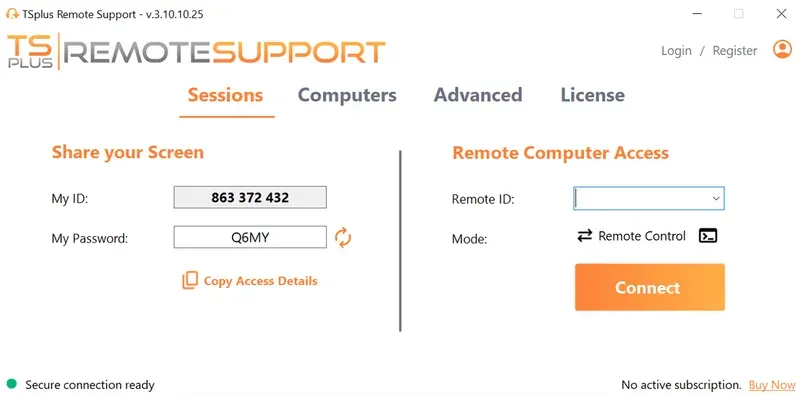
TSplus Remote Support is built for help desks and MSPs that need fast, secure remote assistance without high per-seat pricing. It emphasizes easy deployment, unattended access and branding at a fair cost. Teams can standardize workflows with saved computers, groups, and role-based permissions, while technicians benefit from quick connect, file transfer, and in-session chat for faster resolutions.
Flexible hosting (including self-hosted options) and a lightweight agent make it straightforward to roll out across sites and maintain over time.
Pros
- Unattended access with saved computers, groups, and role-based control.
- Technician-friendly UI with quick connect, file transfer and session chat.
- Self-hosted or cloud-hosted flexibility to meet security policies.
- Branding options for support portals and client components.
- Predictable, competitive licensing suited to growing teams.
Cons
- Focused on remote support; advanced UEM/PSA integrations are lighter than full RMM suites.
- macOS/Linux feature parity may trail Windows-first scenarios in some workflows.
Pricing
As of October 2026, TSplus Remote Support uses concurrent-connection licensing, with unlimited users and devices. Annual subscriptions start at $8 per connection per month for one connection, decreasing to $7 for three, $6 for five and $5 for ten or more. All features are included, with self-hosting available for qualifying deployments. A 14-day free trial is offered.
2. ConnectWise ScreenConnect

ConnectWise ScreenConnect - Advanced Remote Support for IT Technicians
ScreenConnect serves busy service desks that need low-latency sessions, strong unattended access and granular control over every connection. It shines in technician workflows-rapid joins, script execution, and a powerful toolbox-without getting in the way of triage speed.
Teams with strict SLAs and complex fleets value its responsiveness and depth, plus the option to self-host for tighter control. Agent-based unattended access, MSI mass deployment, and fine-grained RBAC/auditing help standardize operations across sites while keeping security teams comfortable.
Pros
- Low-latency sessions and robust technician shortcuts. Sessions initiate quickly over varied networks, and helpers like toolbox, clipboard sync and command execution reduce time-to-resolution.
- Strong unattended access and mass deployment support. Persistent agents, MSI/package deployment and group policies let admins onboard and manage large fleets consistently.
- Rich session controls (reboot/reconnect, toolbox, scripts). Technicians can restart into safe mode, push files or scripts, and resume sessions without re-authenticating users.
Cons
- Pricing can trend higher at scale. Per-tech licensing and add-ons can raise TCO as teams, endpoints, or compliance requirements grow.
- Governance features may require careful configuration for stricter environments. Role scoping, audit logs and remote access policies need explicit setup to satisfy tight security standards.
Pricing
As of October 2026, ScreenConnect offers One at $30 per month, Standard at $47 per concurrent technician per month, and Premium at $57 per concurrent technician per month, billed annually. One includes 10 unattended agents and one session, while Standard and Premium provide unlimited unattended agents and broader technician capabilities. Enterprise pricing is available by quotation.
3. RealVNC (VNC Connect)

RealVNC (VNC Connect) – Cross-Platform Remote Access
RealVNC favors a lightweight footprint and broad OS coverage, which makes it dependable for mixed Windows/macOS/Linux estates that need predictable day-to-day access. Setup is intentionally minimal, agents are small, policies are straightforward and admins can standardize access quickly without heavy back-end work.
It is well suited to routine maintenance, quick health checks, and training scenarios where reliability and low overhead matter more than deep automation. Centralized governance is present but simpler than enterprise suites, so teams should confirm RBAC and auditing needs during a pilot.
Pros
- Cross-platform coverage (Windows, macOS, Linux). Viewers and servers are available across major OSes, supporting mixed estates and legacy hardware.
- Straightforward setup with minimal overhead. Lightweight agents and clear policies make initial roll-out fast for small IT teams.
- Good for mixed-device inventories and simple access scenarios. It suits routine maintenance, quick checks, and training use cases where advanced automation isn’t essential.
Cons
- Feature depth for enterprise governance is more limited. Centralized policy, compliance reporting, and granular RBAC trail more enterprise-focused tools.
- Bulk management and automation are not as extensive as RMM suites. Scripting, patch orchestration, and large-scale agent lifecycle controls are comparatively basic.
Pricing
As of October 2026, RealVNC Connect offers Essentials, Plus, Premium and Enterprise plans. Essentials includes three managed devices and one active connection; Plus supports up to 50 devices and three active connections; Premium increases these limits to 150 devices and five active connections. Enterprise offers custom pricing and additional deployment controls. Public prices depend on the selected configuration and region.
4. GoTo Resolve

GoTo Resolve – Remote Support and IT Management
GoTo Resolve consolidates remote support, ticketing and light device management so service desks can work from a single browser-based console. Attended and unattended sessions launch quickly, and built-in automation cuts context switching between diagnostics, fixes and ticket updates.
It’s a strong match for distributed help desks wanting SaaS convenience and coordinated workflows without stitching multiple tools together. Larger environments should validate policy granularity, role scoping and cost progression as device and technician counts grow.
Pros
- Integrated ticketing and automation workflows. Built-in help desk and task automation reduce context switching between support and device actions.
- Cross-platform support with browser-based connectivity. Remote sessions launch from the web with agentless options for attended scenarios.
- Helpful for distributed service desks. Chat, permissions, and queueing streamline collaboration across time zones and teams.
Cons
- Suite approach may include features you don’t need. Bundled capabilities can add complexity and cost if your use case is purely remote support.
- Costs can increase as devices and technician’s scale. Tier upgrades and device caps may prompt higher plans for growing environments.
Pricing
As of October 2026, GoTo Resolve is being presented within the LogMeIn Resolve product portfolio. Free and paid offerings combine remote support with additional IT management capabilities. Organizations should confirm the current package, technician and device allowances, and any RMM or ticketing costs with the vendor before comparing quotes.
5. RemotePC

RemotePC – Affordable Unattended Remote Access
RemotePC focuses on core remote access features at a price point that works for SMBs and lean IT teams. Agent deployment and unattended access are straightforward, helping admins roll out to many endpoints without complex packaging or infrastructure.
Day-to-day use is simple enough for non-specialists, making it practical for routine remote tasks and hybrid work setups. Organizations with stricter governance or integration needs should assess RBAC depth, identity options and reporting before standardizing.
Pros
- Competitive pricing with frequent promotions. Long-term discounts and multi-device bundles make entry costs attractive for SMBs.
- Simple deployment for unattended machines. Lightweight agents, invite links, and web dashboards keep on-boarding straightforward.
- Works across major operating systems. Clients for Windows, macOS and mobile apps cover common remote work scenarios.
Cons
- Advanced governance and automation are limited compared to enterprise tools. Role-based controls, centralized auditing, and compliance tooling are narrower in scope.
- Branding and integrations may be basic. Organizations with strict identity, SSO or ecosystem needs may find customization options limited.
Pricing
As of October 2026, RemotePC offers Solo, Pro, Team and Enterprise plans. The Pro plan covering 10 computers has a regular annual price of $99.50, with introductory discounts available. Team and Enterprise plans support larger device inventories and multiple users. Since RemotePC frequently advertises first-year promotions, compare standard renewal prices rather than the initial discounted cost alone.
6. Zoho Assist

Remote Support Inside the Zoho Ecosystem
Zoho Assist fits naturally alongside the wider Zoho suite, offering fast, browser-based sessions and uncomplicated agent deployment. Teams already using Zoho apps benefit from smoother authentication flows and familiar admin patterns, which reduces onboarding time.
Unattended access and routine maintenance are easy to manage, making it a good choice for small to mid-size organizations prioritizing simplicity. For enterprises, confirm the availability of granular permissions, audit trails, and integration breadth outside the Zoho ecosystem.
Pros
- Smooth fit for Zoho users with easy agent deployment. Native ties to the Zoho suite simplify authentication, invites and asset visibility.
- Clear web-based sessions and unattended access. Browser sessions launch quickly and persistent agents keep endpoints reachable for maintenance.
- Competitive pricing. Plans map well to small teams and growing businesses that prioritize simplicity and predictable costs.
Cons
- Advanced enterprise controls are lighter than specialist tools. Granular RBAC, audit exports and compliance workflows can require workarounds.
- Change management and scripting are limited. Large-scale automation and deep remediation tooling are not the platform’s focus.
Pricing
As of October 2026, Zoho Assist Remote Support starts at $10 per technician per month for Standard, $15 for Professional and $24 for Enterprise, billed annually. Separate Unattended Access plans start at $10 per month for 25 unattended computers. A free edition and a 15-day trial are available. Costs depend on whether your priority is attended support, unattended maintenance or both.
7. TeamViewer

TeamViewer – Remote Support Across Multiple Devices and Platforms
TeamViewer is a widely recognized remote connectivity platform with extensive OS and device coverage, including mobile and specialized endpoints. Its ecosystem of add-ons, conditional access options, and integrations addresses complex enterprise scenarios across multiple locations and networks.
Performance is reliable at scale, and end users are often familiar with the client, which shortens time to first connection. The trade-off is licensing complexity and higher costs at larger seat counts, so budget and policy models should be mapped carefully before rollout.
Pros
- Mature feature set and strong brand recognition. The platform supports varied devices, peripherals, and advanced workflows out of the box.
- Wide device and OS support including mobile. Specialized modules extend coverage to phones, rugged devices and IoT scenarios.
- Add-ons for enterprise needs. Options like conditional access, integrations, and management packs target complex governance requirements.
Cons
- Pricing at scale can be high. Enterprise bundles and add-ons add up as technician counts or capabilities expand.
- Admin complexity may be overkill for smaller teams. Broad configurability can lengthen initial setup and policy tuning.
Pricing
As of October 2026, TeamViewer offers Remote Access, Business, Premium and Corporate subscriptions, with Tensor for larger enterprise deployments. Published US quotation figures indicate approximately $50.90 per month for Business, $120.90 for Premium and $245.90 for Corporate, excluding taxes. Annual billing applies, and add-ons such as mobile device support can increase the total cost. Confirm the current regional quotation before purchasing.
How Do These Solutions Compare?
| Solution | Primary use case | Browser access | Pricing basis |
|---|---|---|---|
| TSplus Remote Support | IT support, MSPs | Web-based support tools | Concurrent connections |
| ScreenConnect | Advanced technician support | Yes | Concurrent technicians |
| RealVNC Connect | Cross-platform device access | Depends on workflow | Active connections |
| LogMeIn Resolve | Support and IT management | Yes | Package and scale |
| RemotePC | Affordable unattended access | Yes | Computers/devices |
| Zoho Assist | Help desk and unattended support | Yes | Technicians or devices |
| TeamViewer | Remote support across diverse devices | Web client available | Users and sessions |
How to Choose the Right Alternative
Start with your security and governance requirements, then balance technician speed and TCO. Confirm unattended access, deployment method (cloud or self-hosted) and the breadth of OS support. Finally, test user experience with a small pilot across real support cases.
Checklist:
- Do we need self-hosting for policy or data sovereignty?
- How many technicians and endpoints must we support?
- Is browser-based access sufficient for most users?
- What level of audit logging and MFA/SSO do we require?
- What is our true per-technician or per-device TCO?
Conclusion
Choosing an AnyDesk alternative is ultimately about fit: governance requirements, technician speed, and total cost. Shortlist two or three tools which match your deployment model and OS mix, then run a pilot with real tickets. Measure time-to-resolution, end-user friction and licensing impact before you commit.
TSplus focuses on practical outcomes, reliable unattended access, browser delivery when needed and predictable licensing. If you want to reduce support costs without losing control, start a TSplus Remote Support trial and validate it in your environment.
TSplus Remote Support Free Trial
Cost-effective Attended and Unattended Remote Assistance from/to macOS and Windows PCs.
Commonly Asked Questions
Is TSplus Remote Support a good AnyDesk alternative for MSPs?
Yes. TSplus Remote Support offers concurrent-connection licensing rather than per-technician pricing, allowing MSPs to support multiple clients without purchasing a separate license for every technician. Saved computers, group organization and role-based permissions help teams manage unattended access efficiently while keeping licensing costs predictable.
How do unattended access and Wake-on-LAN compare between TSplus Remote Support and AnyDesk?
Both platforms support unattended access via persistent agents with policy-driven permissions. TSplus Remote Support streamlines repeat maintenance with saved computers and group management, while AnyDesk offers address books and permissions for similar outcomes. Wake-on-LAN is supported in both ecosystems where network and hardware conditions allow.
Can I self-host with TSplus Remote Support vs AnyDesk?
Yes. TSplus Remote Support supports both cloud-hosted and self-hosted deployments, giving IT teams flexibility over infrastructure and data management. AnyDesk also offers on-premises hosting, but through its enterprise-level Ultimate plan. Organizations comparing the two should evaluate hosting requirements alongside licensing costs, deployment complexity and security policies.
Do I need client installs, and how do sessions start vs AnyDesk?
Both tools typically use lightweight agents for unattended access and a small client for attended sessions, enabling quick connections with minimal user friction. TSplus Remote Support emphasizes technician speed with quick-connect flows, chat and file transfer built into the session. AnyDesk similarly focuses on rapid joins through its client, with features like clipboard sharing and permissions prompts.
How can I reduce TCO when switching from AnyDesk to TSplus Remote Support?
Compare total costs over 12–36 months, including the number of concurrent connections, technicians, managed devices and potential add-ons. TSplus Remote Support licenses simultaneous support sessions rather than individual technicians or endpoints, helping control costs as your team and device fleet grow. Unattended access and organized device groups can also reduce time spent on routine maintenance.


