








)
)
Remote access lets us connect to computers, applications, desktops and business systems from outside a traditional office. For employees, it can mean flexibility and uninterrupted workflow. For IT teams, that means delivering the said freedom without losing control over security, performance or cost.
This guide explains what remote access means today, how it affects its users: people, IT agents and businesses, and how IT teams can make remote access simple. It also shows how TSplus Remote Access helps organizations deliver secure remote desktops and apps without the complexity of heavy enterprise platforms.
What Does Remote Access Really Mean?
Remote access is often described as a technical connection between a user and a distant system. That definition is correct, but the picture it paints is incomplete. Remote access is also the reason
- a parent can finish work after school pickup,
- a technician can fix a server after hours,
- a small business can keep operating during a local disruption,
and so much more.
At a technical level, remote access can involve such means as a Virtual Private Network, Remote Desktop Protocol, browser-based access, terminal access or remote support software. Broadly remote access is a connection to a data-processing system from a remote location, including remote access services, VPNs, remote desktop software and terminal emulation.
For people, the meaning is more practical. Remote access turns work from a fixed place into a controlled digital service. That shift changes how employees organize their day, how managers think about productivity and how IT teams protect company resources.
What Does Remote Access Change for Employees?
Coherence and continuity
Remote access gives hybrid employees workflow continuity. A user can open business applications from home, a customer site, a branch office or a temporary location. The value is not only convenience but also access to the same work environment when physical access is not possible.
Reclaimed time
For all staff, remote access can reduce wasted time and cut the tiredness and stress from their commute. Instead of commuting only to use a specific application, employees connect securely and complete focused work from a suitable location. This flexibility can support better work-life balance, especially for people with caregiving responsibilities or long commutes.
Balance: availability vs personal time
Remote access also changes expectations. If people can connect from anywhere, work can spread into evenings, weekends and personal spaces. A good remote access strategy should therefore support boundaries as well as availability.
Balance: managing policies and the human factor
This is where IT and management decisions become human decisions. Session timeouts, access rules, device policies and support processes all affect the daily experience of employees. Secure remote access should protect the company without making people feel locked in to or out of their own work.
What Does Remote Access Change for Businesses?
Resilience
For businesses, remote access supports resilience. Offices can close, travel can be interrupted, devices can fail and local events can disrupt operations. When applications and desktops remain reachable through secure remote access, employees can keep serving customers. Therefore, businesses can keep running so become more resilient.
Broader horizons
Remote access also widens the talent pool. Businesses can hire beyond one local commute area, support regional offices and work with specialists who are not nearby. For MSPs, remote access makes it possible to support many clients without sending technicians on-site for every issue.
Lower outlay, longer-term value
The business case is not only about flexibility. Remote access can reduce hardware dependency, maximize the usage of legacy software, simplify application delivery and support faster onboarding. New users can receive access to the right desktops and apps without waiting for every application to be installed locally.
Balance: flexibility vs security
However, remote access must not become uncontrolled access. A business gains flexibility only within IT’s definition of who connects, what each person can reach, when access is allowed and how activity is monitored. With those controls, flexibility rhymes with security.
What Does Remote Access Mean for IT Teams?
Versatility
For IT teams, remote access moves the perimeter. The user may be at home, in a hotel, on a personal network or using a managed laptop outside the office. The application may still run on company infrastructure, but the access path now crosses networks and devices that IT may not fully control.
Identity
This change increases the importance of identity. User accounts, multi-factor authentication, role-based access and offboarding processes become central to daily security. A forgotten account or overprivileged remote user can create more risk than a missing software patch.
Simplicity
IT teams also need simplicity. A remote access platform which requires too many clients, gateways, exceptions or manual steps can become difficult to support. When remote access is complicated, users create workarounds and administrators lose visibility.
Visibility
Visibility is essential. IT should know who connected, from where, to which system and for how long. Logs, session history and failed login tracking turn remote access from a blind trust model into a managed service.
What Are Some Main Remote Access Models?
Remote access is not a single product category. The right model depends on what people need to do and what IT needs to protect.
| Model | What people experience | Best fit | Main IT concern |
|---|---|---|---|
| VPN access | A tunnel into the company network | Broad access to internal resources | Network exposure and segmentation |
| Remote desktop access | A full remote Windows desktop | Office PC or server-based work | RDP hardening and access control |
| Browser-based access | A web portal to apps or desktops | Simple cross-platform access from any location | Portal security and authentication |
| Application publishing | Only assigned apps appear | Centralized resources and business software delivery | App mapping and host capacity |
| Remote support | A technician helps a user or device | Troubleshooting and helpdesk work | Consent, logging and session control |
VPN
A VPN is useful when users need network-level access, but it can be too broad for people who only need one application. Remote desktop access is familiar and powerful, but it must be protected against direct exposure. Browser-based access can make remote access simple by giving users one clear entry point.
Publishing apps or desktops
Application publishing is often the best fit for business software. Instead of giving every user a full desktop, IT publishes the exact Windows applications required for each role. This reduces clutter for users and improves control for administrators.
Technical remote support
Remote support is related but different. It helps technicians troubleshoot devices and assist users, but it is not always the best model for daily application access. Many organizations need both remote access and remote support, but should not confuse the two.
Secure Remote Access Starts With Trust
When a user enters credentials or accesses any resource, secure remote access asks a layered question around trust.
- Is this person,
- allowed to access
- this particular resource,
- from this device,
- at this time?
Every part of the architecture should help answer that question.
Authentication
Authentication confirms identity. Multi-factor authentication adds protection when passwords are stolen, reused or phished. For administrators and external support providers, MFA should be treated as a baseline requirement.
Least privilege
Least privilege limits what users can reach. A finance employee may need accounting software, but not server administration tools. A contractor may need one application, but not the full internal network.
Session control
Session control adds accountability. IT teams should be able to review logins, failed attempts, session duration and unusual access patterns. This information helps with troubleshooting, security investigations and compliance evidence.
User experience
User experience also matters. If secure access is too slow or confusing, people may delay work, share credentials or ask for unsafe exceptions. Security works best when the safest path is also the easiest path.
How do I Keep Remote Access as Simple as Possible?
Open, sign in, access!
Keeping remote access simple starts with the user journey. A user should not need to know server names, internal IP addresses or technical connection details. A user should sign in, pass authentication and see the resources assigned to their role.
Centralize
Centralization helps IT deliver this experience. When applications run on controlled servers, IT can patch and manage them in one place. Users receive consistent access, even when their endpoint device changes.
Browser-based web-portal access
Browser-based access can reduce setup time. A secure web portal gives hybrid employees, contractors and external users a familiar way to reach remote desktops and apps. It can also reduce the need to install and maintain multiple client tools.
Publication of select applications
Application publishing makes the workspace cleaner. People see the tools they need, not every system in the environment. This improves usability and supports least privilege at the same time.
Streamlined administration
Administration should also stay predictable. IT teams need clear licensing, straightforward user management and practical monitoring. A platform which is simple for employees but difficult for administrators will not stay simple for long.
Where Does TSplus Remote Access Fit?
TSplus Remote Access helps organizations deliver secure remote desktops and applications from Windows environments. Our software is built for anyone who want remote access without the overhead of complex enterprise virtualization platforms.
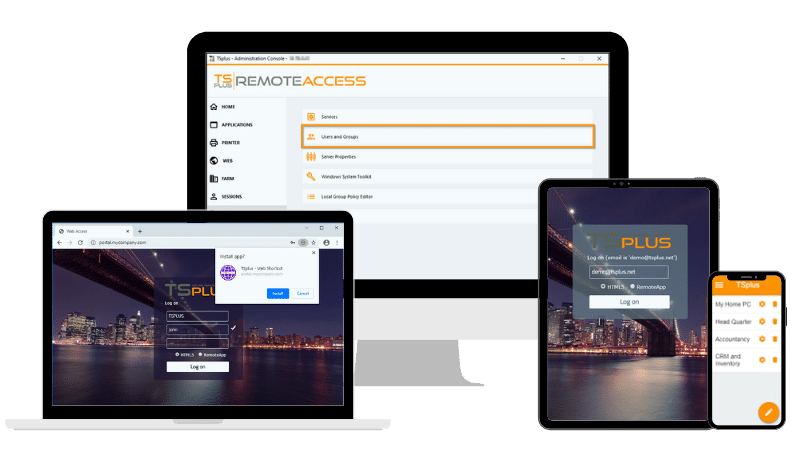
TSplus Remote Access Free Trial
Ultimate Citrix/RDS alternative for desktop/app access. Secure, cost-effective, on-premises/cloud
Simplicity: something for everyone
For employees, TSplus Remote Access provides a clear path to the apps and desktops they need. For IT teams, it centralizes access management and supports browser-based delivery. In turn, this provides organizations with simple remote access which nonetheless affords granular control of users, sessions and resources.
Versatile, scalable and affordable
TSplus Remote Access proves especially welcome with smaller IT teams yet those overseeing broad networks appreciate it too. Currently, many organizations need secure access to business applications while not always needing the complexity of a large Virtual Desktop Infrastructure project. Our software helps IT teams publish full desktops, individual applications or web-based access from an infrastructure they easily control. TSplus gives them a route to simpler remote desktops and apps which is both more practical and more affordable.
Remote Access as part of a comprehensive software suite
The wider TSplus suite will strengthen the environment around remote access.
- TSplus Advanced Security adds protection against unwanted access and brute-force attempts.
- TSplus Server Monitoring helps IT teams track performance and availability.
- TSplus Remote Support helps technicians assist users when they need direct help.
Remote Access Checklist for People-Centric IT
A people-centric remote access strategy should support work, security and manageability at the same time, from those handling it to those at the usage end. Here is your rough checklist for selecting or expanding your remote access platform.
- Define user groups and list who needs remote access: including employees, administrators, contractors and MSP technicians.
- Identify what each group needs: full desktops, individual applications, server tools or support sessions.
- Choose the right models: VPN, remote desktop, browser portal, application publishing or remote support.
- Require multi-factor authentication for remote users and administrators.
- Apply least privilege in user and group assignments, so each person sees only the resources required for their role.
- Wherever possible, avoid direct internet exposure of remote desktop services or management interfaces to the public internet.
- Enable logging for successful logins, failed attempts, session activity and administrative changes.
- Test the performance and user experience from real locations, not only from the IT office.
- Document support paths so users know what to do when access fails.
- Review access rights during onboarding, role changes and offboarding.
This checklist keeps the project grounded. Remote access is not only an infrastructure decision; it is a work design decision. The best implementation helps people work effectively while giving IT the control needed to protect the business.
Conclusion
Remote access has become part of everyday work. It affects where people work, how businesses stay resilient and how IT teams secure applications beyond the office. When remote access is well designed, it gives people flexibility without turning security into a burden.
TSplus Remote Access helps organizations deliver secure remote desktops and apps in a simpler way. Whether for hybrid teams, MSPs or businesses, it offers a practical path to remote access which benefits users, business continuity and IT control.
Want to scale remote access with better ROI? Talk to a TSplus specialist.
TSplus Remote Access Free Trial
Ultimate Citrix/RDS alternative for desktop/app access. Secure, cost-effective, on-premises/cloud
)
)
)
