








)
)
Introduction
A remote work digital office app gives employees secure access to business applications, desktops, files and collaboration resources from almost any location. It is not just a remote connection tool. It is a practical way to give remote teams a consistent work environment while IT keeps control over access, security and administration.
Traditional office infrastructure was built for a different routine. Most employees sat on-site, used company-managed devices and connected to applications through the local network. Distributed work has changed that pattern, so organizations need a workplace that follows people without turning every device into a new management problem.
TSplus Remote Access Free Trial
Ultimate Citrix/RDS alternative for desktop/app access. Secure, cost-effective, on-premises/cloud
What Is a Remote Work Digital Office App?
A workspace that travels with the employee
A digital office is a virtual work environment where employees reach the applications, desktops, files, communication tools and company resources they use every day. The employee may be at a desk in the office or on a laptop at home, but the work environment remains familiar. That consistency matters because remote work should not feel like a workaround.
Why the digital office is different from scattered remote tools
Many companies started remote work by adding separate tools as needs appeared. A VPN solved one access problem, a file-sharing platform solved another, and a meeting tool helped teams communicate. That approach can work for a while, but it often creates a fragmented experience for employees and a harder environment for IT to secure.
A remote work digital office app gives the organization a more coherent model. Applications, desktops and resources remain centralized, while employees connect through a clear and secure path. This makes remote work easier to support because the business is not relying on a patchwork of disconnected access methods.
The value of a remote work digital office application
The traditional model assumes that work happens mainly on-site. The digital office model assumes that work can happen wherever users can connect securely.
| Traditional Office | Digital Office |
|---|---|
| Access is usually tied to the office network | Access can be provided from approved locations |
| Productivity often depends on specific office hardware | Users can work through centralized apps and desktops |
| Software deployment can require repeated endpoint work | Applications can be published and managed centrally |
| Flexibility is limited when employees are away | Hybrid and remote work become easier to support |
| Business continuity may depend on office availability | Teams can keep working when the office is disrupted |
| Infrastructure costs can grow around local systems | Costs can be controlled through centralized delivery |
This comparison does not mean the physical office is no longer useful. Many organizations still rely on offices for collaboration, operations and culture. The point is that the digital office gives the business more resilience, because work is no longer blocked whenever users are away from the building.
Why Businesses Need Digital Office Solutions?
Remote teams need a reliable daily routine
Remote and hybrid employees do their best work when access feels predictable. They should not have to ask whether a business application only works from the office, whether a file is stored in the right place or whether their device can run a specific tool. A digital office reduces those small points of friction by giving employees one familiar workspace for daily tasks.
This reliability is also important for managers and business leaders. When employees can work from different locations without losing access to core systems, the organization can hire more flexibly, support different schedules and stay productive during office disruptions.
IT teams need control without making work harder
Security teams and administrators have different but equally important concerns. Remote work expands the number of connection points, devices and user scenarios they must manage. A digital office helps by:
- Centralizing access decisions
- Reducing uncontrolled local installations
- Making user activity easier to monitor
The goal is not to make remote work feel locked down or difficult. The goal is to create a secure route that employees actually want to use. When access is both simple and governed, users are less likely to look for risky shortcuts.
Why Remote Access to Business Resources Needs to be Secured?
Access should be simple for users and controlled for IT
Secure remote access is the foundation of any remote work digital office app. From the employee side, the process should feel straightforward:
- Open the portal
- Verify identity
- Reach the applications or desktops assigned to the role
From the IT side, every session should be protected by access policies, encrypted communication and clear visibility.
This balance is important because remote work succeeds only when people can connect without unnecessary friction. If access is too complex, employees lose time and support tickets increase. If access is too open, the organization creates risk. A strong digital office keeps both realities in view.
Sensitive data should stay closer to managed systems
Remote access can become risky when data is copied across unmanaged laptops, personal devices or unsecured channels. A digital office app helps reduce that exposure by keeping applications and data closer to the systems IT can protect. Employees can work with the information they need without spreading sensitive files across endpoints.
In practice, this means the platform should support:
- Encrypted connection
- Secure communication protocols
- Granular permissions
- Controlled application access
- Session rules
These controls do not need to get in the way of the user experience. They simply create guardrails so remote work remains productive and defensible.
Identity verification is part of the work experience
Multi-factor authentication, also called MFA, is now a basic requirement for most remote access environments. Passwords alone are too easy to steal, reuse or guess. By asking users to verify their identity with an additional factor, a digital office app reduces the chance that a compromised password becomes a business incident.
For employees, MFA should be clear and quick. For IT teams, it should fit the organization's access policies and risk tolerance. This is especially important when employees connect from personal devices, shared networks or locations outside the corporate perimeter.
Why Should Access to Applications and Desktops Be Centralized?
Employees should not have to chase their tools
Most employees move between several systems during the day. A sales team may use a Customer Relationship Management platform, an accounting team may need finance software, and operations teams may rely on industry-specific Windows applications. When each tool has a different access path, the workday becomes harder than it needs to be.
A remote work digital office app gives users one workspace for those resources. Employees can open the applications they are authorized to use, and administrators can decide which users, groups or roles should see each resource. This creates a cleaner experience for employees and a more manageable environment for IT.
Application publishing can be more efficient than full desktops
Not every user needs a complete remote desktop. In many cases, employees simply need one or two business applications to do their work. Application publishing lets IT deliver those tools directly, which can make the experience faster, simpler and less resource intensive.
Full desktop delivery still has a place for roles that need a complete environment. IT teams can provide published applications for some users and full desktops for others, without building a separate remote work strategy for every role.
Centralized management reduces repetitive work
Local software installations create ongoing maintenance. Every endpoint can become another place to patch, troubleshoot and secure. Centralized application delivery helps IT teams manage updates, permissions and availability from one location, which reduces repetitive work and improves consistency.
When applications are updated centrally, employees are less likely to encounter different versions, missing components or configuration problems between devices. The digital office becomes the stable place where the approved work environment lives.
Why Cross-Platform Compatibility Is Needed?
Remote work rarely happens on one device type
Modern teams use a mix of:
- Windows PCs
- macOS computers
- Linux workstations
- Android phones
- iPhones
- Tablets
Some devices are company-owned, while others belong to employees or external partners. A remote work digital office app should support this reality instead of assuming every user works from the same endpoint.
Cross-platform access is especially useful for hybrid work, Bring Your Own Device policies, contractors and organizations with several offices. The employee can connect from the available device, while IT still controls what the user can access inside the digital workspace.
Consistency helps employees feel confident
A consistent user experience is not just a design preference. It affects adoption. When employees see the same applications, settings and workflows each time they connect, they spend less time adjusting and more time working.
Consistency also reduces support requests. Users can follow the same routine from home, the office or a branch location, and help desk teams can troubleshoot from a clearer baseline. That shared baseline is one of the quiet strengths of a well-designed digital office.
Why Collaboration and Communication Support Are Primordial?
Collaboration and communication are important
Remote access alone does not create a complete digital office. Employees also need to talk to colleagues, share updates, coordinate projects and find the documents that support their work. A remote work digital office app should either include collaboration features or integrate smoothly with the tools the business already uses.
The important point is that collaboration should not feel separate from the work environment. When employees can reach applications, files and communication channels from the same digital workspace, remote work feels less fragmented.
File access should stay organized and secure
Document access is often where remote teams feel the difference between a smooth process and a messy one. Email attachments, personal storage and duplicated files can quickly create confusion. A digital office should help users reach the right files while preserving:
- Permissions
- Storage policies
- Auditability
This matters for productivity, but it also matters for security. When employees know where to find approved documents, they are less likely to create unofficial copies or share information through uncontrolled channels.
How Can You Check Performance and Reliability?
A digital office must feel responsive
Remote work tools are judged by the daily experience they create. If applications lag, sessions drop or screens load slowly, employees will quickly lose trust in the system. Performance is therefore not a technical bonus. It is part of whether the digital office is usable.
Organizations should think about performance from the beginning. User experience is influenced by:
- Network capacity
- Server resources
- Session load
- Application behavior and monitoring
A reliable platform makes remote work feel normal rather than fragile.
Business continuity depends on dependable access
Digital office apps also support business continuity. When weather, transport issues, local incidents or office closures prevent employees from reaching a physical workplace, the business still needs people to work. Reliable access to applications and desktops helps the organization keep operating through disruption.
This is one reason digital offices are becoming strategic rather than temporary. They give businesses a practical way to stay resilient while supporting the flexible work patterns employees now expect.
Why is Scalability Needed for Growing Organizations?
The workspace should adapt as teams change
Business needs rarely stay still. New employees join, contractors come and go, departments change tools and branch offices open or close. A remote work digital office app should make these changes manageable.
Without redesigning the environment every time the organization grows, scalability means IT can:
- add users
- publish applications
- adjust permissions
- support more session
This is especially valuable for SMBs, MSPs and businesses expanding across multiple locations.
One model can support several work patterns
Some organizations are fully remote, while others use hybrid schedules or office-based teams with occasional remote access needs. A flexible digital office can support all of these patterns through one access model. That keeps administration simpler and avoids creating separate systems for each group.
The same principle applies to distributed offices. IT teams can standardize access across locations while still assigning resources based on local business requirements, departments or user roles.
How to Easily Deploy and Administrate your Digital Office App?
Simple deployment helps projects move faster
Organizations do not always have the time, budget or specialist staff for complex virtual desktop projects. A good remote work digital office app should be practical to deploy and realistic to maintain. Faster setup helps businesses support remote work without delaying other IT priorities.
Simplicity means the product is designed so administrators can configure, without unnecessary complexity:
- access
- publish applications
- support users
Central administration keeps the environment understandable
Administrators should be able to manage users, groups, permissions, published applications and sessions from a clear interface. Central administration reduces routine work and makes it easier to understand how the remote work environment is configured.
This clarity helps with troubleshooting as well. When users report an access issue, IT teams can check assignments, permissions and session activity from a central point instead of searching across several tools.
Cost control is part of the decision
Digital office projects should improve flexibility without creating unpredictable cost. Infrastructure requirements, licensing, support, training and administration all affect the total cost of ownership. A practical solution helps organizations make better use of existing systems while reducing the need for heavy endpoint management.
For many businesses, the right digital office app is the one that gives remote teams secure access without forcing the organization into a larger platform than it needs.
What Are the Security and Compliance Features Needed?
Role-based access keeps permissions focused
Not every employee needs every application, desktop or dataset. Role-based access control helps organizations apply least privilege by assigning resources according to a user's job. This reduces exposure and makes permissions easier to review over time.
The approach is simple: employees get what they need to work, and unnecessary access stays closed. That clarity supports security, but it also makes the user workspace cleaner.
Monitoring makes remote work visible
Audit logs and monitoring help teams understand who connected, which resources were used, when sessions started and whether unusual behavior occurred. This visibility supports:
- security investigations
- compliance reviews
- operational troubleshooting
Monitoring also helps with performance planning. If the platform shows rising session counts or recurring bottlenecks, IT teams can respond before users feel the impact.
Compliance needs consistent policies
Organizations often need to meet industry, contractual or regional data protection requirements. A digital office app cannot replace a complete compliance program, but it can help apply access controls and session policies consistently across remote users.
That consistency matters because remote work can otherwise create exceptions. When the digital office becomes the standard route to business resources, it is easier to document controls and show how access is managed.
How Can You Choose the Right Digital Office App for Your Organization?
Start with the way people actually work
Choosing a remote work digital office app is not just a software comparison. Start by mapping the users, applications, desktops, files and workflows that matter most. This helps the organization avoid buying unnecessary complexity while making sure critical requirements are not missed.
It is also worth looking at support patterns. If employees often need the same few applications, application publishing may be more useful than full desktop delivery. If some roles need complete environments, the platform should support that as well.
Balance security with usability
Security and accessibility should be designed together. A tool that is secure but frustrating will push employees toward shortcuts, while a tool that is easy but weak will increase risk. The best digital office solutions make the secure path the easiest path.
IT leaders should also review:
- scalability
- licensing
- administration effort
- user experience
The right decision is the one that fits today's environment and can still support the organization as remote work needs evolve.
How TSplus Helps Create a Digital Office for Remote Teams?
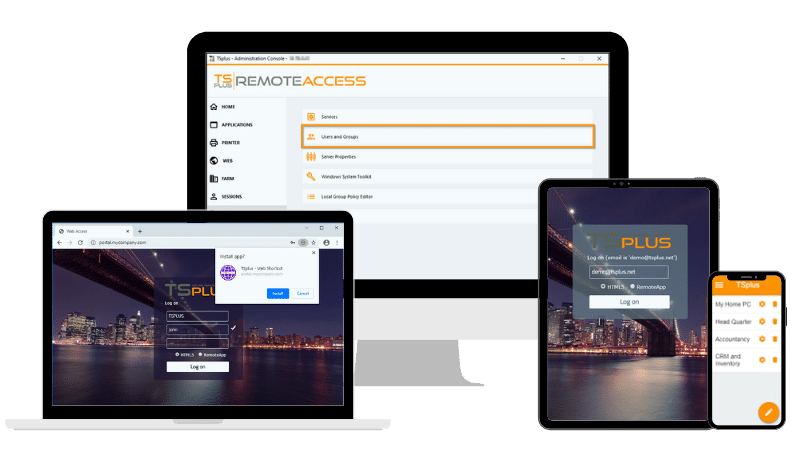
TSplus Remote Access enables IT teams to publish applications and desktops, so employees can work from virtually any location through a controlled access point. Instead of installing every application on every endpoint, organizations can centralize access and give users a more consistent way to work.
Application publishing and web access
With TSplus, IT teams can publish Windows applications and make them available through a web portal. Users access the resources they are authorized to use, which keeps the experience simple and avoids exposing a full desktop when application access is enough.
Cross-device work for remote teams
Remote teams can access their work environment from Windows, macOS, Linux, Android and iOS devices through a browser-based portal. This model supports hybrid work, external users and flexible device policies while keeping access centralized.
Centralized administration and scalable deployment
TSplus gives administrators tools to manage users, sessions, applications and access settings from a central point. This simpler administration model helps SMBs, MSPs and growing enterprises create a digital office that can scale with changing business needs.
A cost-effective path to the digital office
TSplus provides many of the practical benefits of remote application delivery and virtual workspaces while helping organizations control infrastructure complexity and licensing costs. For businesses that need secure remote access without heavy VDI overhead, our solution offers a direct path to a reliable digital office.
Conclusion
A remote work digital office app is more than a remote access tool. It is the foundation of a modern workplace where employees can securely reach applications, desktops, files and business resources from wherever work happens.
The strongest solutions make remote work feel natural for employees and manageable for IT teams. By combining secure access, centralized application delivery, cross-platform support, reliable performance, monitoring and simple administration, organizations can support flexible work while keeping data, infrastructure and user access under control.
TSplus Remote Access Free Trial
Ultimate Citrix/RDS alternative for desktop/app access. Secure, cost-effective, on-premises/cloud
)
)
)
