









)
)
Enabling a remote workforce means giving people the access, support, policies and working conditions they need to perform effectively beyond the traditional office. Success depends on more than connectivity. To set up for success, organizations must align employee experience, remote work infrastructure, security and management practices around a clear operating model.
What Does Enabling a Remote Workforce Mean?
A remote workforce includes employees, contractors, managers and technicians who perform some or all of their work away from a central business location. Some people work permanently from home, while others divide their time between offices, customer sites and remote locations.
Enabling that workforce can feel like a puzzle. It means ensuring each authorized user can reach the right applications, desktops, files and support services from an approved device and location. All the while, access must remain reliable and secure without forcing employees to solve technical problems on their own.
Remote access is only the starting point
Setting up remote access software does not, by itself, create a functional remote workplace. Employees also need adapted routines, clear processes, suitable devices, responsive support, effective communication and realistic expectations about availability.
The distinction is important. Remote employee access answers the question: “Can this person connect?”. Remote workforce enablement asks: “Can this person complete the job securely, consistently and without unnecessary friction?”. Managers, team leaders and HR, meanwhile, ask: “Will my workforce remain motivated, productive and cohesive? And how?”.
The four foundations of workforce enablement:
A sustainable model connects four interdependent areas.
| Foundation | Core question |
|---|---|
| People | Can employees work productively and maintain healthy boundaries? |
| Management | Are responsibilities, communication methods and expected outcomes clear and coherent? |
| Technology | Can users reach the applications and resources required for their roles? |
| Security | Are identities, devices, sessions and business data appropriately protected? |
An oversight or imbalance in one foundation inevitably impacts other areas. For example: strong technology cannot compensate for unclear policies or vice versa, while strict controls which make normal work impractical may encourage employees to use unsanctioned tools.
Why Is Remote Workforce Enablement a Business Strategy?
Remote and hybrid work affect recruitment, operating costs, business continuity and the employee experience. Management teams should therefore treat workforce enablement as a business decision supported by IT, rather than as an isolated infrastructure project.
Flexibility, productivity and employee experience
Cut the commute
Location flexibility can reduce commuting time and help employees organize focused work around personal responsibilities. It can also widen access to roles for people who live far from an office or require more adaptable working arrangements.
Professional grade set-up and clear targets
However, flexibility does not automatically improve productivity. Employees still need dependable access, appropriate equipment, manageable workloads and opportunities to communicate. Managers should therefore evaluate whether remote processes remove friction or merely transfer administrative and technical burdens to users.
Boundaries and communication
Healthy remote working also requires boundaries. Organizations should clarify such items as normal working days and core hours, expected outcomes, communication routines, escalation procedures and expectations for response times. An example: managers who treat constant online presence as proof of productivity may increase interruptions and undermine the flexibility the policy was intended to provide.
Business continuity and access to talent
A remote-ready organization can continue operating when an office, transport network or local facility becomes unavailable. Additionally, centralized applications and secure access paths allow approved staff to work remotely and move between locations without rebuilding their working environment.
Remote capability can also expand recruitment beyond commuting distance. A broader talent pool may help organizations fill specialist roles, support global customers or add seasonal capacity. Nonetheless, the benefit depends on whether onboarding, communication, security and support can scale with the workforce.
How Can You Build the People and Management Framework?
Technology should support the working model the organization has chosen. Before selecting tools, management, human resources, security and IT teams do need to define who may work remotely, what each role requires, how employees will be supported and how security will be upheld.
Set clear expectations for hybrid teams
Remote policies should cover location eligibility, approved devices, data handling, working hours and communication channels. Policies should distinguish between roles with fully remote potential and roles requiring physical presence for specific tasks.
Teams also need practical working agreements. These may specify which discussions require meetings, when asynchronous communication is preferred and where decisions are documented. Consistent practices help remote employees avoid missing the kind of information exchanged informally in an office.
Managers can focus on goals, service quality and completed work rather than physical or digital visibility. This outcome-based approach supports trust while preserving accountability.
Design onboarding and support around remote users
Remote onboarding should give new employees access to people as well as systems. A login account and laptop are not enough when the employee does not know where to find procedures, who approves access or how to request help. Social interaction may also be part of the picture as it contributes to good morale, team cohesion and efficient collaboration.
A useful onboarding process includes:
- Provisioning the required account, device and applications before the start date.
- Explaining security responsibilities and acceptable-use policies.
- Testing access to business-critical resources.
- Introducing communication and support channels.
- Scheduling early check-ins with the manager and team.
The process should conclude with a simple confirmation that the employee can work independently and knows where to obtain assistance.
Manage outcomes without creating surveillance
Outcomes and productivity
Performance monitoring should measure whether services and workflows are working, not turn ordinary employee activity into intrusive observation. Excessive surveillance can damage trust and encourage people to optimize visible activity instead of useful results.
Setting goals and objectives
Managers can instead track agreed deliverables, response standards, project progress and service outcomes. IT teams should monitor application availability, session performance, server capacity and support demand. This distinction supports secure workforce management without confusing technical visibility with employee management.
Balancing expectations, trust, productivity and wellbeing
WHO and International Labour Organization guidance also emphasizes that safe telework includes physical and mental wellbeing. Security, productivity and employee health should be treated as connected operational concerns.
What Helps Establish the Right Remote Work Infrastructure?
Remote work infrastructure is the combination of servers, networks, access services, applications, identity systems and endpoint devices that support work outside the office. The right architecture depends on what your company and its users need to access and where business data should remain.
Balance application publishing and remote desktops
Full remote desktop
A full remote desktop gives the user a centralized Windows environment containing applications, files and settings. This model suits employees who need several connected tools or a consistent desktop experience.
App publishing
Application publishing delivers only the applications assigned to the user. It can simplify the interface, reduce unnecessary access and help organizations web-enable established Windows software without replacing it.
Simple, adapted and balanced
The choice should follow the role. An administrator may need a complete desktop, while a finance employee may require only their accounting and document-management applications. Least-privilege design remains easier long term when IT teams publish only the resources each user needs. If layers complicate visibility, systems administration will get overloaded.
Support browsers, managed devices and BYOD
Browser access can make digital workplace solutions easier to reach from different operating systems and devices. It can also reduce local installation requirements for employees, contractors and occasional users.
BYOD or browser-based
Bring Your Own Device, or BYOD, requires additional decisions. Management must determine which personal devices are permitted, what data may be accessed and whether device validation or management is required. Highly sensitive roles may need organization-managed endpoints, while browser-based access may be suitable for lower-risk scenarios.
Connection scenarios
The connection method should match the device, application and data classification rather than applying one policy to every user.
Our TSplus client and partner case studies illustrate these different requirements:
- Longdendale High School used centralized access to support staff and students across nine servers and as many as 450 concurrent users.
- MédiSolution used HTML5 delivery to web-enable healthcare applications, beginning with 45 users and preparing to scale further.
Need simple application publishing and secure remote desktops without a complex enterprise stack? Start a free TSplus Remote Access trial.
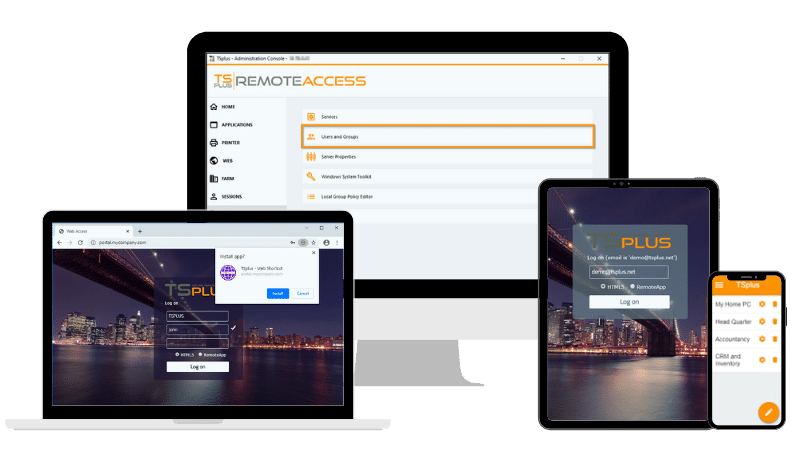
TSplus Remote Access Free Trial
Ultimate Citrix/RDS alternative for desktop/app access. Secure, cost-effective, on-premises/cloud
Make remote support part of the design
Remote users will encounter password problems, device issues, display errors and unfamiliar software. Without a remote support channel, small problems can leave employees unable to work or lead them towards unsafe workarounds.
Remote support software allows technicians to assist users, troubleshoot devices and perform approved maintenance without physical access. Attended support suits live user assistance, while unattended access can support managed maintenance when the device owner is unavailable.
NB: Support teams should document consent, authentication, session recording and technician permissions according to organizational requirements.
Why Secure Remote Employee Access from the Start? And How?
A distributed workforce increases the number of devices, locations and networks involved in business activity. Security controls must therefore protect identities, sessions and data without assuming every connection originates from a trusted office network.
The National Institute of Standards and Technology (NIST) recommends defining which remote access methods, device types and access levels an organization permits. This policy-first approach prevents security from becoming a collection of disconnected technical settings.
Strengthen identity and access control
Multi-factor authentication (MFA)
MFA should protect remote accounts, particularly privileged and administrative access. A stolen password should not be sufficient to open a session to business systems.
Least privilege
Access should also follow least privilege. Employees should receive only the applications, files and administrative rights needed for their responsibilities. Role-based assignments make access easier to review when a user changes position or leaves the organization.
Zero trust
Zero Trust principles add a useful mindset: verify the user, device and context rather than trusting a connection because it has reached the internal network. Zero Trust is an architecture and operating model, not a single feature or product.
Protect devices, applications and data
Update and patch
Ideally, IT teams should maintain supported operating systems, security updates, endpoint protection and encryption where appropriate. Organizations using personal devices should define minimum security requirements and procedures for lost, compromised or shared equipment.
Centralize apps
Centralized application delivery can reduce the amount of business data stored on endpoints because processing remains on the server. However, administrators must still review clipboard use, file access and transfer, printing, downloads and local drive redirection according to the sensitivity of the information.
Lock IDs, devices, times and more
Logging and alerting help IT teams identify repeated login failures, unusual locations and service problems. Records should support security and troubleshooting without collecting more personal information than the organization genuinely needs.
Balance security with usability
Controls that are difficult to understand or repeatedly interrupt legitimate work can lead to avoidance. Users may save passwords insecurely, transfer files through personal services or delay necessary work.
Security teams should test the complete user journey, including sign-in, multi-factor authentication, application launch and support escalation. Clear guidance and predictable controls improve compliance because employees know what is expected.
Manage, Monitor and Scale the Remote Workforce
A remote work deployment is not finished when the first users connect. IT and management teams need visibility into capacity, reliability, support demand and changing workforce requirements.
Monitor services instead of watching employees
Remote application and desktop services should be monitored for availability, CPU and memory usage, connection activity and response time. Alerts help technicians investigate problems before a server slowdown affects a large group of employees.
Historical data also supports capacity planning. IT teams can identify peak periods, overloaded resources and applications that require more infrastructure. Monitoring should remain transparent and proportionate, with a clear distinction between service health and individual employee surveillance.
Plan for continuity and growth
What if …?
A business continuity plan should identify the applications and roles required to maintain essential operations in the event of unforeseen issues, as well as for day-to-day running. IT teams benefit from testing remote access before disruption occurs and document how users, licenses and server capacity will be expanded.
How about when …?
Scalability may involve adding users to an existing server, distributing sessions across a farm or creating separate access rules for departments and customers. The architecture should account for expected growth, temporary demand and geographic distribution.
Case in action
Optimium provides one example among the TSplus case study library. The managed IT provider uses TSplus across 18 servers and multiple networks while regularly refining browser access, application assignments and session reliability. The deployment demonstrates that implementation quality depends on testing and ongoing technical support, not only on product selection.
Use industry requirements to shape the model
Different industries define remote work differently. A school may prioritize broad access and continuity. A healthcare software provider may prioritize controlled browser delivery and regulatory requirements. An MSP may need to manage multiple customer environments. Other organisations may choose to add a balancing layer to their infrastructure to consistently offer seamless access while accounting for widely fluctuating potential usage.
Organizations should therefore avoid copying a generic remote work template. The operating model should reflect user roles, application dependencies, data sensitivity, service hours and compliance obligations. Our Presales team are on-hand for demonstrations and expert feedback on ideas and projects you may have.
How Does TSplus Simplify Remote Workforce Enablement?
Some organizations require broad virtual desktop infrastructure or cloud desktop services. Others need a simpler way to deliver centralized Windows applications and desktops without the cost and administrative overhead of a large enterprise platform.
TSplus Remote Access provides application publishing, full remote desktops and browser-based access for Windows applications. Administrators can assign resources by user or group and choose whether users receive a complete desktop or only selected applications.
The supporting TSplus products address other parts of the operating model:
- TSplus Remote Support enables attended assistance, unattended maintenance and remote training.
- TSplus Advanced Security adds protections and access controls for application servers and remote access environments.
- TSplus Server Monitoring provides visibility into servers, applications, websites and user sessions.
Together, the products allow organizations to build remote access, support, protection and monitoring around their actual requirements. Deployment can remain on-premises, cloud-hosted or distributed across several environments.
This modular approach also supports cost control. Organizations can begin with the services they need, test the user experience and expand as the workforce grows instead of adopting unnecessary platform complexity from the outset.
Conclusion
Enabling a remote workforce is an organizational capability, not simply a technical connection. Employees need reliable access, clear policies, effective management, responsive support and security controls that reflect real working conditions.
The strongest remote workforce strategies align people, technology and security from the beginning. When these foundations work together, remote and hybrid work can improve flexibility, resilience and access to talent without placing unmanageable pressure on users or IT teams.
Build secure remote access around the applications, users and infrastructure you already have. Try TSplus Remote Access or speak to us.
TSplus Remote Access Free Trial
Ultimate Citrix/RDS alternative for desktop/app access. Secure, cost-effective, on-premises/cloud
)
)
)
