








)
)
What Is An RDP Client?
Enabling connections
An RDP client is software which connects a user device to a remote Windows desktop, Windows Server session or published application using Remote Desktop Protocol. Microsoft describes Remote Desktop as a way to connect to Windows desktops and apps over a network connection using RDP, including Remote Desktop Services, Azure Virtual Desktop, Windows 365 and remote PCs.
A tool for a job
However, not every tool in an “RDP clients” list does the same job. Microsoft Remote Desktop Connection is a native RDP client. Remmina and FreeRDP are open-source clients. mRemoteNG, Royal TS and Devolutions Remote Desktop Manager are connection managers. TSplus Remote Access is a secure remote access and application publishing platform with HTML5 browser access, which places it in a different but highly relevant category.
Reliability, scalability, and more
That distinction matters for IT teams. On one hand, a sysadmin connecting to one Windows Server needs a reliable client. Meanwhile, an MSP managing hundreds of endpoints needs profiles, credential handling and session organization. And an SMB delivering Windows applications to remote users needs secure access, user management and browser delivery .
How Do Our Top RDP Clients Compare? Summary Table:
|
Tool |
Best for |
Type |
Platforms |
Main limitation |
|
Microsoft Remote Desktop Connection |
Windows admin access |
Native RDP client |
Windows |
Basic session management |
|
Windows App |
Microsoft cloud desktops |
Microsoft remote access client |
Windows, macOS, iOS, Android, web |
Best suited to Microsoft cloud services |
|
Microsoft Remote Desktop mobile and Mac clients |
Cross-device RDP |
Native RDP client |
macOS, iOS, Android |
Management varies by platform |
|
Remmina |
Linux workstations |
Open-source remote desktop client |
Linux, Unix-like systems |
Less familiar to Windows-only teams |
|
FreeRDP |
Developers and custom integrations |
Open-source RDP implementation |
Cross-platform |
Technical setup |
|
mRemoteNG |
Admin session organization |
Connection manager |
Windows |
Not a publishing platform |
|
Royal TS |
Multi-protocol admin workflows |
Connection manager |
Windows, macOS |
Requires configuration discipline |
|
Devolutions Remote Desktop Manager |
MSP and enterprise vault workflows |
Connection manager |
Windows, macOS, mobile |
More platform than small teams may need |
|
Apache Guacamole |
Clientless browser access |
Remote desktop gateway |
Browser client |
Server deployment and maintenance |
|
TSplus Remote Access |
Browser-based Windows access and app publishing |
Remote access platform |
HTML5 browser plus Windows infrastructure |
Not just a standalone local client |
Best RDP Clients And Related Tools in 2026
1. Microsoft Remote Desktop Connection
Microsoft Remote Desktop Connection remains the familiar default for many Windows administrators . It is built into Windows and works well for direct administrative sessions to Windows PCs and servers.
For sysadmins, its biggest advantage is simplicity. A server name, user account and network path are often enough to start a session. It also supports common RDP features such as display settings, local resource redirection and saved connection files.
Pros
- Built into Windows
- Familiar to most administrators
- Good for direct server administration
- No extra procurement process
Cons
- Limited connection management
- Not ideal for large server estates
- Unsafe if RDP is exposed directly to the internet
- No application publishing layer by itself
Takeaway
Choose Microsoft Remote Desktop Connection when a Windows administrator needs a straightforward RDP client for controlled internal access or VPN-protected server management.
2. Windows App
Windows App is Microsoft’s newer client experience for accessing Windows across Microsoft cloud and remote desktop services. Microsoft Learn lists client options for Azure Virtual Desktop and identifies Windows App as part of the modern connection path for cloud and remote Windows access.
Windows App is especially relevant for organizations invested in Azure Virtual Desktop, Windows 365 or Microsoft Dev Box. It is less of a generic SMB publishing solution and more of a Microsoft ecosystem client.
Pros
- Strong fit for Microsoft cloud desktops
- Cross-platform direction from Microsoft
- Supports modern remote workspace scenarios
- Useful for Azure Virtual Desktop environments
Cons
- Best value appears inside the Microsoft ecosystem
- May not replace every classic RDP workflow
- Can be excessive for simple SMB server access
- Licensing and cloud architecture still need planning
Takeaway
Choose Windows App when an organization is already standardized on Microsoft cloud desktops or is moving from traditional RDP clients into Azure Virtual Desktop or Windows 365.
3. Microsoft Remote Desktop for macOS, iOS and Android
Microsoft’s platform clients help Mac, iPhone, iPad and Android users connect to remote Windows resources. These clients are important because many IT environments support mixed-device access rather than Windows-only endpoints.
For BYOD and mobile access, the client experience is only one part of the decision. IT teams also need identity controls, MFA, gateway design and session policies.
Pros
- Official Microsoft client family
- Good fit for mixed-device environments
- Useful for remote workers and mobile admins
- Familiar RDP behavior across devices
Cons
- User experience varies by device
- Mobile screens limit desktop productivity
- Still requires secure RDP architecture
- No app publishing management by itself
Takeaway
Choose Microsoft Remote Desktop mobile and Mac clients when users need occasional access to Windows desktops from non-Windows devices.
4. Remmina
Remmina is a popular open-source remote desktop client for Linux. The Remmina project describes it as a free, open-source tool for protocols such as RDP, SSH, SPICE and VNC.
For Linux administrators, Remmina is often the practical choice because it handles multiple protocols from one interface. It is useful for technical teams that manage Windows servers from Linux workstations.
Pros
- Strong Linux fit
- Supports multiple protocols
- Open-source and widely packaged
- Good for technical users
Cons
- Less familiar to Windows-only admins
- User experience depends on distribution packages
- Not a centralized access platform
- Limited business policy management
Takeaway
Choose Remmina when Linux users need a capable RDP client for Windows server or desktop access.
5. FreeRDP
FreeRDP is an open-source implementation of RDP. It is often used by technical users, developers and projects that need RDP capabilities inside other tools.
FreeRDP is less of a polished end-user application and more of a foundation for advanced workflows. It can be powerful, but it expects technical confidence.
Pros
- Open-source RDP implementation
- Useful for scripting and integration
- Cross-platform potential
- Strong technical community relevance
Cons
- Not the easiest option for non-technical users
- Configuration can be complex
- No built-in business access portal
- Requires careful security handling
Takeaway
Choose FreeRDP when the requirement is technical control, automation or integration rather than a simple desktop application.
6. mRemoteNG
mRemoteNG is a connection manager rather than a pure RDP client. It helps administrators organize multiple remote connections in one interface, including RDP and other protocols.
This is useful for sysadmins who manage many Windows servers. Instead of juggling separate RDP files, administrators can group connections and switch between sessions.
Pros
- Convenient for many server connections
- Multi-protocol support
- Familiar admin workflow
- Lightweight compared with enterprise suites
Cons
- Not a remote access platform
- Security depends on configuration
- No native app publishing
- Windows-centric usage pattern
Takeaway
Choose mRemoteNG when the problem is session organization for administrators, not remote access delivery for end users.
7. Royal TS
Royal TS is a professional connection management tool for administrators who need to manage RDP, SSH and other connection types. It fits IT teams that want more structure than a basic RDP client can provide.
The tool is especially useful where admins need shared connection documents, organized folders and repeatable workflows.
Pros
- Strong connection organization
- Multi-protocol admin support
- Suitable for professional IT teams
- Available for Windows and macOS
Cons
- Requires setup discipline
- Not designed as an end-user app portal
- Licensing adds cost
- Still depends on secure backend architecture
Takeaway
Choose Royal TS when an IT team needs a mature admin console for many remote systems.
8. Devolutions Remote Desktop Manager
Devolutions Remote Desktop Manager is built for broader remote connection and credential workflows. It is especially relevant for MSPs, IT departments and teams that need governance around privileged access.
This category overlaps with password management, vaulting and team administration. That makes it powerful, but also more complex than a simple RDP client.
Pros
- Strong MSP and team use case
- Centralized connection management
- Credential workflow support
- Broad protocol coverage
Cons
- More complex than a basic RDP client
- Requires policy design
- May be heavy for small teams
- Does not replace app publishing by itself
Takeaway
Choose Devolutions Remote Desktop Manager when the main issue is controlled administration across many client environments.
9. Apache Guacamole
Apache Guacamole is a clientless remote desktop gateway. The Apache project states that Guacamole supports standard protocols such as RDP, VNC and SSH and requires only a web browser once installed on a server.
Guacamole is attractive because users do not need a local RDP client. The tradeoff is that IT teams must deploy, secure and maintain the gateway infrastructure.
Pros
- Browser-based access
- Supports RDP, VNC and SSH
- No local client installation
- Open-source project
Cons
- Requires server deployment
- Needs security hardening
- Admin experience depends on implementation
- Not a turnkey commercial SMB suite
Takeaway
Choose Apache Guacamole when an IT team wants open-source browser access and has the skills to operate the gateway securely.
10. TSplus Remote Access
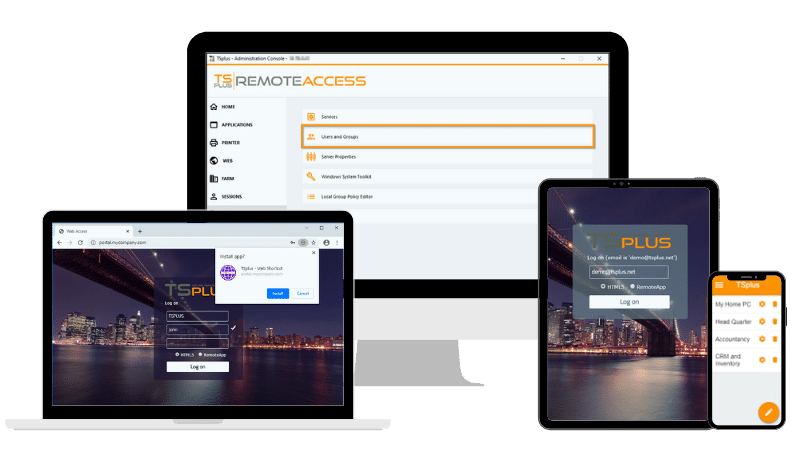
TSplus Remote Access is not just another local RDP client. It is a secure remote access and application publishing platform which enables users to access Windows desktops and applications through an HTML5 browser or configured client access.
This makes TSplus Remote Access especially relevant for systems administrators in any context, from SMBs, ISVs, software vendors, MSPs and enterprise. Instead of asking every user to install and maintain a local RDP client, IT can publish Windows applications through a browser-based portal and centralize access management.
Pros
- Browser-based HTML5 access
- Windows application and desktop publishing
- Good fit for SMB and ISV scenarios
- Simplifies user access compared with local client rollout
- Works well with TSplus security, monitoring and support tools
Cons
- Not positioned as a basic free RDP client
- Requires server-side deployment
- Best suited to business access use cases
- Needs correct sizing for multi-user environments
Takeaway
Choose TSplus Remote Access when users need simple, secure access to Windows applications or desktops without relying only on local RDP client installation.
In our dedicated guide comparing HTML5 and native RDP clients, you can read up on how both approaches can rely on RDP, but differ in deployment effort, compatibility, performance and workload fit.
Need secure, affordable app publishing without the Citrix complexity ?
How Might You Choose The Best RDP Client?
The best RDP client depends on its purpose. For one administrator connecting to one Windows server, Microsoft Remote Desktop Connection is usually enough. For Linux users, Remmina is often the better fit. For MSPs , a connection manager such as Devolutions Remote Desktop Manager may be more appropriate.
For end-user access, the decision changes. A business that needs to publish accounting software, ERP clients, legacy Windows applications or full desktops should evaluate the access architecture, not only the client. In that scenario, browser-based access through TSplus Remote Access can reduce endpoint friction as well as simplify support.
A practical selection process should start with five questions:
- Who needs access: admins, employees, customers or contractors?
- What is being accessed: full desktops, servers or individual applications?
- Which devices are used: Windows, Mac, Linux, tablets or unmanaged devices?
- How is access secured: VPN, RD Gateway, MFA, IP filtering or browser portal?
- Who will manage the environment: internal IT, MSP or software vendor?
These questions prevent a common mistake: choosing a convenient RDP client while ignoring security, user experience and administration.
Security checklist for RDP access
RDP should not be exposed casually to the public internet. Microsoft Remote Desktop Services are designed to deliver virtualized applications and secure remote desktop sessions, but the architecture must be configured correctly.
For production environments, IT teams should apply the following baseline:
- Use Network Level Authentication where supported.
- Avoid direct exposure of TCP 3389 to the internet.
- Place external access behind a gateway, VPN or secure portal.
- Enforce multi-factor authentication for remote users.
- Restrict access by user, group, device and IP address where possible.
- Monitor failed logons, session activity and unusual behaviour.
- Keep Windows Server, RDS components and clients updated.
This is where the TSplus suite strengthens many setups. TSplus Remote Access handles remote access and application publishing and integrates MFA of your choice. TSplus Advanced Security adds protective controls, while Server Monitoring helps IT teams track performance and server health. Finally, TSplus Remote Support covers attended support sessions, for example when helpdesk teams need to assist users directly.
Final recommendation
How about testing some of our pick of best RDP clients alongside TSplus Remote Access and comparing them for yourself? Try the fit for anything from basic Windows administration, Linux workstations, admin sessions or browser access to applications. TSplus software, whether Remote Access or the other products in our suite, is developed to be simple to handle yet provide granular control and tight security. Change your question from “Which RDP client should I install?” to “How can IT deliver remote access simply, securely and centrally?”.
TSplus simplifies remote access and app delivery for systems administrators everywhere.
TSplus Remote Access Free Trial
Ultimate Citrix/RDS alternative for desktop/app access. Secure, cost-effective, on-premises/cloud
)
)
)
