








)
)
Agentless remote access can reduce endpoint friction, especially when users connect from unmanaged laptops, tablets, contractor devices or locked-down workstations. However, IT teams still need to understand where the gateway runs, what browser-based access can and cannot do, and when VPN, RD Gateway, ZTNA or VDI fit better.
For SMB IT admins, MSPs and sysadmins, the aim is not simply to avoid installations. The goal is to deliver secure, manageable and cost-effective remote access without creating hidden operational risk.
What Is Agentless Remote Access?
Definition:
Agentless remote access is a remote connectivity model where the user or managed endpoint does not require adding a persistent software agent for every access session. In practice, the term is used in different ways by vendors, so IT teams should clarify to what agentless actually refers before choosing a platform.
Agentless:
- Some products use “agentless” to mean that the end-user device only needs a browser.
- Others use it to mean that the target server or workstation does not need a locally installed agent.
- A third category refers to monitoring or discovery tools which query systems through standard protocols rather than installed collectors.
Remote access to desktops and applications:
For remote desktop and application delivery, the most useful definition is practical:
agentless remote software reduces or removes client-side installation while centralizing the access stack on a gateway, portal or server.
Agentless, Clientless, Browser-Based: Key Differences
These are related yet not identical.
Agentless remote access:
Agentless remote access usually means no persistent agent is required on one side of the connection.
Clientless remote access:
Clientless remote access means the user does not need a native client, plug-in or extension.
Browser-based remote access:
Browser-based remote access means the session is delivered through a web browser, often using HTML5.
Example:
A browser-based remote desktop gateway is a common example. The user opens a secure URL, authenticates, selects an application or desktop and starts a session inside the browser. The gateway handles protocol translation, authentication flow and session routing behind the scenes.
Why Does the Term Matter for IT Decision-Makers?
The terminology matters because “no install” does not mean “no infrastructure.” A browser-based remote access service still needs authentication, encryption, identity mapping, session brokering, access policies, logging and server-side maintenance.
This distinction is especially important for systems administration or to SMBs and MSPs. A tool which looks simple for one user can become difficult to secure at scale if it lacks group-based access, session configuration, multi-factor authentication, IP restrictions, audit logs, server monitoring...
The best question is therefore not “Is this agentless?”. Rather ask: “Where does the access control live, and how will IT secure, monitor and support it?”
How Does Agentless Remote Access Work?
Agentless remote access normally relies on a central access point between the user and the internal resource. This access point may be a web portal, HTML5 remote desktop gateway, RD Gateway, ZTNA broker, VPN concentrator or remote support relay.
- The user authenticates to the access layer.
- The access layer checks identity, policy and resource permissions.
- Then it connects the user to a remote application, full desktop, server console or support session.
This design reduces the dependency on user-device configuration, but it increases the importance of gateway hardening and server security. If the gateway is exposed to the Internet, it must be treated as a critical production component.
Browser-Based Remote Access
Browser-based remote access is one of the most common forms of agentless access for end users. The browser becomes the user interface, while the gateway communicates with remote hosts using protocols such as Remote Desktop Protocol (RDP), Virtual Network Computing (VNC) or Secure Shell (SSH).
Microsoft Remote Desktop web client allows users to access admin-published remote apps and desktops from a compatible browser. Microsoft also notes that users need a supported browser and the URL provided by the administrator.
Another example is how Apache Guacamole describes itself as a clientless remote desktop gateway which supports standard protocols such as RDP, VNC and SSH, with no plug-ins or client software required once the gateway is installed.
For IT teams, the architectural pattern is clear: the browser is only the front end. The remote access stack still runs on servers, gateways and identity systems.
RDP, RD Gateway and VPN in context
RDP
Remote Desktop Protocol is commonly used to deliver Windows desktops and applications. In a secure architecture, RDP should not be exposed directly to the Internet. Instead, IT teams should place a controlled access layer in front of internal resources.
RD Gateway
RD Gateway is Microsoft’s gateway role for routing RDP traffic from external users to internal Windows resources. It allows remote users to connect through HTTPS rather than opening direct RDP access to each host.
VPN
A virtual private network, or VPN, uses tunneling and encryption to extend private network access across a public network. VPNs remain useful for network-level access, but they often grant broader connectivity than a user needs for a single application or desktop.
Tools for a purpose
Agentless access and VPN access therefore solve different problems: publishing specific resources vs extending network reach. RD Gateway brokers RDP securely. ZTNA tools enforce application-level access based on identity and context.
Where the Gateway Sits
In a browser-based model, the gateway should sit between external users and internal session hosts. External users connect to the gateway over HTTPS. The gateway then connects to internal desktops, applications or servers through approved internal protocols.
This placement helps reduce direct exposure of remote hosts. It also gives IT one place to enforce authentication, certificate policy, access rules and logging.
However, the gateway becomes a high-value target. IT teams should protect it with strong authentication, TLS certificates, patch management, restricted administrative access, geo-blocking where appropriate and monitoring.
What Are the Main Benefits of Agentless Remote Access?
Agentless remote access is attractive because it reduces friction for users and IT administrators. The benefits are strongest when the access scenario is well-defined, such as published business applications, contractor access, occasional remote work or support workflows.
Less Endpoint Friction
The most visible benefit is simpler onboarding. Users need not install a full remote desktop client, VPN client or custom launcher before connecting. This is useful for contractors, external accountants, temporary staff, students, field workers and BYOD users.
For IT teams, fewer endpoint dependencies should mean fewer support tickets. Browser-based access also helps when users work from devices where they cannot install software, such as locked-down corporate laptops or shared workstations.
This does not remove all endpoint risk. The browser, device health and user identity still matter. However, it can reduce the operational burden of maintaining many client configurations.
Faster Access for Contractors and BYOD Users
Agentless remote access is particularly useful for third-party access.
Access based on need and usage
External users often need limited access to a specific application, server or support session. They should not receive broad network access by default. For hybrid-work managers, the same logic applies to employees who need occasional access to centralized Windows applications.
Welcome adaptability
A browser portal can publish only the resources required for the user’s role.
Access can be revoked centrally when the contract ends or the support case closes.
Finally, a browser-based experience can be easier to support than a full VPN and desktop client deployment.
Centralized Access Control
Agentless remote software can simplify access control when it is designed around a central portal. IT teams can assign applications, desktops and permissions by user or group. They can also apply policies for authentication, working hours, IP addresses or countries.
Centralization is valuable for MSPs managing several customer environments. A consistent access pattern reduces variation and makes documentation easier.
It also supports better security reviews. Instead of auditing many endpoint clients, IT can focus on gateway configuration, published resources, account permissions and session logs.
Which Limitations Should IT Teams Understand?
Agentless remote access is useful, but, as with anything, it is not always the ideal model. Decision-makers should understand its limitations before replacing VPNs, native RDP clients, remote support agents or VDI platforms.
Browser Constraints
Comprehensive access and manoeuverability
A browser session may not match the full experience of a native client. Multi-monitor support, advanced printing, USB redirection, file transfer, clipboard behaviour, audio quality and keyboard shortcuts can vary by product and browser.
Powerful software or media needs and the like
Some users need high-performance graphics, CAD tools, media workflows or low-latency input. These users may be better served by a native remote desktop client, specialized streaming protocol or full VDI platform.
Handheld devices such as smartphone and tablets
Mobile access also needs attention. A solution may work in a mobile browser, but that does not mean the user experience is suitable for daily work. Small screens, touch input and external keyboard behaviour can affect productivity.
Security Misconceptions
Agentless does not automatically mean secure. A poorly configured web portal risks exposing authentication pages, session brokers or internal applications to attack.
All components of telework, remote access and BYOD technologies should be secured against expected threats. This includes client devices, gateways, internal hosts and policy controls.
For remote access, security should include multi-factor authentication, TLS, least privilege, account lockout, IP filtering, brute-force protection, logging and patching. IT teams should also avoid exposing port 3389 directly to the Internet.
Performance and User Experience Trade-Offs
Browser-based remote access depends on the browser, gateway, network path, session host and application workload. A slow session can come from any of these layers.
Performance issues often appear as display lag, slow printing, delayed file operations or audio problems. These issues are not always caused by the remote access product itself. They may reflect server capacity, bandwidth, latency, DNS, certificate checks or overloaded session hosts.
This is why monitoring matters. If IT teams cannot see CPU, memory, disk, session count and user activity, troubleshooting becomes guesswork.
Agentless Remote Access Decision Checklist
Before choosing an agentless remote access architecture, IT teams should map the use case, risk level and required user experience.
| Question | Choose agentless or browser-based access when | Consider another model when |
|---|---|---|
| Who is connecting? | Contractors, BYOD users, occasional users or external partners | Power users need full workstation integration |
| What do they need? | One app, one desktop or a limited resource set | Broad network access is required |
| What endpoint control exists? | Devices are unmanaged or locked down | Corporate-managed devices can run native clients |
| What security is required? | MFA, HTTPS, group-based access and logging are enough | Device posture, advanced conditional access or full isolation is required |
| What performance is needed? | Office apps, ERP, CRM or legacy Windows apps | CAD, video, graphics or very low-latency workflows |
| How will IT support it? | Central portal and monitoring are available | IT needs persistent unattended endpoint control |
This checklist helps separate convenience from architecture. Agentless access is strongest when IT wants to publish controlled resources to users without broad network exposure.
How About Browser-Based Alternatives to Agentless Remote Software?
Agentless remote access is not a single product category. It overlaps with several technologies, each with different strengths.
HTML5 RDP Gateways
HTML5 RDP gateways deliver Windows desktops or applications through a browser. They are useful for centralized Windows application delivery, legacy app publishing and contractor access.
The main advantage is simplicity for the user, while the main challenge is ensuring the gateway is secure, monitored and capable of supporting expected workloads.
This model is often a strong fit for SMBs needing application publishing without Citrix-level complexity.
VPN, ZTNA and VDI
VPNs extend network access. They remain useful for administrators, site-to-site connectivity and cases where users need several internal services. However, VPNs can provide more access than necessary if policies are not tightly scoped.
Zero Trust Network Access, or ZTNA, focuses on identity-based access to specific applications rather than network segments. ZTNA can be effective for third-party access and private web apps, but it may not replace full remote desktop or Windows application delivery.
Virtual Desktop Infrastructure, or VDI, centralizes full desktop environments. VDI is powerful for standardized enterprise desktops, but it can be expensive and complex for SMBs only needing to publish a few Windows applications.
Remote support tools
Remote support and technical assistance tools solve a different problem. They allow support agents to view or control an end-user device for troubleshooting, training or maintenance.
Some remote support workflows are browser-initiated, but unattended maintenance may still require an installed component or persistent configuration. Rather than a weakness, this simply reflects a different use case.
IT teams should separate application access from support access. Employees need controlled access to business apps. Support agents need secure tools to assist users and maintain devices.
How TSplus Meets Agentless Remote Access Needs
TSplus addresses the practical middle ground for SMBs and MSPs: secure remote access and application delivery without the cost and complexity of large VDI platforms.
TSplus Remote Access: for Application and Desktop Publishing
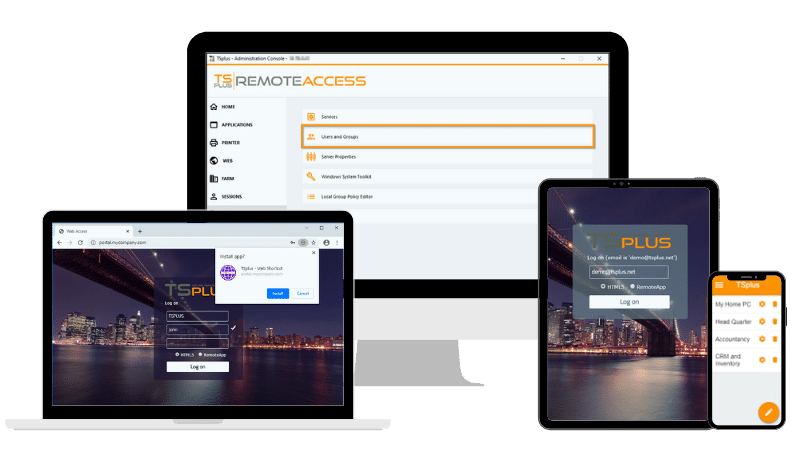
TSplus Remote Access enables IT teams to publish full remote desktops or individual Windows applications through a secure web portal. Users can either access centralized tools from a browser through the HTML5 client or use alternative connection modes where a native-like experience is more appropriate.
This flexibility matters because not every user needs the same access method. Contractors may only need browser-based access to one application. Internal staff may prefer a RemoteApp-style experience. Power users may need a full desktop.
TSplus Remote Access helps IT teams web-enable legacy Windows applications without rewriting them. For SMBs, that is often the most direct path to modern remote access: centralize the application, publish it securely and control who can connect.
Troubleshooting RDP or publishing apps for remote users? Get a guided demo of TSplus Remote Access.
TSplus Advanced Security and MFA: for Secure Application Servers and Access
Agentless remote access should always be paired with strong security controls.
360° Security made simple
TSplus Advanced Security helps protect public-facing remote access environments with features such as brute-force protection, IP filtering and endpoint protection policies.
MFA add-on for extra login safety
The TSplus MFA add-on strengthens identity security by requiring an additional authentication factor. This is especially important when users connect from unmanaged devices or external networks.
Together, these controls help reduce common remote access risks: credential attacks, unauthorized geographies, repeated failed logins and overexposed entry points.
TSplus Server Monitoring and Remote Support
Simple real time server and network monitoring
TSplus Server Monitoring gives IT teams visibility into server health, websites, applications and user activity. This helps administrators detect overloaded session hosts, performance degradation and abnormal remote access usage before users report widespread issues.
Remote support in all simplicity
TSplus Remote Support complements remote access with attended and unattended assistance. Support teams can troubleshoot user devices, assist remote employees and maintain endpoints without mixing support workflows with application publishing.
A simpler architecture and fluidity in management
For MSPs, systems administrators and SaaS or DaaS providers, these products combine to make a software suite minus the grind and friction. Publish business applications to the Web, protect the servers and the access layer, track infrastructure health and enable agents to resolve user issues quickly from anywhere.
Conclusion
Agentless remote access can simplify remote work, contractor access and application delivery, but it should not be evaluated only as a “no install” feature. IT teams need to understand the full architecture: browser, gateway, identity, session host, security controls and monitoring.
For many teams, the best approach is not a heavy VDI platform or a broad VPN. A browser-based remote access portal, protected by strong authentication and monitored centrally, can provide the right balance of usability, security and cost control.
Help your IT reach that balance with TSplus and scale remote access with better ROI. Talk to a TSplus specialist.
TSplus Remote Access Free Trial
Ultimate Citrix/RDS alternative for desktop/app access. Secure, cost-effective, on-premises/cloud
)
)
)
