








)
)
Introduction
VPN and Remote Desktop Protocol remain core technologies for enabling secure remote access across enterprise and SMB environments. While both are widely used, they rely on different access models that directly affect security boundaries, infrastructure complexity, and user experience. As remote work and distributed IT operations become standard, choosing between VPN and RDP is an architectural decision rather than a simple technical preference.
TSplus Remote Access Free Trial
Ultimate Citrix/RDS alternative for desktop/app access. Secure, cost-effective, on-premises/cloud
How Does VPN vs RDP Remains a Critical IT Decision?
Remote Access as a Security Boundary
Remote access directly defines how much of the internal environment becomes reachable from outside the network. Each connection extends trust beyond the corporate perimeter, affecting security exposure and operational continuity.
Network-level access tends to widen the impact of credential compromise, while session-based access naturally limits lateral movement. This distinction influences:
- Incident response effort
- Audit scope
- Practical enforcement of least-privilege access
Different Access Models, Different Risks
VPN and RDP serve different access models with distinct risk profiles. VPNs provide broad network connectivity, while RDP delivers controlled, session-based access. When misconfigured, VPNs increase lateral movement, and exposed RDP services remain common attack targets.
Security incidents show that excessive access scope accelerates ransomware spread and data exfiltration. VPN-related issues often stem from overly permissive setups, while RDP incidents typically result from exposed services or weak authentication controls.
The Architectural Decision Behind Remote Access
The challenge for IT teams is not choosing a “better” technology, but aligning the access model with the workload. Matching access scope, user context, and security controls helps reduce attack surface while maintaining operational clarity.
This architectural choice also affects scalability and long-term efficiency. Access models aligned with workload boundaries are easier to manage and adapt as environments evolve, supporting regulatory changes, cloud transitions, and Zero Trust adoption.
What Is a VPN and What Is RDP?
Defining a VPN (Virtual Private Network)
A VPN establishes an encrypted tunnel between a remote endpoint and an internal network. Once authenticated, the remote device gains network-level access similar to being physically connected on-site.
This model is effective for accessing multiple internal services but expands the trust boundary to the entire endpoint. From a security standpoint, the VPN does not limit what the user can reach, only who is allowed in.
Defining RDP (Remote Desktop Protocol)
Remote Desktop Protocol enables interactive control of a remote Windows system by transmitting screen updates and receiving keyboard and mouse input. Applications and data remain on the host system rather than the client device.
RDP provides session-level access instead of network-level access. The user interacts with a controlled environment, which inherently limits data exposure and lateral movement when properly configured.
How Does VPN and RDP Differ Architecturally?
Network-Level Access with VPN
A VPN extends the internal network to the remote device by creating an encrypted tunnel. Once connected, the endpoint can communicate with multiple internal systems using standard network protocols. From an architectural perspective, this effectively moves the network perimeter to the user’s device, increasing reliance on endpoint security and segmentation controls.
Session-Based Access with RDP
RDP operates at the session level rather than the network level. Users connect to a specific desktop or server, and only screen updates, keyboard input, and mouse events traverse the connection. Applications and data remain on the host system, keeping internal networks isolated from remote endpoints.
Impact on Security and Scalability
These architectural differences shape both security posture and scalability. VPNs must handle all traffic generated by remote users, increasing bandwidth and infrastructure demands. RDP centralizes workloads and limits exposure, making it easier to control access, monitor sessions, and scale remote access without expanding the network perimeter.
How Does VPN and RDP Differ In Security Implications?
VPN Security Model and Its Limitations
VPNs rely on strong encryption and authentication, but their main weakness lies in overexposure. Once connected, a compromised endpoint can access far more resources than necessary.
Common risks include:
- Lateral movement inside flat networks
- Credential reuse and token theft
- Limited visibility into application-level behaviour
Security frameworks increasingly view VPNs as high-risk unless paired with segmentation, endpoint compliance checks, and continuous monitoring.
RDP Security Model and Exposure Risks
RDP has a long history of abuse when exposed directly to the internet. Open RDP ports remain a frequent entry point for brute-force attacks and ransomware.
However, RDP itself is not inherently insecure. RDP significantly reduces attack surface compared to network-level access models when it is protected by:
- TLS encryption
- Network Level Authentication (NLA)
- Access gateways
According to NIST guidance on remote access security, limiting network exposure and isolating sessions is a core defensive principle.
Zero Trust and the Shift Toward Session-Based Access
Zero Trust security models favor identity- and session-based access over network-level trust. This shift aligns naturally with RDP-style access, where users connect only to specific desktops or applications.
VPNs can be adapted to Zero Trust principles, but doing so often requires additional infrastructure. RDP gateways and brokers achieve similar outcomes with fewer moving parts.
How Does VPN and RDP Differ in Cost and Operational Overhead?
VPN Cost Structure
VPN deployments typically incur costs across several layers:
- Per-user or per-device licensing
- Gateway infrastructure and bandwidth scaling
- Ongoing security maintenance and monitoring
As remote usage grows, VPN traffic concentration often leads to performance bottlenecks and additional infrastructure spend.
RDP Cost Structure
RDP is built into Windows environments, making baseline access cost-effective. Infrastructure is centralized, bandwidth usage is low, and scaling additional users is often simpler.
RDP adds strong security controls without introducing full network tunnelling costs when it is secured with:
- Gateways
- Platforms like TSplus
This results in lower total cost of ownership for many organizations.
What Are the User Experience and Performance Characteristics of VPN and RDP?
VPN User Experience Considerations
VPNs aim to be transparent to end users by providing direct access to internal applications and services. Once connected, users interact with systems as if they were on the local network. However, performance is highly dependent on:
- Routing efficiency
- Tunnel overhead
- Traffic inspection
Latency-sensitive workloads such as voice, video, and graphics-heavy applications can degrade noticeably when all traffic is forced through centralized VPN gateways.
RDP User Experience Considerations
RDP delivers a consistent desktop or application experience regardless of the user’s device. Because processing occurs on the remote host, performance depends primarily on latency and session optimization rather than raw bandwidth.
Modern RDP implementations use adaptive compression and graphics acceleration to maintain responsiveness, but high latency can still introduce input lag if sessions are not properly tuned.
How Should You Choose Between VPN and RDP Based on Use Case?
When VPN Is the Better Fit
VPN is best suited for scenarios that require broad access to multiple internal services. Users who need to interact with file shares, internal web applications, databases, or legacy systems often benefit from network-level connectivity. In these cases, VPN provides flexibility, but it also requires strong endpoint security and careful segmentation to limit exposure.
When RDP Is the Better Fit
RDP is more appropriate for workloads that benefit from controlled, centralized access. Remote desktops, published applications, administrative access, and IT support sessions align well with session-based delivery. By keeping applications and data within the host environment, RDP reduces attack surface and simplifies access control.
Aligning Access Model with Risk and Operations
Selecting between VPN and RDP should be driven by access scope, risk tolerance, and operational requirements. Network-level access maximizes flexibility but increases exposure, while session-based access prioritizes containment and control. Aligning the access model with the specific workload helps balance security, performance, and manageability.
Optimizing Secure Remote Access with TSplus
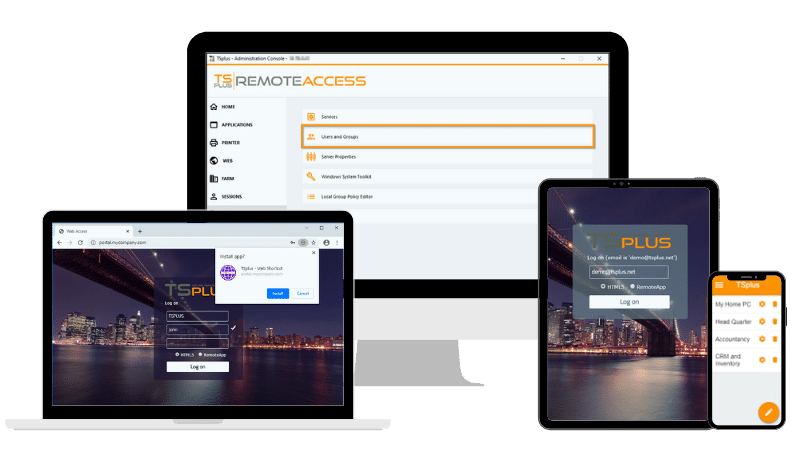
TSplus Remote Access builds on RDP by adding a secure access layer designed for controlled, session-based delivery. It provides HTML5 browser access, native clients, encryption, multi-factor authentication, and IP filtering without extending the network perimeter.
For organizations seeking to reduce VPN dependency while maintaining secure remote productivity, TSplus offers a practical and scalable alternative.
Conclusion
VPN and RDP are fundamentally different remote access models with distinct security, cost, and user experience implications. VPNs extend trust to remote devices, while RDP confines access to isolated sessions.
For many IT environments, especially those adopting Zero Trust principles, session-based remote access delivers stronger containment, lower overhead, and simpler long-term management.
TSplus Remote Access Free Trial
Ultimate Citrix/RDS alternative for desktop/app access. Secure, cost-effective, on-premises/cloud
)
)
)
