





)
)
Introduction
Remote access technology has become essential to modern IT environments shaped by hybrid work, distributed infrastructure, and centralized application delivery. It supports everything from employee access to internal resources to remote administration and technical support. Yet not all remote access solutions work the same way. To design secure and efficient environments, IT teams need to understand how these technologies function, where they differ, and which security controls matter most.
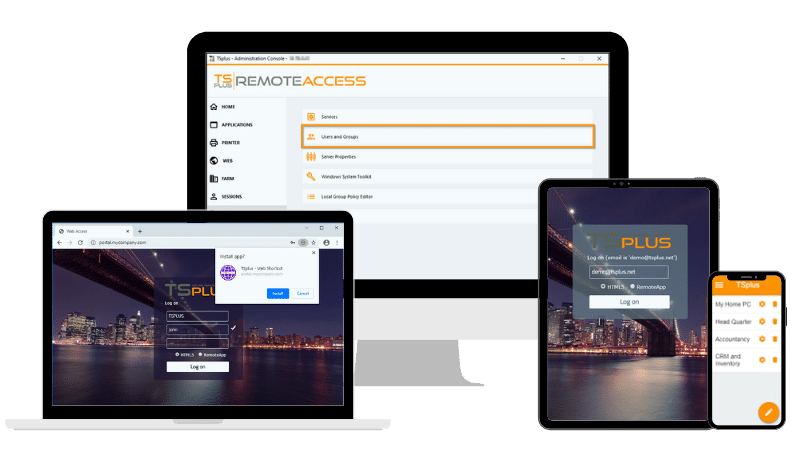
TSplus Remote Access Free Trial
Ultimate Citrix/RDS alternative for desktop/app access. Secure, cost-effective, on-premises/cloud
What Is Remote Access Technology?
Remote access technology refers to the tools, protocols, and infrastructure that allow authorized users to connect to computers, applications, or internal resources from a different location. Depending on the setup, the connection may provide access to:
- a full desktop
- a single application
- a support session
- part of a private network
In practice, remote access supports a wide range of business needs. Common examples include:
- employees opening internal applications from home or while traveling
- administrators managing servers and infrastructure remotely
- helpdesk teams troubleshooting user devices without being physically present
Although these scenarios are related, they rely on different technical models and security requirements. That distinction matters. Granting network-level access through a VPN is not the same as publishing a single Windows application through a browser. Likewise, remote support software is not designed for the same purpose as a remote desktop or application delivery platform.
How Remote Access Technology Works?
Most remote access models follow the same general process. A user initiates a connection, the platform verifies identity, the session is protected, and the requested resource is delivered.
Connection initiation
A remote session usually begins from one of the following entry points:
- a client application
- a web browser
- a thin client
Depending on the platform, the user connects either directly to a remote endpoint or through a gateway, broker, or access portal.
In modern environments, the gateway layer is often critical. Instead of exposing remote systems directly to the internet, many organizations route access through a controlled entry point that applies authentication, policy, and logging.
Identity and access verification
Before a session begins, the platform must confirm the user’s identity and determine what they are allowed to access. This often includes:
- usernames and passwords
- multi-factor authentication
- device checks
- certificates
- conditional access policies
Identity verification is one of the most important parts of remote access design. A connection is only as secure as the process used to validate the user and enforce the correct level of access.
Secure session establishment
Once access is approved, the session must be protected with encryption. The exact method depends on the technology used:
- VPN platforms create an encrypted tunnel
- remote desktop platforms protect the session itself
- browser-based access generally relies on encrypted web communication
Secure transport is essential, but it is only one layer. A strong remote access environment also depends on access control, monitoring, and limited exposure.
Resource delivery
After authentication and protection are in place, the platform delivers the required resource. That may include:
- a full desktop
- a single published application
- a support interface
- a path into the internal network
This is where remote access technologies differ most. Some provide broad connectivity, while others deliver only the specific application or interface the user needs. In many cases, narrower access is easier to secure and manage.
What Are the Main Types of Remote Access Technology?
Remote access is not a single architecture. IT teams usually choose among several delivery models, and many environments combine more than one depending on user needs, security requirements, and infrastructure design.
VPN remote access
A VPN creates an encrypted tunnel between the remote device and the corporate network. From the user perspective, the device behaves almost as if it were physically connected to the office network.
VPN access remains common because it is flexible and familiar. It is especially useful when users need access to several internal resources, such as:
- file shares
- internal web applications
- legacy client-server software
- multiple systems across the private network
At the same time, VPN can increase risk because it extends network connectivity rather than limiting access to one specific resource. For that reason, VPN is usually best suited to cases where users genuinely need network-level access.
Remote desktop access
Remote desktop technology allows a user to view and control a remote computer session. It is widely used for:
- server administration
- remote workstation access
- centralized desktop environments
- Windows-based application environments
Remote desktop access can be delivered in several ways. Some organizations use it for administrative access to individual systems, while others rely on broader platforms that provide full desktop or session-based delivery to multiple users.
This model is powerful, but it must be deployed carefully. Remote desktop can provide strong usability and centralization, yet it also requires strong authentication, good session control, and careful management of internet exposure.
Remote application delivery
Remote application delivery publishes individual applications instead of an entire desktop. The application runs on a centralized server, while the user interacts with it remotely from their own device.
This model is often a strong fit for organizations that want to provide access to specific Windows applications while keeping infrastructure centralized. Its main advantages often include:
- reduced bandwidth use
- simpler application updates
- centralized administration
- less software to manage on endpoints
Remote application delivery is especially useful when legacy or specialized applications must remain available to distributed users without being installed on every device.
Browser-based remote access
Browser-based remote access uses web technologies to deliver desktops or applications through a browser without requiring a heavy client installation. This makes access easier to deploy and often easier to scale across mixed environments.
It is particularly useful for scenarios such as:
- contractor access
- temporary staff onboarding
- mixed-device environments
- reducing endpoint setup requirements
Browser-based access can improve flexibility and convenience, but it still requires the same discipline as any other remote access method. Ease of use should not come at the cost of weaker authentication, broader permissions, or reduced control.
What are The Common Use Cases for Remote Access Technology?
Remote access technology supports a wide range of operational needs across modern organizations. Although the core objective is always to connect users or IT teams to distant systems, the business purpose, access scope, and security requirements can vary greatly from one use case to another.
Remote and Hybrid Work
Remote and hybrid work remains one of the main reasons organizations deploy remote access solutions. Employees often need reliable access to resources such as:
- internal applications
- shared files
- business systems
- full corporate desktops
Remote access helps maintain productivity when staff are working from home, traveling, or moving between office locations. In this context, the best solutions combine strong security with consistent performance and simple access for end users.
IT Administration
IT administration is another major use case for remote access technology. System administrators, network engineers, and infrastructure teams often need to connect remotely in order to:
- manage servers
- access administrative consoles
- review configurations
- perform updates and maintenance
- troubleshoot technical issues
Remote administrative access reduces the need for physical intervention and allows faster response to operational problems. Because these sessions often involve elevated privileges, they usually require tighter access controls, stronger authentication, and closer monitoring than standard user access.
Security Risks in Remote Access Environments
Remote access technology improves flexibility and continuity, but it also creates more paths into business systems. For that reason, remote access should be treated as part of the overall security architecture, not just as a convenience feature. The main risks usually involve identity, exposure, session control, and monitoring.
Identity and Authentication Risks
One of the most common remote access risks is unauthorized access through weak or stolen credentials. If passwords are reused, poorly managed, or not protected by multi-factor authentication, attackers may gain access without needing to exploit the technology itself.
This risk becomes more serious when privileged accounts are involved. Administrative remote access should be protected with:
- stronger authentication
- tighter account controls
- clear separation between standard and high-privilege access
Exposure and Access Path Risks
Remote access services that are directly exposed to the public internet are easier to discover, probe, and target. Poorly configured endpoints, open ports, and overly broad access paths can all increase the attack surface.
To reduce this risk, organizations should limit unnecessary exposure through measures such as:
- controlled gateways
- limited access scope
- carefully defined entry points
- reduced direct connectivity to internal systems
Session, Device, and Monitoring Risks
Even after a user is authenticated, the session itself can create security concerns. Remote access may involve:
- unmanaged devices
- file transfers
- clipboard sharing
- unusual access locations
Without proper control, these factors can increase risk. Monitoring is therefore essential, as logging connection attempts, session activity, unusual patterns, and privilege use helps IT and security teams detect suspicious behaviour earlier.
Why Risk Reduction Matters
Remote access does not have to create unacceptable risk, but it does require deliberate control. When organizations combine strong authentication, limited exposure, clear access policies, and active monitoring, remote connectivity becomes much easier to manage securely.
The goal is not simply to let users connect from anywhere. The goal is to keep remote access aligned with business needs while reducing unnecessary opportunities for misuse, compromise, or data loss.
What to Look for in a Modern Remote Access Solution?
A modern remote access solution should do more than connect a user to a distant system. It should help IT teams secure access, control who can reach which resources, and simplify administration across users, devices, and locations. The best solutions combine security, usability, and operational efficiency without adding unnecessary complexity.
Strong Security Controls
Security should be one of the first criteria in any remote access evaluation. A modern solution should support:
- strong authentication
- controlled access policies
- encrypted sessions
- reduced direct exposure of internal systems
This matters because remote access often connects users to sensitive business applications, administrative tools, or internal resources. A platform that strengthens identity verification and limits unnecessary access will usually provide a stronger foundation than one focused mainly on convenience.
Flexible Access Delivery
Different users do not always need the same type of access. Depending on the use case, they may require:
- a full remote desktop
- a single published application
- browser-based access without local client installation
A good remote access solution should support multiple delivery methods without forcing the organization into one rigid model. This flexibility helps IT teams match access to the real requirement rather than giving every user broader access than necessary.
Centralized Management and Visibility
Modern remote access should be manageable at scale. IT teams need centralized administration to:
- configure access
- apply policies
- monitor usage
- maintain consistency across users and systems
Visibility is just as important. A platform that makes it easier to review sessions, manage permissions, and monitor activity can reduce administrative burden while improving security oversight.
Performance and Infrastructure Fit
Remote access must perform well in everyday conditions. Users expect stable sessions, responsive applications, and reliable access whether they are working from home, traveling, or connecting from branch locations.
The solution should also fit the existing environment rather than force unnecessary infrastructure changes. Important factors include:
- compatibility with current systems
- reasonable deployment requirements
- predictable scaling
- practical long-term maintenance
Balancing Simplicity and Capability
The most effective remote access solution is not always the one with the longest feature list. In many cases, the better choice is the platform that delivers the required security, control, and usability while remaining simple enough to deploy, manage, and support efficiently.
When organizations evaluate remote access in that way, they are more likely to choose a solution that fits real business needs. This usually leads to better adoption, easier administration, and a stronger balance between user access and operational control.
Where TSplus Remote Access Fits
TSplus Remote Access fits organizations that need to publish Windows applications or desktops without the cost and complexity of heavier platforms. It helps IT teams centralize application delivery, simplify deployment, and provide browser-based or remote desktop access through a controlled environment. This makes it a practical option for SMBs and businesses modernizing access to Windows resources.
Conclusion
Remote access technology is now a strategic part of IT design rather than a simple convenience feature. Different models, including VPNs, remote desktops, support tools, browser-based access, and application publishing, serve different operational needs and risk profiles. When organizations match the right technology to the right use case, they can improve user access, strengthen security, reduce administrative burden, and support long-term flexibility across changing work environments.
TSplus Remote Access Free Trial
Ultimate Citrix/RDS alternative for desktop/app access. Secure, cost-effective, on-premises/cloud
)
)
)
