








)
)
Introduction
The “on-premises vs cloud” debate often gets reduced to cost or control. In reality, infrastructure strategy is about aligning hosting models with workload behaviour, compliance obligations, team capacity, and risk tolerance. A strong IT strategy also avoids lock-in thinking: many organizations run a hybrid environment by design, not by accident, because different workloads have different requirements. This article helps IT teams make that choice consistently and defend it with clear criteria.
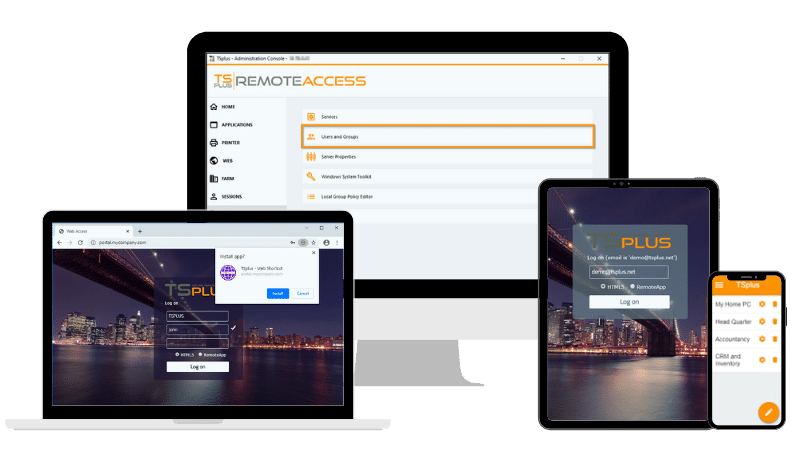
TSplus Remote Access Free Trial
Ultimate Citrix/RDS alternative for desktop/app access. Secure, cost-effective, on-premises/cloud
What Is On-Premises Infrastructure in 2026?
On-premises infrastructure refers to compute, storage, and networking hosted in facilities your organization controls, such as a server room, private datacentre, or colocation footprint. This is often where TSplus Remote Access is deployed to publish Windows apps and desktops securely. The IT team owns the lifecycle end to end: procurement, patching, monitoring, backup strategy, and hardware refresh.
What are the strengths of on-premises infrastructure?
On-premises infrastructure is often the best option when predictable performance, data locality, and deep configuration control are non-negotiable. Many legacy and line-of-business systems also run most reliably in stable on-prem environments where dependencies are well understood. For security teams, on-prem can simplify certain governance decisions because network boundaries and physical custody are explicit.
Common advantages include:
- Consistent LAN latency for tightly coupled apps and peripherals
- Clear data residency and locality controls for regulated workloads
- Full stack customization for segmentation, hybrid identity, and legacy dependencies
What are the common limits of on-premises infrastructure?
On-premises infrastructure scales in steps, not instantly. Hardware lead times, maintenance windows, and refresh cycles can slow delivery, while long-lived environments can accumulate technical debt if upgrades are delayed. Operationally, on-prem requires continuous staffing for patching, incident response, physical security, and capacity planning, which can be challenging for lean IT teams.
Typical constraints include:
- Capacity planning and procurement delays when new resources are needed fast
- Higher operational load for patching, monitoring, backups, and physical security
- Refresh-cycle risk when hardware upgrades are postponed
What Is Cloud Infrastructure and What Are the Main Models?
Cloud infrastructure delivers compute, storage, and platform services over the internet, typically via providers such as Microsoft Azure, AWS, or Google Cloud. Instead of purchasing hardware, organizations provision services on demand and pay via usage-based billing, subscriptions, or reserved capacity.
How do IaaS, PaaS, and SaaS change operational responsibility?
Cloud models shift responsibility depending on the level of abstraction. IaaS provides virtual machines and networks, leaving the customer responsible for operating systems, identity, and application security. PaaS reduces operational effort by managing runtimes and patching at the platform level. SaaS goes further by delivering complete applications where the customer focuses mainly on configuration, user access, and data governance.
A simple way to frame the shift:
- IaaS: fastest lift-and-shift path, but you still own OS hardening and patching
- PaaS: fewer moving parts to operate, but platform constraints increase
- SaaS: minimal ops overhead, but customization and portability are reduced
Why does the shared responsibility model matter for security?
Cloud security depends on correct ownership boundaries. Providers protect the underlying infrastructure, but customers remain responsible for identity, permissions, configuration, and data protection controls. Misconfigured access and inconsistent policies are among the most common sources of cloud exposure, which is why cloud migrations should prioritize identity governance and security baselines, not only workload relocation.
Where IT teams must stay accountable:
- Identity and access management (MFA, least privilege, conditional access)
- Network exposure control (public endpoints, inbound rules, segmentation)
- Data protection ( encryption , key management, backup and retention policies)
How Do On-Premises and Cloud Compare Across Key IT Criteria?
A useful comparison is not “which is better,” but “which is better for this workload and this operating model.” The differences below reflect where each model tends to create advantages or hidden costs.
How do cost and budgeting differ (CapEx vs OpEx)?
On-premises infrastructure typically requires higher upfront investment for hardware, licensing, facilities, and deployment time. That cost can be justified when workloads are stable and right sized, because predictable utilization can deliver efficient long-term value. Cloud infrastructure reduces upfront cost and can improve financial agility, but costs can rise when environments are always-on, overprovisioned, or poorly governed. Cloud cost control usually requires tagging discipline, sizing policies, and regular cost reviews rather than one-time purchasing decisions.
Cost planning usually comes down to:
- Stable workloads: on-prem right-sizing or cloud reservations can both work well
- Variable workloads: cloud elasticity can reduce overbuying
- Hidden costs: cloud egress, unmanaged storage growth, and idle resources
How do security, compliance, and data residency differ?
On-premises infrastructure provides direct control over data location, segmentation, and physical access, which can help in industries with strict locality requirements. Cloud infrastructure can meet compliance requirements too, but it demands consistent configuration and strong identity controls across accounts, subscriptions, and services. For regulated environments, the most practical question is often whether the organization can enforce policy and logging more reliably in one model than the other, given available tooling and team capacity.
Key differences IT leaders should validate:
- Data residency: where sensitive data is stored and how location is enforced
- Auditability: log consistency, retention, and evidence of access controls
- Exposure management: how quickly misconfigurations are detected and remediated
How do performance and latency differ?
On-premises infrastructure can deliver consistent LAN performance for tightly coupled systems and local dependencies. Cloud infrastructure performs well for distributed teams and globally accessed services, but latency-sensitive workloads may require careful region placement, edge patterns, or local components. Performance outcomes depend less on the word “cloud” and more on architecture choices such as network design, storage tiers, and application behaviour under load.
Performance drivers to check:
- User proximity: are users local, regional, or global?
- Dependency mapping: which services must stay close together to avoid latency issues?
- Network design: private connectivity, routing, and bandwidth constraints
How do scalability and delivery speed differ?
Cloud infrastructure usually wins on speed of provisioning and elasticity. New environments can be created quickly for development, testing, and temporary capacity peaks, then shut down when not needed. On-premises infrastructure can still scale, but scaling often involves procurement cycles, physical installation, and change windows, which is slower but sometimes more predictable.
Scaling typically looks like:
- Cloud: scale out quickly, then scale back when demand drops
- On-prem: scale through planned growth steps and capacity buffers
- Hybrid: keep steady cores on-prem, burst or expand into cloud when needed
How do operations, patching, and skills differ?
On-premises infrastructure requires broad internal ownership: hardware lifecycle, hypervisors, storage, networking, patching, monitoring, and physical security. Cloud infrastructure shifts physical operations to the provider but increases the need for governance and platform skills such as identity management, policy-as-code, security posture management, and cloud cost optimization. In practice, cloud reduces certain operational burdens while increasing the importance of standardization and automation.
Operational differences usually surface in:
- Day-2 workload: patching cadence, monitoring coverage, and incident response
- Skill sets: infrastructure engineering vs cloud governance and platform operations
- Standardization: templates, configuration baselines, and automation maturity
How does business continuity and disaster recovery differ?
On-premises infrastructure can achieve strong continuity, but it often requires a second site, replication design, and regular failover testing. Cloud infrastructure offers resilient building blocks, but disaster recovery still depends on architecture discipline, including backup policies, multi-region planning, and identity recovery processes. The deciding factor is not “where it runs,” but “how thoroughly continuity is engineered and tested.”
Practical DR checkpoints include:
- Defined RTO/RPO per application, not per datacentre
- Tested restore and failover procedures, not just documented runbooks
- Identity recovery planning (accounts, keys, and privileged access paths)
Why Is Hybrid Infrastructure the Default for Many IT Strategies?
Hybrid infrastructure is common because application portfolios are mixed by nature. Some workloads are modern and elastic, while others are legacy, regulated, or tightly coupled to local networks. Hybrid strategies allow IT teams to modernize at different speeds without forcing risky rewrites or rushed migrations.
What workloads typically stay on premises?
On-premises is often retained for legacy line-of-business applications, systems with specialized hardware dependencies, environments with strict data residency constraints, and workloads that run continuously with stable utilization. It is also common for organizations to keep authentication backbones, directory services, or sensitive data stores closer to core governance controls, depending on risk models.
Common “stay on-prem” workload patterns:
- Legacy apps with fragile dependencies or unsupported architectures
- Specialized hardware, peripherals, or OT/edge-adjacent environments
- High-stability workloads that run 24/7 with predictable demand
What workloads typically move to cloud first?
Cloud is often a strong fit for new applications, dev and test environments, CI pipelines, collaboration tooling, elastic analytics, and workloads that must serve distributed users. Cloud adoption is also common when IT needs faster provisioning, standardized templates, and easier scaling across regions.
Common “move first” workload patterns:
- Dev/test and CI workloads that benefit from rapid provisioning
- Customer-facing services needing regional scalability and resilience
- Analytics or batch workloads that scale up/down with demand
How Do You Choose the Right Infrastructure Model?
A good choice framework is repeatable and workload based. It should help IT teams produce consistent answers without relying on individual preference or vendor narratives.
What decision questions should IT leaders ask?
Pick a repeatable set of questions and apply it to every workload. That keeps “cloud vs on-prem” decisions grounded in requirements, not preferences, and makes approvals easier across security, finance , and ops.
- What are the workload’s uptime and recovery targets (RTO/RPO)?
- Are data residency or audit constraints strict?
- Is demand stable or highly variable?
- Is the workload latency-sensitive?
Pair that with operational reality, because the best platform on paper fails if governance and day-2 operations cannot be sustained.
- What identity and MFA standards must apply everywhere?
- Can the team maintain patching, monitoring, and incident response?
- How will cloud cost controls prevent sprawl?
- What level of vendor lock-in is acceptable?
What is a simple workload-to-platform mapping method?
Score each workload from 1 to 5 across five factors: data residency strictness, latency sensitivity, demand variability, modernization readiness, and operational overhead. Workloads with strict residency and high latency sensitivity often favor on-premises or private cloud.
Workloads with variable demand and strong modernization readiness often favor public cloud. Mixed scores typically point to hybrid, where the workload is split by component or migrated in phases with consistent identity and monitoring.
How TSplus Helps Bridge On-Premises, Cloud, and Hybrid Access?
TSplus helps organizations standardize secure access to Windows applications and desktops across on-premises, cloud, and hybrid environments by simplifying application publishing, improving remote access consistency, and supporting practical security layers that reduce exposure while keeping deployments manageable for SMB and mid-market IT teams.
TSplus Remote Access supports centralized delivery for remote desktops and published applications, so users get a consistent entry point even when workloads stay on-prem or move into cloud VMs. This approach also reduces access fragmentation between sites, improves administrative visibility, and makes it easier to keep authentication and session policies aligned as infrastructure evolves.
Conclusion
On-premises infrastructure remains a strong choice when control, locality, and predictable performance matter most. Cloud infrastructure is often the best path for agility, distributed access, and rapid delivery when governance is strong. Hybrid infrastructure is frequently the most realistic strategy because it matches different workloads to different requirements without forcing disruption. The most effective IT strategy is the one that stays consistent: clear workload criteria, disciplined identity controls, and operational practices that are sustainable over time.
TSplus Remote Access Free Trial
Ultimate Citrix/RDS alternative for desktop/app access. Secure, cost-effective, on-premises/cloud
)
)
)
