








)
)
AI agents are beginning to interact with desktop applications much as human users do. For IT teams, this raises an important question: could existing Windows software, including applications without modern APIs, become accessible to AI-driven workflows without first being replaced or rebuilt?
The answer has implications beyond AI automation. It affects desktop architecture, application delivery, identities, permissions and cybersecurity, particularly when agents can take actions rather than simply retrieve information.
Why Do AI Agents Need Access to Desktop Applications?
The place of APIs?
Most enterprise automation works best when software communicates through an application programming interface (API). APIs provide structured operations and predictable inputs and outputs without requiring software to interpret a graphical interface.
The difficulty is that enterprise environments contain applications which were never designed around modern APIs. Bespoke Windows applications, older ERP clients and proprietary line-of-business software can remain essential long after their original architecture has become outdated.
Enter AI Agents
Computer use offers another route. Instead of requiring every application to expose an API, an AI agent can potentially interact with the same interface provided to a human user.
This is no longer only experimental. Amazon Web Services (AWS) now positions Amazon WorkSpaces for AI agents as a managed environment in which agents can operate desktop applications, including applications without modern APIs. Microsoft similarly describes Windows 365 for Agents as an execution environment for tasks requiring interaction with desktop and web applications that lack reliable APIs.
Since these are vendor propositions, assume not every legacy application or workflow is ready for autonomous operation. Be aware of this when planning production infrastructure.
How Can AI Agents Actually Use Windows Applications?
Desktop AI agents do not all interact with software in the same way. Computer-use systems can analyze screenshots and generate mouse clicks and keyboard input, effectively reproducing some human interaction with a graphical user interface.
Other approaches use operating-system controls, accessibility information or deterministic automation techniques closer to robotic process automation (RPA). Hybrid architectures can combine these methods with APIs or Model Context Protocol (MCP) tools.
AWS, for example, combines visual desktop interaction with MCP tool forwarding, allowing suitable tasks to use a direct tool rather than pixel-level interaction. Microsoft also distinguishes computer-using agents from RPA within its Windows 365 for Agents architecture.
For IT teams, this distinction is significant. A structured interface should generally be preferred when it provides the required functionality reliably and securely. GUI interaction becomes particularly interesting when no suitable programmatic route exists.
Does Every AI Agent Need Its Own Desktop?
Once an agent needs a graphical application, IT teams must decide where that interaction should occur.
Local Desktop Access
An agent can potentially operate software installed on a physical workstation. This provides direct access to existing applications, files and user context, but it also risks mixing human and autonomous activity within the same environment.
Local execution also needs careful definition. An agent may run locally while sending prompts, screenshots or application data to a remotely hosted AI model. Where the desktop runs and where data is processed are separate architectural questions. The questions raised by these overlaps and separations need further consideration.
Dedicated Virtual Desktops and DaaS
A dedicated virtual desktop creates a stronger separation. AWS WorkSpaces for AI agents and Microsoft Windows 365 for Agents illustrate this model, providing agent workloads with managed desktop sessions rather than allowing them to act directly on an employee workstation. Microsoft describes pooled Cloud PCs with managed identities, device posture and governed session lifecycles.
Desktop as a Service (DaaS) is therefore becoming one possible execution layer for AI agents as well as human users.
Remote Application Delivery
Yet an entire virtual desktop may not always be necessary. If an agent needs only one or two Windows applications, IT teams can also consider whether those applications should be centrally hosted and delivered as controlled remote sessions.
This refocuses the architecture question from "Where should the agent's desktop live?" to "What resources does this agent actually need to reach?"
Could AI Participate in Giving a New Lease of Life to Your Legacy Windows Applications?
Legacy software has traditionally presented a difficult choice for automation projects. If an important application lacks an API, organizations may need custom integration, RPA or application modernization before connecting it to newer workflows.
AI agents add another possibility. If software can interpret and manipulate the existing user interface, the GUI itself can become an integration surface.
Some examples:
AWS explicitly presents avoiding application modernization and custom integration as a use case for its agent WorkSpaces. Microsoft is developing access from agent Cloud PCs to on-premises line-of-business applications, similarly framing the capability around automating workflows without first modernizing legacy applications.
AI Desktop Automation: potential worth exploring
That does not make every old application suitable for AI desktop automation. Interfaces change, visual interpretation can fail, sessions can reach unexpected states and licensing may restrict how applications are used. A workflow which is technically accessible to an agent still needs testing for reliability, supportability and business risk.
Which New Security and Compliance Questions Does AI Agent Access Raise?
Giving an AI agent access to business software changes its role from information assistant to active system participant. The security model therefore needs to assume that an agent can make mistakes, misunderstand context, take technically permitted actions which were never intended or even somehow plainly overstep its remit.
An AI Agent Needs an Identity and Defined Permissions
Agent access should start with least privilege. IT teams need to determine which account an agent uses, which applications and files it can access, which network resources it can reach and whether it might execute privileged or destructive operations.
The PocketOS incident provides a particularly stark illustration of why architectural controls matter. In April 2026, an AI coding agent working on a staging task obtained a Railway API token and deleted the company's production database and associated backups in a single API operation. The reported deletion took nine seconds.
The lesson is broader than coding agents. Instructions telling an agent not to perform a dangerous operation are not equivalent to infrastructure preventing that operation.
Local AI and Third-Party AI Create Different Data Paths
Organizations also need to map where information travels. A desktop may be hosted locally while the model interpreting its contents operates on third-party infrastructure.
Screenshots can expose customer records, credentials or confidential application data. Prompts, logs and contextual information can create additional data flows subject to retention, residency and regulatory requirements.
Before deployment, IT teams should therefore identify where the agent executes, where the AI model executes and where application data is processed or retained.
Human Approval Needs a Meaningful Boundary
Human-in-the-loop controls matter most before consequential actions, not after them. Deleting data, changing permissions, submitting financial transactions or modifying production systems may warrant explicit confirmation or simply fall outside the agent's permitted scope.
The wider risk is no longer hypothetical. The AI Incident Database added 148 incident IDs during its May-July 2026 processing period, while cautioning that these additions span events from different dates and should not be interpreted as an incident-frequency measurement. Its roundup nevertheless highlights recurring issues involving autonomous systems, privacy and AI-assisted cybersecurity activity.
Logs Matter All the More When the User Is Software
An agent session should leave enough evidence to reconstruct what took place. Authentication records, session activity , application logs and agent actions can all contribute to that audit trail.
Administrators also need a way to terminate activity quickly. AWS has added real-time session visibility and access revocation to WorkSpaces for AI agents, while Microsoft describes monitoring, session controls and human intervention as parts of its agent Cloud PC architecture. These controls highlight key operational questions IT teams should ask, regardless of platform.
What Should IT Decide Before Giving an AI Agent Desktop Access?
A useful starting point is to treat an AI agent as a new class of privileged user rather than an unusually capable automation script.
Before allowing desktop access, determine whether GUI interaction is genuinely necessary and isolate the agent from resources it does not need. Give it a dedicated identity with least-privilege permissions, and define which actions require human approval or cannot be performed autonomously.
IT teams should also ensure that activity can be logged, stopped, investigated, and at worst reversed, though everything should be done for this to never be necessary. Finally, test failure conditions as deliberately as successful workflows: an agent's behaviour when an application freezes, credentials fail or unexpected information appears may matter even more than its behaviour during the ideal sequence.
Where Does Remote Application Delivery Fit?
The arrival of AI agents does not automatically mean organizations need more Cloud PCs. For environments already hosting Windows applications centrally, remote application delivery presents another architectural possibility.
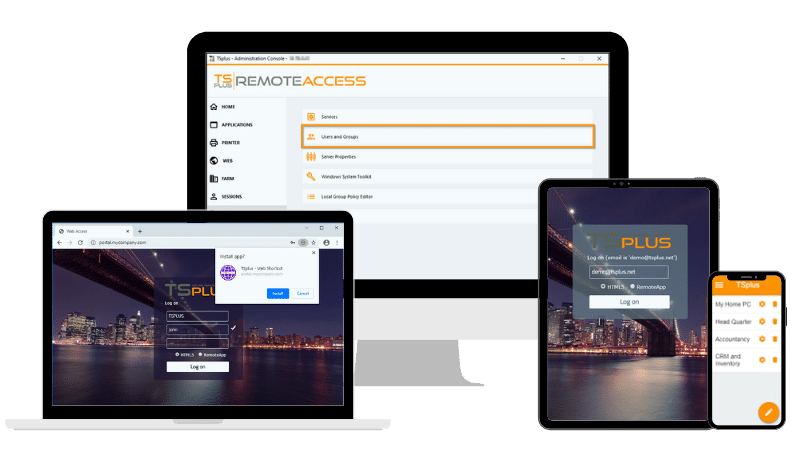
TSplus Remote Access provides centralized Windows application publishing and remote access without requiring each user to operate a complete cloud desktop. As organizations begin evaluating agent access to existing applications, the same principle raises an interesting possibility: provision access around the application and task rather than automatically around an entire desktop.
This is not to suggest that TSplus Remote Access is itself an AI-agent platform. Rather, AI agents make existing questions about application publishing, session isolation, access control and infrastructure ownership relevant to a new type of application consumer.
AI Agents Is Set To Change The Approach To Legacy Applications
Legacy Windows applications were designed around people sitting at keyboards. Computer-using agents challenge that assumption by making graphical interfaces potentially accessible to software as well.
For IT teams, the important question is therefore not simply whether an AI agent can click through an old Windows application. It is how to provide only the access the agent needs in order to maintain control over identities, data, sessions and infrastructure. As AI agents become application users, sound remote access architecture is likely to matter increasingly, not less.
TSplus Remote Access Free Trial
Ultimate Citrix/RDS alternative for desktop/app access. Secure, cost-effective, on-premises/cloud
)
)
)
