









)
)
Introduction
Remote desktop technology is now essential for delivering secure access to applications and Windows desktops across distributed teams. As device diversity grows, IT leaders must choose between browser-based HTML5 access and native RDP clients. Both rely on RDP but differ in performance, compatibility, and hardware integration. This guide explains how each works and helps you identify the right approach for your environment.
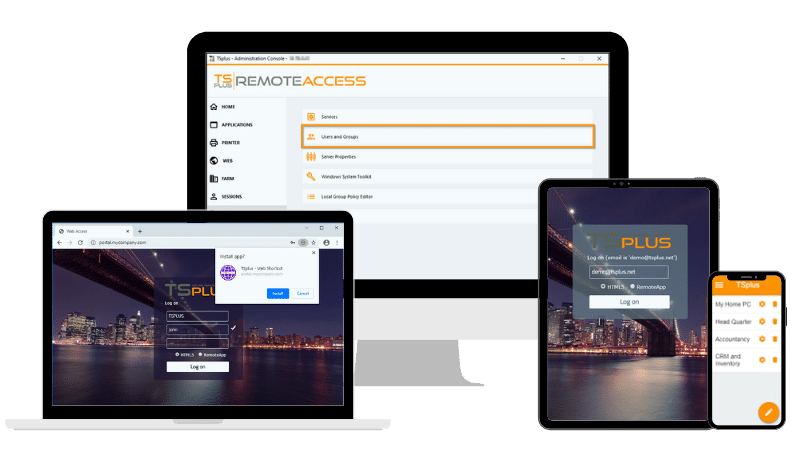
TSplus Remote Access Free Trial
Ultimate Citrix/RDS alternative for desktop/app access. Secure, cost-effective, on-premises/cloud
How Does HTML5 Remote Desktops and Native RDP Clients Work?
Remote desktop workflows depend on two main components: the client, which users interact with, and the remote server, which hosts the desktops or applications. The difference between HTML5 and native clients lies primarily in how the endpoint connects to the server.
HTML5 Remote Desktop: Browser-Based Access
An HTML5 remote desktop runs inside a modern web browser. A gateway or web portal acts as an intermediary between the user and the remote host. The browser sends keyboard, mouse, and screen-update data over secure HTTPS (TLS/SSL), while the server translates these interactions into RDP operations behind the scenes.
Because no software is installed on the endpoint, HTML5 clients offer true “zero-footprint” access. Users can connect from virtually any device:
- Windows
- macOS
- Linux
- iOS
- Android
- ChromeOS
This is especially valuable in environments where software installation is restricted:.
Native RDP Client: Installable Desktop and Mobile Applications
A native RDP client is a standalone application such as Microsoft Remote Desktop. It connects directly to the remote server using the RDP protocol. Unlike a browser, the client has deep access to local hardware capabilities, enabling advanced features such as:
- Audio redirection
- Drive mapping
- USB passthrough
- Multi-monitor support
- Printer redirection
- GPU acceleration
Native clients are typically preferred for performance-sensitive workloads or users who require strong integration with local resources. They are well suited for stable, managed environments where IT can deploy and update client software on each endpoint.
How Does HTML5 and Native RDP Features Compare?
Understanding the practical differences between HTML5 and native clients helps clarify which method is more appropriate for specific user groups.
Compatibility and Device Flexibility
HTML5 clients offer the broadest compatibility because they depend only on a browser. They work consistently across desktops, tablets, smartphones, thin clients, and Chromebooks. Native clients offer strong feature support, but capabilities vary by OS version and platform-especially on mobile devices or non-Windows systems.
Performance and Resource Requirements
HTML5 sessions perform well for standard office workloads such as document editing, CRM, ERP, and file access. However, browser sandboxing limits hardware acceleration and advanced redirection. Native RDP clients deliver the best performance for multimedia, video conferencing, engineering applications, or workloads that rely on GPU rendering or multi-monitor setups.
Peripheral Support and Local Resource Access
Because browsers restrict access to local hardware, HTML5 sessions typically provide limited device redirection. Basic clipboard and file transfer features may be available, but USB devices, scanners, smart cards, and printers are often partially or completely unsupported. Native clients fully support RDP’s redirection capabilities, making them essential for users who depend on local peripherals.
Security and Compliance
HTML5 remote desktops run over HTTPS, providing strong encryption and minimal endpoint footprint—ideal for high-security or regulated environments. However, organizations requiring hardware-based authentication, smart-card workflows, or granular device-redirection controls may prefer native clients, which expose more RDP-level security options.
Deployment and Maintenance
HTML5 reduces endpoint complexity because nothing is installed locally. IT teams maintain only the server-side portal. Native clients require installation, updates, and compatibility management on every device, adding overhead but often improving functionality for power users.
When Should You Use HTML5 Remote Access?
HTML5 remote access is most effective in environments that prioritize accessibility, device flexibility, and minimal endpoint management.
Device Diversity and Endpoint Flexibility
HTML5 remote desktops are well suited for environments with mixed or unmanaged devices. Because access occurs through a browser, users can connect from personal laptops, tablets, smartphones, or Chromebooks without installing any software. This makes HTML5 a practical choice for organizations supporting BYOD models or teams working across varied operating systems.
Simplified Access for External and Transient Users
Contractors, temporary staff, and third-party partners often require short-term or occasional access to corporate resources. HTML5 sessions make onboarding straightforward because all they need is a URL and valid credentials. IT teams avoid client deployment tasks, and users benefit from immediate, frictionless access regardless of their device or location.
Lightweight Workloads and Reduced IT Overhead
HTML5 works best for office-oriented tasks such as email, file access, CRM, or ERP applications, where hardware-level redirection isn't required. Since no client installation or updates are needed, organizations significantly reduce endpoint support efforts. This approach is especially valuable for distributed teams, remote-first businesses, and environments where employees frequently switch devices.
When Should You Use Native RDP Clients?
Native RDP clients become the preferred option when performance, hardware integration, and controlled endpoint environments are essential.
Advanced Peripheral Access and Hardware Integration
Native RDP clients are ideal when users rely on local devices such as:
- Printers
- USB peripherals
- Scanners
- Smart-card readers
Because the client application integrates directly with the operating system, it can provide full hardware redirection and richer session capabilities. This makes native access essential for teams whose workflows depend on consistent interaction with local resources.
High-Performance and Graphics-Intensive Workloads
Engineering applications, multimedia editing tools, CAD/CAM software, and data-heavy workloads require strong performance and low latency. Native RDP clients support GPU acceleration, multi-monitor setups, and optimized rendering paths that browsers cannot match. For users running demanding applications, native RDP delivers the stability and responsiveness they need.
Managed Environments with Consistent Endpoints
Organizations that maintain standardized and centrally managed device fleets benefit from the predictable experience offered by native RDP clients. IT departments can deploy and configure client software across all devices with minimal disruption. This controlled approach ensures feature consistency and supports advanced authentication and compliance requirements.
What are The Considerations and Deployment Trade-Offs of HTML5 Remote Desktop and Native RDP Client?
Limitations of Browser-Based Sessions
HTML5 sessions depend heavily on browser capabilities and security sandboxing. As a result, some advanced RDP features may be limited or unavailable, including:
- Device and peripheral redirection
- Smart-card authentication
- Hardware-accelerated graphics
Performance can also vary across browsers and devices, which may lead to inconsistent user experiences and requires validation before broad deployment.
Infrastructure Requirements
HTML5 reduces endpoint complexity but increases server-side requirements. Deployments typically involve:
- Web portals or HTML5 gateways
- SSL certificate management
- Reverse proxies or load balancing
Because all sessions rely on this infrastructure, gateway performance and availability become critical, making monitoring and capacity planning essential.
Balancing User Experience and Accessibility
HTML5 provides fast and convenient access for light workloads, while native clients offer better performance for technical tasks. Choosing the right approach often depends on clearly defined user profiles.
User experience can vary significantly based on expectations, particularly for users who rely on advanced desktop features such as:
- Multi-monitor setups
- GPU-assisted rendering
- Local device integration
When expectations are not aligned with capabilities, productivity and adoption can suffer.
Licensing and Cost Implications
Native RDP deployments may require RDS Client Access Licenses (CALs) and additional components at scale. HTML5 gateways can simplify endpoint licensing but introduce infrastructure considerations.
Typical cost factors include:
- Gateway or portal servers
- SSL certificates
- Load-balancing requirements
Evaluating both models together helps organizations understand total cost of ownership rather than focusing on licensing alone.
How Can You Evaluate the Right Approach for Your Environment?
Assessing Device Diversity Across the Organization
The variety of devices in use strongly influences whether HTML5 or native RDP is more suitable. Mixed or unmanaged fleets benefit from HTML5 because it avoids software installation. Standardized Windows environments, on the other hand, can support native RDP deployment more easily.
Understanding Application and Workload Requirements
Your applications largely determine which access method performs best. HTML5 handles office workloads reliably, while graphics-heavy or data-intensive tasks require the performance advantages of native RDP clients. Matching typical workloads to the right client type helps maintain productivity.
Evaluating Peripheral and Hardware Integration Needs
Users who rely on printers, scanners, USB devices, or smart-card readers generally need native RDP clients for full hardware redirection. HTML5 is limited by browser sandboxing and offers only basic interaction. Understanding how often these peripherals are used guides the correct choice.
Aligning Security and Compliance Requirements
Security requirements may lead an organization toward one approach over the other. HTML5 provides zero-install, encrypted browser access suitable for tightly controlled endpoints. Native clients support hardware tokens and detailed redirection controls, making them better aligned with stricter compliance models.
Considering IT Resources and Deployment Capacity
IT teams with limited deployment capacity often prefer HTML5 because no local installation or updates are required. Native RDP clients provide more control and features but demand ongoing maintenance. The available IT resources influence which approach is sustainable.
Reviewing User Mobility and Work Patterns
Mobile and geographically dispersed workers benefit from HTML5 due to its browser-based accessibility. Office-based roles or those needing multi-monitor or GPU-accelerated workflows perform better with native RDP clients. User behaviour patterns help determine the right method.
Accounting for Budget and Licensing Constraints
Licensing considerations play a role in selecting an access method. Native RDP may require additional CALs or licensing components, whereas HTML5 shifts some costs to gateway infrastructure. Evaluating these requirements helps determine long-term affordability.
Measuring Performance Expectations and User Experience Standards
Performance-sensitive environments often depend on native RDP to support rendering, responsiveness, and hardware acceleration. HTML5 is suitable for general productivity tasks but may not meet expectations for high-fidelity workloads. Understanding baseline performance needs ensures proper alignment.
How TSplus Remote Access Delivers the Best of HTML5 and Native RDP?
Solutions such as TSplus Remote Access enable organizations to deliver both HTML5 web access and native RDP client connections from a single platform. Administrators can assign connection methods based on user roles or workload requirements. This approach provides flexibility for the entire organization while maintaining security, performance, and centralized management.
Conclusion
HTML5 remote desktops and native RDP clients each address different needs: HTML5 offers broad accessibility and minimal endpoint management, while native clients deliver superior performance and full hardware integration. In most environments, a hybrid model works best—HTML5 for flexible access and native RDP for demanding workloads—ensuring the right balance of security, usability, and performance across all user groups.
TSplus Remote Access Free Trial
Ultimate Citrix/RDS alternative for desktop/app access. Secure, cost-effective, on-premises/cloud
)
)
)
