









)
)
An endpoint management system helps IT teams monitor, secure, configure and support the devices that connect to company resources. In practice, those endpoints include Windows PCs, macOS devices, mobile devices, servers, virtual desktops, remote access hosts and the applications users depend on.
For SMB IT managers and sysadmins, the challenge is rarely just device control. The real goal is to keep people productive, protect business data and reduce everyday administration without building an enterprise stack that takes months to deploy.
What Is an Endpoint Management System?
An endpoint management system is software that gives administrators centralized visibility and control over endpoint devices. Typical capabilities include device inventory, configuration management, patch management, software deployment, compliance reporting, remote troubleshooting and security policy enforcement.
In a small or midsize business, endpoint management often combines several tool categories. A company may use a Unified Endpoint Management platform for laptops and phones, a Remote Monitoring and Management tool for servers, a remote support tool for helpdesk work and a remote access platform to centralise applications.
Endpoint management system vs UEM, MDM, EMM and RMM
Unified Endpoint Management, or UEM, is the broadest modern category. A UEM platform manages several device types, operating systems and ownership models from one console.
Mobile Device Management, or MDM, focuses mainly on smartphones, tablets and mobile policies. Enterprise Mobility Management, or EMM, extends MDM with mobile application, content and identity controls. Remote Monitoring and Management, or RMM, focuses more on monitoring, maintenance, patching and support, especially for MSPs and distributed IT teams.
These categories overlap. For practical buying decisions, the useful question is broader than “Which acronym is correct?” It is “Which tool reduces the most both risk and workload for my users, devices and infrastructure?”
Where endpoint security fits
Endpoint security
protects endpoints against threats such as malware, ransomware, credential abuse and unauthorized access.
Endpoint management
helps keep devices healthy, configured and updated. The two functions work best together because a well-managed endpoint is easier to secure, and a secure endpoint is easier to trust.
For remote access environments, endpoint security should also include the servers and gateways to which users connect. This is where monitoring, access hardening and remote support become essential parts of the endpoint management picture.
Why Does Endpoint Management Matter?
Endpoint management matters because every laptop, phone, remote session and server can become a support issue, compliance gap or attack path. Without centralised visibility, IT teams lose time answering basic questions:
- Which devices are exposed?
- Which systems are unpatched?
- Which users are affected?
- Which application server is overloaded?
This is especially painful for SMBs, where the same administrator may handle helpdesk, servers, cybersecurity, remote access and vendor management. A practical endpoint management strategy reduces manual checks and gives the administrator enough information to act before users are blocked.
Hybrid work has changed the endpoint perimeter
Hybrid work has expanded the endpoint perimeter beyond the office network. Employees connect from home, branch offices, personal networks, mobile devices and unmanaged locations. As a result, endpoint device management now includes remote access security, user experience monitoring and support for devices that IT teams may never physically touch.
An endpoint management system should therefore do more than list devices. It should help IT understand access, sessions, applications, performance, security posture and user impact.
Endpoint management is also about people
Good endpoint management improves the working day for both administrators and users. Admins get fewer blind spots and less repetitive manual work. Users get faster support, fewer outages and safer access to the applications they need.
That people-first view matters. A powerful UEM platform may be the right answer for a complex device fleet, but some lean teams and SMBs gain more value by reducing endpoint dependency through browser-based Remote Access, better Server Monitoring, secure access policies and practical Remote Support.
Endpoint management criteria checklist
Before comparing tools, define what your environment actually needs. The best endpoint management system for an enterprise with 20,000 mixed devices may be excessive for an MSP or an SMB with Windows servers, remote users and a small IT team.
Use the checklist below to evaluate products consistently.
Visibility and inventory
A useful endpoint management system should show what exists, who uses it and whether it is healthy. For laptops and mobile devices , this means:
- hardware inventory,
- software inventory
- ownership and
- compliance state.
For remote access environments visibility should also include:
- servers,
- sessions,
- applications,
- bandwidth and
- user activity.
Patch management and configuration control
Patch management is one of the most important endpoint management functions. Look for:
- operating system updates
- third-party application patching
- scheduling, reporting and
- failure visibility.
Additionally, configuration control is equally important because misconfigured endpoints and exposed services can create security gaps.
Security policy enforcement
Endpoint management software should help enforce baseline security policies. Depending on the tool, that may include:
- encryption
- password rules,
- conditional access,
- device compliance,
- remote wipe
- firewall policies,
- malware protection integrations or
- access restrictions.
For a remote access infrastructure security should include:
- brute-force protection
- IP filtering,
- working-hour restrictions,
- ransomware protection and
- strong authentication.
Remote support and user experience
Endpoint management is not complete without support workflows. IT support teams need to:
- diagnose issues,
- assist users,
- transfer files,
- view device information and
- resolve problems without unnecessary travel or long ticket chains.
For remote and hybrid teams, user experience is also a technical metric. Slow sessions, overloaded servers and unstable applications can look like endpoint problems even when the root cause is infrastructure.
Reporting, automation and cost
Reporting turns endpoint data into decisions. SMB IT teams should look for:
- clear dashboards,
- alerts
- historical trends and
- exportable reports.
Automation is useful, but only when it saves real time without creating a fragile system.
Cost should include:
- licensing
- training bills,
- deployment
- maintenance
- the time to train up staff members and
- the time required to operate the platform.
A lower-cost tool that fits your team may deliver more value than a larger platform that remains cryptic and underused.
How did we evaluate the solutions?
We evaluated each solution through the lens of a sysadmin or of an SMB IT manager. The focus is practical value, rather than always the largest possible feature list.
The main criteria were:
- endpoint visibility,
- patch and configuration management
- security features,
- remote support value,
- monitoring
- usability
- ecosystem fit and
- cost awareness.
We also considered whether each product fits the following categories:
- full UEM platform,
- RMM platform,
- Apple-focused management tool or
- endpoint-adjacent solution which reduces management complexity in another way.
Endpoint management systems comparison table
|
Software |
Best for |
Main category |
Strongest value |
SMB fit |
|
TSplus Server Monitoring |
Remote access infrastructure visibility |
Monitoring and endpoint complexity reduction |
Server, session, app and user activity monitoring |
High |
|
Microsoft Intune |
Microsoft 365 environments |
UEM |
Device compliance, app control and conditional access |
Medium to high |
|
ManageEngine Endpoint Central |
Broad endpoint administration |
UEM and endpoint security |
Patch, inventory, deployment and remote control |
High |
|
NinjaOne |
MSPs and lean IT teams |
RMM and endpoint management |
Monitoring, patching, automation and remote support |
High |
|
VMware Workspace ONE UEM |
Large mixed fleets |
Enterprise UEM |
Cross-platform device and app management |
Medium |
|
IBM MaaS360 |
Security-led mobility management |
UEM and MDM |
Mobile security, compliance and AI-assisted insights |
Medium |
|
Scalefusion |
Kiosk, frontline and access-aware devices |
UEM |
Device management plus access controls |
High |
|
Jamf Pro |
Apple-first organizations |
Apple device management |
macOS, iOS and Apple app lifecycle control |
High for Apple fleets |
|
Ivanti Neurons for UEM |
Enterprise endpoint automation |
UEM |
Discovery, self-healing and policy enforcement |
Medium |
|
Hexnode UEM |
Mixed-device SMBs and midmarket |
UEM |
Device management, kiosk, patch and security workflows |
High |
1. TSplus Server Monitoring
TSplus Server Monitoring is not a full Unified Endpoint Management platform. It does not replace Microsoft Intune, Workspace ONE UEM or a classic MDM system for enrolling laptops and mobile devices.
Its value is different and important for smaller structures and leaner teams. TSplus Server Monitoring helps IT teams monitor the remote access infrastructure upon which endpoints are dependent: servers, websites, applications, bandwidth, processes, users and concurrent sessions. For organisations delivering Windows applications or remote desktops, such visibility can solve many problems users describe as “endpoint issues.”
A sysadmin can use TSplus Server Monitoring to detect overloaded servers, track user activity, identify application bottlenecks and review historical performance. Combined with TSplus Advanced Security, Remote Support and Remote Access, it becomes part of a practical stack for reducing endpoint complexity and securing the environment.
Pros
- Strong fit for Windows Server and Linux, Remote Desktop Services and remote access environments.
- Helps administrators monitor server health, user sessions, application usage and performance trends as well as website health.
- Easier to deploy and operate than many enterprise endpoint platforms.
- Complements TSplus Remote Access, Advanced Security and Remote Support.
- Useful for preventing user-impacting issues before tickets multiply.
Cons
- Not a full UEM, MDM or laptop lifecycle management platform.
- Does not replace dedicated patch management for all endpoint operating systems.
- Best suited to remote access infrastructure rather than direct control of every device.
When to choose TSplus Server Monitoring
Choose TSplus Server Monitoring when your main challenge is visibility across remote access servers, sessions, applications, user activity and websites. It is especially relevant if you want to reduce endpoint dependency by centralising application access and monitoring the infrastructure behind it.
Need better visibility across remote access servers, sessions and applications? Start your free TSplus Server Monitoring trial.
2. Microsoft Intune
Microsoft Intune is a cloud-based endpoint management service for managing and securing devices, applications and access to organisational resources. It is a natural choice for companies already standardised on Microsoft 365, Microsoft Entra ID and Microsoft Defender.
Intune can enroll devices, apply configuration profiles, deploy applications, manage compliance policies and integrate with conditional access. For Windows-heavy businesses, it offers a strong long-term foundation, although setup and policy design require care.
Pros
- Strong integration with Microsoft 365, Entra ID and Defender.
- Good fit for Windows, macOS, iOS, Android and Linux endpoint scenarios.
- Supports compliance policies and conditional access.
- Scales from SMB to enterprise environments.
Cons
- Can require significant Microsoft ecosystem knowledge.
- Some advanced capabilities depend on licensing.
- Policy troubleshooting can become complex for small teams.
When to choose Microsoft Intune
Choose Microsoft Intune when your organisation already relies on Microsoft cloud identity, Microsoft 365 and Windows endpoint management.
3. ManageEngine Endpoint Central
ManageEngine Endpoint Central is a comprehensive endpoint management and security platform. It covers patch management, software deployment, asset management, OS deployment, remote control, configurations, and mobile device management.
For SMBs that want many endpoint administration functions in one console, Endpoint Central is a strong candidate. It is especially relevant for teams needing practical patching and inventory without committing fully to a Microsoft-only or enterprise-only stack.
Pros
- Broad feature set for endpoint management, patching and inventory.
- Good balance between UEM, endpoint security and IT operations.
- Available for a wide range of endpoint administration use cases.
- Strong fit for IT teams who want centralized operational control.
Cons
- Breadth can require careful module selection.
- Interface and configuration depth may take time to master.
- Smaller teams should avoid deploying more features than they can maintain.
When to choose ManageEngine Endpoint Central
Choose ManageEngine Endpoint Central when you need comprehensive endpoint management software with patching, deployment, inventory, and remote control in one platform.
4. NinjaOne
NinjaOne is a cloud-based IT operations platform with strong RMM roots. It is popular with MSPs and internal IT teams that need monitoring, alerting, patch management, automation, remote access and endpoint support from a single console.
For SMB IT teams, NinjaOne is attractive because it focuses on day-to-day operational work. Instead of starting with device policy design, it helps teams see endpoint health, automate maintenance and respond quickly.
Pros
- Strong RMM, monitoring and patch management capabilities.
- Good fit for MSPs and lean internal IT teams.
- Includes automation and remote support workflows.
- Useful for distributed endpoints and recurring maintenance.
Cons
- Not always the deepest UEM choice for complex mobile policy management.
- Pricing usually requires a quote.
- Some organizations may still need separate identity or security tooling.
When to choose NinjaOne
Choose NinjaOne when your priority is remote monitoring, patching, automation and support across distributed endpoints.
5. VMware Workspace ONE UEM
VMware Workspace ONE UEM, now under Omnissa, is an enterprise-grade UEM platform for managing desktops, mobile, rugged, server and specialty devices across multiple operating systems. It is built for organisations with diverse fleets and mature IT processes.
Workspace ONE UEM is powerful, but it may be more than some SMBs need. It fits best where device diversity, compliance requirements and enterprise integrations justify the complexity.
Pros
- Strong cross-platform UEM capabilities.
- Suitable for complex device fleets and enterprise environments.
- Supports device, application and compliance management.
- Good fit for organisations standardising digital workspace operations.
Cons
- Can be complex for smaller IT teams.
- Deployment and administration may require specialist skills.
- May be excessive for SMBs with simpler endpoint needs.
When to choose VMware Workspace ONE UEM
Choose Workspace ONE UEM when you need enterprise-level device and application management across a large, mixed endpoint estate.
6. IBM MaaS360
IBM MaaS360 is a UEM and mobile security platform designed to manage and secure endpoints from a central console. It is particularly strong for mobile device management, compliance, threat protection and security-led endpoint administration.
For SMBs, MaaS360 is most relevant when mobile devices, BYOD and regulated access are central concerns. It is less likely to be the simplest choice for a small Windows-only environment.
Pros
- Strong mobile and security management capabilities.
- Supports compliance, policy enforcement and threat protection.
- Useful for BYOD and mobile workforce scenarios.
- Backed by IBM security ecosystem capabilities.
Cons
- May feel more security-suite oriented than simple operations-focused tools.
- Can be more than needed for smaller, desktop-focused SMBs.
- Best value appears in mobile-heavy or compliance-sensitive environments.
When to choose IBM MaaS360
Choose IBM MaaS360 when mobile security, BYOD, compliance and centralised endpoint protection are top priorities.
7. Scalefusion
Scalefusion is a UEM platform focused on endpoint, access and security management. It is especially interesting for organisations managing frontline devices, kiosks, tablets, rugged devices or shared endpoints.
Scalefusion combines device management with access-aware controls, making it useful where device trust and application access are closely connected. For SMBs in retail, healthcare, logistics or education, that practical orientation can be valuable.
Pros
- Strong for kiosk, frontline and shared-device use cases.
- Combines endpoint management with access and security controls.
- Good support for remote device management and policy enforcement.
- Practical for industry-specific device fleets.
Cons
- May not be the first choice for deep Windows server monitoring.
- Advanced needs should be checked against supported platforms and editions.
- General office environments may not use its kiosk strengths.
When to choose Scalefusion
Choose Scalefusion when you manage shared, mobile, kiosk or frontline endpoints and want device policies tied closely to access control.
8. Jamf Pro
Jamf Pro is a leading Apple device management platform for macOS, iOS, iPadOS and Apple TV environments. It helps IT teams deploy, configure, secure and patch Apple devices using Apple-native management capabilities.
For Apple-first SMBs, Jamf Pro can be the most natural endpoint management system. For mixed environments, it is often paired with another tool for Windows, Android or broader infrastructure monitoring.
Pros
- Strong Apple-first management experience.
- Excellent fit for macOS and iOS lifecycle management.
- Supports app deployment, patching and user self-service workflows.
- Large Apple IT community and integration ecosystem.
Cons
- Best suited to Apple fleets, not general UEM for every endpoint type.
- Mixed-device organizations may need additional tools.
- Windows-focused SMBs will not get full coverage from Jamf Pro alone.
When to choose Jamf Pro
Choose Jamf Pro when Apple devices are central to your organisation and you want mature, Apple-native endpoint management.
9. Ivanti Neurons for UEM
Ivanti Neurons for UEM is designed to discover, manage, configure and secure devices from a unified interface. It emphasises automation, visibility, policy enforcement and self-healing endpoint operations.
Ivanti is best suited to organisations with complex endpoint estates, mature IT operations and a need for automation at scale. SMBs should evaluate whether the enterprise depth matches their available administration time.
Pros
- Strong discovery, endpoint visibility and automation.
- Designed for large and complex device environments.
- Supports policy enforcement and endpoint remediation.
- Useful where IT wants to consolidate endpoint operations.
Cons
- May be complex for smaller teams.
- Best suited to organizations with mature endpoint processes.
- Smaller SMBs may prefer a simpler operational tool.
When to choose Ivanti Neurons for UEM
Choose Ivanti Neurons for UEM when automation, discovery and enterprise endpoint operations are more important than simplicity.
10. Hexnode UEM
Hexnode UEM is a unified endpoint management platform for managing and securing mobile, desktop and specialty devices from a central console. It supports use cases such as device enrollment, policy enforcement, kiosk lockdown, patch workflows and remote security.
For SMBs and midmarket teams, Hexnode is a practical option when device variety matters but enterprise complexity needs to stay manageable. It is also relevant for teams that want UEM features without building a large endpoint management programme from scratch.
Pros
- Broad UEM coverage across mobile and desktop use cases.
- Strong kiosk and remote device management capabilities.
- Practical interface for SMB and midmarket teams.
- Useful for mixed-device environments.
Cons
- Deep enterprise automation may require comparison with Ivanti or Workspace ONE.
- Patch and platform capabilities should be checked for each operating system.
- Some environments may still need separate server monitoring or RMM tools.
When to choose Hexnode UEM
Choose Hexnode UEM when you need accessible unified endpoint management across mixed devices, kiosks and remote endpoints.
Which Endpoint Management System Should You Choose?
The best endpoint management system depends on what creates the most work for your IT team and what saves the most.
Secure & configurable
Choose TSplus Server Monitoring if your main problem is remote access infrastructure visibility, user sessions, server performance and application availability. Add TSplus Advanced Security for access hardening, TSplus Remote Support for user assistance and TSplus Remote Access to reduce endpoint dependency through centralised application delivery.
Windows first
Choose Microsoft Intune if you are Microsoft-first and need device compliance, app protection and conditional access. Choose ManageEngine Endpoint Central if you want broad endpoint operations with patching, inventory and deployment. Choose NinjaOne if monitoring, automation and MSP-style maintenance are your daily priorities.
High automation
For complex enterprise fleets, consider Workspace ONE UEM or Ivanti Neurons for UEM. For mobile-heavy or security-led programmes, evaluate IBM MaaS360. For frontline, kiosk or shared devices, Scalefusion and Hexnode UEM deserve attention. For Apple-first organisations, Jamf Pro is usually the specialist benchmark.
Can You Reduce Endpoint Management Complexity?
Yes. Endpoint management does not always mean adding more agents, consoles and policies. Sometimes the best improvement is to reduce how much has to be managed on each endpoint.
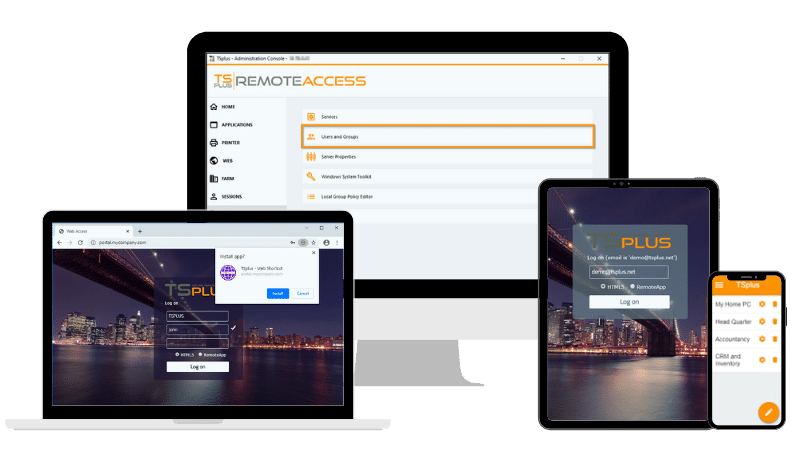
TSplus supports that approach. TSplus Remote Access can publish Windows applications centrally and make them available through browser-based remote access. This reduces the need to install and maintain business software on every user device.
TSplus Server Monitoring helps administrators understand whether the remote access servers and applications are healthy. TSplus Advanced Security helps protect exposed remote access paths. TSplus Remote Support helps IT assist users when endpoint or access problems still occur.
Together, this suite does not replace UEM for device enrolment or mobile policy management. Instead, it gives SMBs a practical way to simplify access, improve visibility, support users and secure the infrastructure behind remote work.
Conclusion
An endpoint management system should help IT teams answer three practical questions:
- What do we have?
- Is it secure and working?
- Can we fix issues before users lose time?
For some organizations, the answer is a full UEM platform while for others, the better first step may be monitoring, securing and simplifying the systems users rely on every day.
TSplus Server Monitoring fits that second path. It helps administrators keep remote access servers, applications, sessions and users visible to them. In addition, supported by TSplus Advanced Security, Remote Support and Remote Access, it offers a people-centred way to reduce endpoint complexity while keeping IT practical, affordable and focused on user productivity.
Simplify remote access monitoring and support for your SMB IT team. Get started with TSplus Server Monitoring today.
TSplus Remote Access Free Trial
Ultimate Citrix/RDS alternative for desktop/app access. Secure, cost-effective, on-premises/cloud
)
)
)
