








)
)
Windows 11 Enterprise Multi-session allows several users to share the same Windows 11 virtual machine at the same time through Azure Virtual Desktop. For users, the goal is simple: access to a familiar Windows workspace from anywhere. For IT teams, the reality is more complex: licensing, Azure architecture, user profiles, performance, security and cost all need to be planned.
This guide explains how Windows 11 Enterprise Multi-session works, where it fits compared with Windows Server RDS and when TSplus Remote Access can provide a simpler application delivery alternative for IT teams, MSPs and businesses.
What Is Windows 11 Enterprise Multi-session?
Windows 11 Enterprise Multi-session is a version of Windows 11 Enterprise designed for Azure Virtual Desktop. It allows multiple concurrent interactive sessions on one session host, while each user receives a separate remote session.
This model is useful because many organizations want the Windows 11 user experience without assigning one dedicated virtual machine to every user. A pooled multi-session host can reduce infrastructure waste by sharing compute, memory and storage across several users.
However, Windows 11 Enterprise Multi-session is not a hidden feature inside standard Windows 11. It is a specific Azure Virtual Desktop operating system option with specific licensing and deployment rules. That distinction matters for compliance, support and long-term reliability.
How does it differ from standard Windows 11?
Standard Windows 11 is a client operating system designed for one interactive user at a time. Remote Desktop can be useful for individual access, administration or support, but standard Windows 11 is not designed to operate as a multi-user Remote Desktop Session Host.
Windows 11 Enterprise Multi-session changes that model inside Azure Virtual Desktop. Users connect through the Azure Virtual Desktop service, which in turn brokers access to session hosts, host pools, desktops and published applications. Thus, the user sees a familiar Windows 11 environment, while IT manages the session infrastructure centrally.
For users, the difference should therefore feel minimal, as long as deployment is well designed. A finance user opens the same accounting software. A support agent reaches the same customer tools. A contractor signs in to a controlled workspace without receiving a full corporate device. For IT, the difference is significant because capacity, profiles, images and cost become shared-service responsibilities.
Where does Azure Virtual Desktop fit?
Azure Virtual Desktop is the delivery platform for Windows 11 Enterprise Multi-session. It provides the control plane which organizes host pools, session hosts, application groups, user assignment and access.
This makes Windows 11 Enterprise Multi-Session a good fit for cloud-first organizations already using Microsoft 365, Microsoft Entra ID and Azure. It is especially relevant for hybrid work, call centers, education labs, temporary staff, contractor access and standardized business desktops.
Nevertheless, the model also has limits. Azure Virtual Desktop reduces some infrastructure responsibility, but it does not remove planning. IT teams still need to size hosts, manage images, configure user profiles, secure access, monitor performance and control Azure consumption.
Can Standard Windows 11 Support Multi-session RDP?
A common concern from administrators is whether standard Windows 11 can support several simultaneous Remote Desktop Protocol sessions. The practical answer is no, for normal production use. Standard Windows 11 is not the supported Microsoft platform for multiple concurrent business users on the same machine.
Reasons unsupported workarounds are risky
While online workarounds may claim to enable multiple RDP sessions on Windows 11 they usually do this by modifying system files or changing unsupported settings. These methods can appear attractive in a lab but are not a sound business strategy.
Unsupported multi-RDP workarounds create several risks. Windows updates can break them. Security tools may conflict with them. Troubleshooting becomes harder. Licensing and supportability can become unclear. For MSPs, such shortcuts can turn into recurring support issues across multiple customer environments.
The better question is not “How can we force Windows 11 to allow more RDP users?”. Instead, the better question is “Which supported remote access architecture matches the users, applications, budget and compliance requirements?”.
When Windows multi-session is the official route
Windows 11 Enterprise Multi-session is the official Microsoft route when the organization needs a shared Windows 11 client desktop through Azure Virtual Desktop. This is different from providing remote access to a single Windows 11 PC, and it is different from hosting users on Windows Server RDS.
This distinction helps IT teams choose correctly:
- Use Windows 11 Enterprise Multi-session when users need a pooled Windows 11 desktop in Azure Virtual Desktop.
- Use Windows Server RDS when users need mature server-based session hosting on Windows Server.
- Use TSplus Remote Access when the main requirement is simple, secure and affordable access to Windows applications or desktops without deploying a full Azure Virtual Desktop environment.
Each model can support remote work, but each model has a different architecture, licensing structure and operational profile.
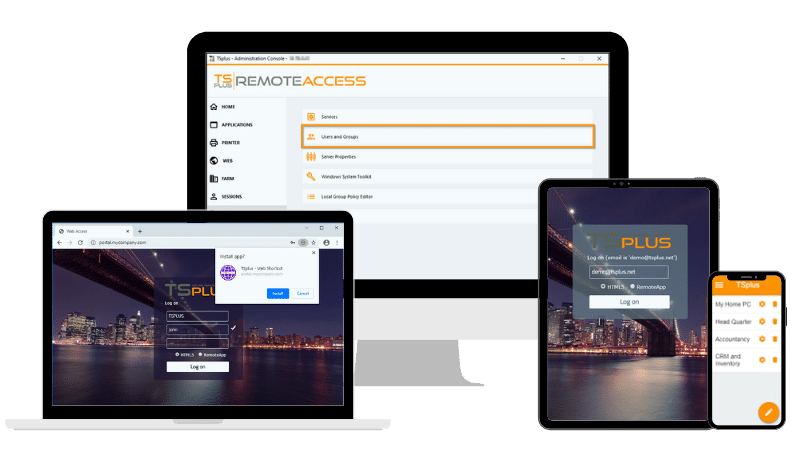
TSplus Remote Access Free Trial
Ultimate Citrix/RDS alternative for desktop/app access. Secure, cost-effective, on-premises/cloud
How to Implement Windows 11 Enterprise Multi-session
A successful implementation starts with users, not virtual machines. IT teams should define who needs access, which applications they use, when they work, how much performance they need and what data they can reach.
Centering on staff potential and user needs prevents overengineering. Some users need a full Windows 11 desktop. Others only need one published application. Some roles require high performance, while others can share pooled resources efficiently.
Plan users, workloads and licenses
Planning
Start by carefully grouping users by role and workload. Task workers, support agents, finance users, administrators, contractors and power users usually have different needs. For each group, document required applications, working hours, file access, peripheral needs and performance expectations.
Licensing
Licensing should be checked at this stage, not after deployment. Windows 11 Enterprise Multi-session access requires eligible Microsoft licensing for internal users, and different rules can apply for external commercial access. Also, Azure infrastructure costs are separate from user licensing.
Full desktops or simple apps
Additionally, this planning phase should define whether users need full desktops or RemoteApp delivery. Full desktops are useful when users need a complete Windows workspace. Meanwhile, application delivery (via RemoteApp with Azure) is often cleaner for users who need controlled access only to specific business applications.
Build the Azure Virtual Desktop environment
The implementation then moves to Azure Virtual Desktop. Administrators create the core environment, including host pools, workspaces, application groups and session hosts. The Windows 11 Enterprise Multi-session image is selected when deploying session hosts.
A host pool groups session hosts which deliver the same desktop or application experience. Such host pools are usual for multi-session deployments because users share a set of session hosts rather than receiving dedicated virtual machines.
Sizing is critical. The number of users per host depends on vCPU, memory, disk performance, graphics needs and application behaviour. A light browser-based workload is very different from an analytics, design or multimedia workload. Administrators should pilot with real users and measure real usage before scaling.
Configure profiles, applications and security
Profiles
User profiles are central to the experience. In pooled environments, users may not return to the same host every day. Without proper profile management, personalization, Outlook data, browser settings and application preferences can become inconsistent.
FSLogix profile containers are commonly recommended for Azure Virtual Desktop. They store the user profile in a container which, in turn, attaches when the user signs in. The result is a more consistent experience across pooled hosts.
Security
Security should be designed from the start. Microsoft Entra ID, multifactor authentication, Conditional Access, least privilege and role-based administration help control who can access what. Session hosts also need patching, hardening, antivirus protection and logging.
Monitor performance and cost
Windows 11 Enterprise Multi-session is not a one-time installation. It is an ongoing managed remote workspace service. After launch, IT teams should monitor session density, CPU, memory, disk latency, sign-in time, failed logons and disconnected sessions.
Why monitor systems
Monitoring protects both cost and user experience. Without data, administrators may overprovision hosts to avoid complaints or under-provision them to save money. Both decisions can be expensive in different ways.
Scaling and balancing
Autoscaling can help reduce Azure consumption by starting and stopping capacity based on schedules or demand. This is especially useful for offices, schools, support teams and MSP customers with predictable working hours.
Windows 11 Enterprise Multi-session vs Windows Server RDS
Platform, licensing and user experience
Windows 11 Enterprise Multi-Session and Windows Server Remote Desktop Services both support centralized access for multiple users. The difference lies in the operating system, platform, licensing and best-fit use case.
Windows 11 Enterprise Multi-session delivers a Windows 11 client experience through Azure Virtual Desktop. Windows Server RDS delivers shared sessions from Windows Server and can run on premises, in private hosting or in cloud infrastructure.
For users, the main difference is the desktop experience and application compatibility. Some users prefer or require a Windows 11 environment. Some applications are tested more naturally on Windows client operating systems. Other applications run perfectly on Windows Server and do not require Windows 11 desktops.
For IT teams, the choice affects skills and operations. Azure Virtual Desktop requires Azure, identity, networking, image management and cost governance skills. Windows Server RDS requires Windows Server, RDS licensing, certificates, patching and session host administration.
Best-fit scenarios
|
Criteria |
Windows 11 Enterprise Multi-session |
Windows Server RDS |
|
User experience |
Windows 11 client desktop |
Windows Server session |
|
Delivery platform |
Azure Virtual Desktop |
On-premises, hosted or cloud |
|
Licensing |
Eligible Microsoft/Windows licenses plus Azure costs |
Windows Server licensing plus RDS CALs |
|
Best fit |
Cloud-first pooled Windows 11 desktops |
Server-based apps and desktops |
|
Operational profile |
Azure VDI management |
Windows Server session management |
The right choice depends on the business requirement. If the organization specifically wants pooled Windows 11 desktops in Azure, Windows 11 Enterprise Multi-session is the natural choice. If the organization mainly needs reliable application delivery, Windows Server RDS or TSplus Remote Access may be simpler.
What Are the Foremost Cost and Migration Considerations?
Cost remains one of the most important parts of any Windows multi-session decision. Windows 11 Enterprise Multi-session can reduce per-user infrastructure waste because several users share one host. However, the final cost depends on design, usage and operations.
Designing for use and work
Azure Virtual Desktop costs include compute, storage, networking and supporting services. User profiles, backups, monitoring and image management can also add cost. Eligible Microsoft licenses may cover user access rights, but they do not remove Azure consumption charges.
Operational effort also has a cost. Azure Virtual Desktop requires planning, monitoring, security governance and support skills. A platform that looks affordable on paper can become expensive if it consumes too much administrator time or creates user downtime.
Migrating
Migration scenarios vary. Moving from physical PCs can improve remote access and standardization, but applications, peripherals and user profiles need testing. Moving from Windows Server RDS can modernize the desktop experience, but licensing and operations change. Moving from Citrix, Omnissa Horizon or another VDI platform requires careful feature mapping, especially around profiles, printing, monitoring, security and support workflows.
Consider hybrid solutions
Some organizations may not need a full migration. A hybrid model can be more realistic. Azure Virtual Desktop can serve users who need a Windows 11 cloud desktop, while Windows Server RDS or TSplus Remote Access continues to deliver stable business applications.
Alternatives to Windows 11 Enterprise Multi-Session
Windows 11 Enterprise Multi-Session is powerful, but it is not the only way to deliver remote desktops and applications. The strongest alternative depends on what your users need and what your IT staff can manage sustainably.
Azure Virtual Desktop
Azure Virtual Desktop is the native platform for Windows 11 Enterprise Multi-Session. It fits organizations that are cloud-first, Microsoft 365-centered and comfortable managing Azure infrastructure.
This option is strongest when users need a complete Windows 11 desktop experience in the cloud. It is less ideal when the organization only needs to publish a few Windows applications and wants to avoid full VDI complexity.
Windows Server RDS
Windows Server RDS remains a mature option for multi-user desktop and application delivery. It is especially relevant when organizations already operate Windows Server infrastructure or need control over where session hosts run.
RDS can be a good fit for on-premises environments, hosted infrastructure and predictable workloads. The user experience is not Windows 11, but for many business applications, reliability and access matter more than the operating system label.
TSplus Remote Access and the TSplus Software Suite
Alternative access to applications and desktops
TSplus Remote Access is a practical alternative for organizations who want secure remote access to Windows applications and desktops without building a full Azure Virtual Desktop environment. It enables application publishing, remote desktop access and secure browser-based HTML5 access from Windows Server infrastructure.
TSplus does not turn standard Windows 11 into Windows 11 Enterprise Multi-Session. Instead, TSplus addresses the same business need through a different model: give users secure access to the applications and desktops they need, while helping IT teams reduce complexity and control cost.
It offers organizations a dependable way to deliver Windows applications remotely when they do not need the full architecture, licensing and Azure operational model behind Windows 11 Enterprise Multi-Session.
Tightening security and infrastructure reliability
The wider TSplus Suite strengthens the remote access environment. TSplus Advanced Security helps protect exposed servers with features such as brute-force protection and IP filtering. TSplus Remote Support helps IT teams assist users outside the office. TSplus Server Monitoring gives administrators visibility into server health, session activity and resource usage.
Together, these products help IT teams deliver, secure, support and monitor remote access without adopting enterprise VDI overhead.
Conclusion
Windows 11 Enterprise Multi-Session gives organizations a way to deliver a shared Windows 11 desktop experience through Azure Virtual Desktop. It can be valuable for cloud-first businesses, hybrid workforces, call centers, education and standardized user environments. However, IT teams must plan Azure Virtual Desktop architecture, eligible licenses, profiles, security, monitoring and Azure costs before deployment.
For many organizations, the larger question is not only how to implement Windows 11 Enterprise Multi-Session. The real question is how to give users secure and reliable access to the Windows applications and desktops they need, without unnecessary complexity. Azure Virtual Desktop, Windows Server RDS and TSplus Remote Access each answer that question differently.
To round up, TSplus Remote Access fits teams who want simpler application and desktop delivery and administration with stronger control over cost and operations.
TSplus Remote Access Free Trial
Ultimate Citrix/RDS alternative for desktop/app access. Secure, cost-effective, on-premises/cloud
)
)
)
