





)
)
Introduction
Remote access is now permanent infrastructure for SMBs, driven by hybrid work and centralized applications, with Microsoft Remote Desktop Services often used as the default foundation. However, many deployments are rushed or poorly planned, leading to security gaps, performance issues, and growing management overhead. This article examines the most common remote desktop deployment mistakes SMBs still make and explains how to avoid them with practical, realistic improvements.
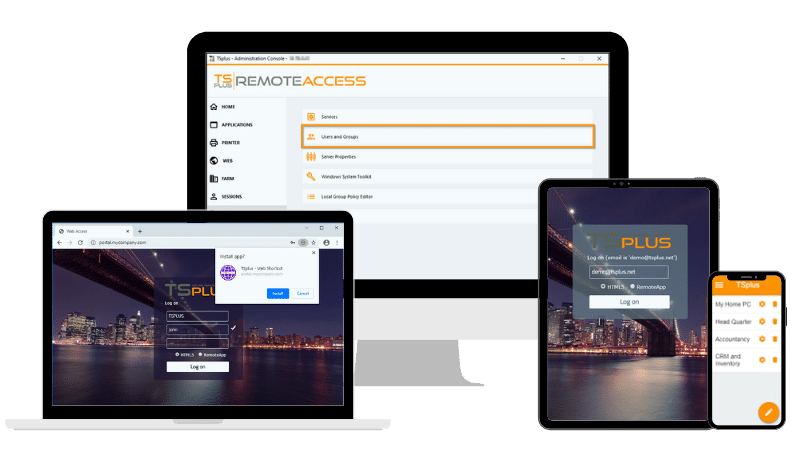
TSplus Remote Access Free Trial
Ultimate Citrix/RDS alternative for desktop/app access. Secure, cost-effective, on-premises/cloud
Why Do SMBs Underestimate Remote Desktop Security Risks?
Security mistakes are especially damaging in SMB environments because response capacity is limited. When an incident occurs, teams often discover that logging, alerting, or recovery processes were never fully defined. This turns containable events into prolonged outages or data exposure, even when the original issue was relatively small.
Common Security Misconfigurations in SMB Remote Desktop Environments
When remote desktop access is rushed into production, several weaknesses often appear together:
- RDP ports exposed directly to the internet
- Weak or reused credentials across users
- No Multi-Factor Authentication (MFA)
- Limited visibility into login attempts
- No network segmentation around RDS servers
Attackers actively scan the internet for exposed Remote Desktop Protocol endpoints. Brute-force attacks, credential stuffing, and ransomware campaigns frequently target poorly protected SMB environments.
Practical Security Controls That Reduce RDP Attack Surface
Remote desktop security should be layered, not dependent on a single control.
- Place RDS behind a secure gateway or VPN
- Enforce strong password policies and MFA
- Restrict inbound access with firewalls and IP filtering
- Monitor failed login attempts and session activity
Microsoft and CISA consistently recommend eliminating direct internet exposure of RDP services. Treat remote desktop access as a privileged entry point, not a convenience feature.
How Does Poor Capacity Planning Break Remote Desktop Deployments?
Infrastructure decisions made early tend to persist far longer than expected. SMBs often keep initial designs long past their intended lifespan, even as usage patterns change. Without periodic reassessment, environments drift away from actual business needs and become fragile under routine load.
Infrastructure Design Errors That Limit Concurrent Remote Sessions
Infrastructure issues usually surface only after users complain:
- Servers undersized for concurrent sessions
- Insufficient bandwidth for peak usage
- No load balancing or session distribution
- Disk and profile storage not designed for growth
These problems are amplified when graphics-heavy or database-backed applications are delivered through RDS.
Capacity Planning Principles for Stable SMB Remote Desktop Performance
Before deployment, SMBs should conduct a simple but structured assessment:
- Number of concurrent users, not total accounts
- Application types and resource consumption
- Peak usage windows and geographic location
- Growth expectations over 12–24 months
Scalable designs, whether on-premises or cloud-based, reduce long-term costs and avoid disruptive redesigns later.
Why Do Licensing and Cost Models Cause Long-Term RDS Issues?
Licensing problems are rarely visible day to day, which is why they are frequently ignored. Issues typically surface during audits, renewals, or sudden growth phases, when remediation becomes urgent and expensive. At that point, SMBs have little flexibility to renegotiate or redesign without disruption.
Where SMBs Commonly Misinterpret RDS Licensing Requirements
Licensing confusion typically appears in several forms:
- Incorrect or missing RDS CALs
- Mixing user and device licensing models incorrectly
- Underestimating administrative or external access needs
- Scaling user counts without adjusting licenses
These mistakes often surface during audits or when usage expands beyond initial assumptions.
How to Maintain Predictable Remote Desktop Costs Over Time
Licensing should be validated early and revisited regularly. SMBs should document licensing decisions and review them whenever user counts or access patterns change. In some cases, third-party remote access solutions simplify licensing and provide more predictable cost structures.
How Does Ignoring User Experience Undermine Remote Desktop Adoption?
Poor user experience does not just reduce productivity; it quietly drives risky behaviour. Users who struggle with slow or unreliable sessions are more likely to copy data locally, bypass remote workflows, or request unnecessary permissions, increasing both security and compliance risk over time.
Technical Factors That Degrade Remote Desktop User Experience
User complaints usually stem from a small number of technical causes:
- High latency due to server location
- Inefficient RDP configuration
- Poor handling of printers and USB devices
- Session drops during peak load
Graphics, audio, and video workloads are particularly sensitive to configuration choices.
Configuration and Monitoring Techniques That Improve Session Quality
Improving UX does not require enterprise-scale investment:
- Enable UDP-based RDP transport where it’s supported
- Optimize compression and display settings
- Use solutions with native remote printing support
- Monitor session-level performance metrics
Proactive monitoring allows IT teams to fix issues before they affect productivity.
Why Does Lack of Role-Based Access Control Increase Risk?
Access models often reflect historical convenience rather than current business structure. As roles evolve, permissions are added but rarely removed. Over time, this creates environments where no one can clearly explain who has access to what, making audits and incident response significantly harder.
Access Control Weaknesses Common in SMB Remote Desktop Setups
Flat access models introduce several risks:
- Users accessing systems beyond their role
- Increased impact of compromised credentials
- Difficulty meeting compliance requirements
- Limited accountability during incidents
This approach also complicates audits and investigations.
Sustainable RBAC Models for SMB Remote Access Environments
Role-Based Access Control does not need to be complex to be effective.
- Separate administrative and standard user accounts
- Grant access to applications rather than full desktops when possible
- Use groups and policies consistently
- Maintain detailed session and access logs
RBAC reduces risk while simplifying long-term management.
Why Is “Set and Forget” a Dangerous Approach to Remote Desktop?
Operational neglect usually stems from competing priorities rather than intent. Remote desktop systems that appear stable are deprioritized in favor of visible projects, even though silent misconfigurations and missing updates accumulate in the background and eventually surface as critical failures.
Operational Gaps Caused by Lack of Visibility and Ownership
SMBs frequently overlook:
- Delayed operating system and RDS updates
- No monitoring of active sessions
- No alerting for abnormal behaviour
- Limited review of access logs
These blind spots allow small issues to escalate into major incidents.
Ongoing Maintenance Practices That Keep RDS Environments Stable
Remote access should be treated as living infrastructure:
- Centralize logging and session visibility
- Apply security patches promptly
- Review access patterns regularly
- Automate alerts for anomalies
Even lightweight monitoring significantly improves resilience.
How Does Overengineering the Remote Access Stack Create More Problems?
Complex stacks also slow decision-making. When every change requires coordinating multiple tools or vendors, teams hesitate to improve security or performance. This leads to stagnation, where known issues persist simply because the environment feels too risky to modify.
How Layered Remote Access Architectures Increase Failure Points
Over-engineered stacks lead to:
- Multiple management consoles
- Higher support and training costs
- Integration failures between components
- Longer troubleshooting cycles
Limited IT teams struggle to maintain these environments consistently.
Designing Simpler Remote Desktop Architectures for SMB Reality
SMBs benefit from streamlined architectures:
- Fewer components with clear responsibilities
- Centralized administration
- Predictable costs and licensing
- Vendor support aligned with SMB needs
Simplicity improves reliability as much as security.
Why Does Insufficient End-User Training Lead to Operational Risk?
User behaviour often mirrors the clarity of the system provided. When workflows are unclear or undocumented, users invent their own processes. These informal workarounds spread quickly across teams, increasing inconsistency, support load, and long-term operational risk.
User Behaviours That Increase Security and Support Risk
Without guidance, users may:
- Share credentials
- Leave sessions open indefinitely
- Misuse file transfers or printing
- Create avoidable support tickets
These behaviours increase both risk and operational cost.
Low-Overhead Training Practices That Reduce Remote Desktop Errors
User training does not need to be extensive:
- Provide short onboarding guides
- Standardize login and logout procedures
- Offer basic security awareness reminders
- Ensure IT support is clearly accessible
Clear expectations reduce errors dramatically.
How Does TSplus Deliver Secure Remote Desktops Without Complexity?
TSplus Remote Access is built specifically for SMBs that need secure and reliable remote desktops and application delivery without the cost and complexity of enterprise-grade RDS deployments. By combining browser-based access, integrated security layers, simplified administration, and predictable licensing, TSplus provides a practical alternative for organizations that want to modernize remote access while keeping their existing infrastructure intact and operationally manageable over the long term.
Conclusion
Remote desktop deployments are most effective when they are designed around real SMB constraints rather than idealized enterprise architectures. Security, performance, and usability must be addressed together, not treated as separate concerns, to avoid fragile or overengineered environments. By avoiding the common mistakes outlined in this article, SMBs can build remote access setups that scale safely, remain manageable over time, and support productivity instead of becoming a growing operational burden.
TSplus Remote Access Free Trial
Ultimate Citrix/RDS alternative for desktop/app access. Secure, cost-effective, on-premises/cloud
)
)
)
