









)
)
When too many RDP sessions remain open, whatever the reasons, sys admins are likely to need to end some of these. Here is how to end, reset, kill etc. an RDP session remotely. Though, bear in mind before setting out that force closing a session, even idle, could cause a loss of data. Due to this, it always good to be able to warn users first, so they can take action. Since any RDP connections can be inroads for security breaches, whether in-house or external, closing them strengthens cyber-security.To wrap up, find out how you can modify network settings with TSplus and simplify this situation.
Why Might You Want to End RDP Sessions Remotely?
Do you want to reset an RDP session? Mainly, RDP sessions should be terminated only if they are lagging or malfunctioning in some way. Indeed, terminating a session surreptitiously will most likely cause its user to loose data. That said, from sessions freeze to resource lock, ghost sessions to user log-ff issues, here are some prime reasons to not leave RDP sessions open without purpose.
Quota Exceeded
There are generally only a set amount of live or open RDP connections possible regardless of set-up. If that quota is entirely used up, the server will stop any new connections.
Ghost Sessions
If a session freezes, it can stop the user from signing out or back in. Also, depending on the setup, closing a session does not automatically end it, with the user being able to open it again later. This will take up a session while they are not using it.
Bandwidth
Open connections take up server space and bandwidth at various points. Therefore, leaving them inactive can quickly add up to pointless clogging up of resources. Simply closing the window does not automatically end a session. This highlights a need for users to be informed and settings adjusted in order to avoid this.
Energy Saving
Consequently, hosting open sessions ends up using memory and energy, both when they are active and inactive. Even the smallest savings of memory or bandwidth usage will add up. Reducing these is welcome seeing energy costs have steeply risen, snowballing on prices everywhere.
Security
Security is important enough to get this second mention. It touches on so many areas of IT and networks, whether local or remote, that it cannot be ignored. Data will be all the more secure, the lesser open connections exist. Especially if those connections are open from roaming devices or outside the corporate network.
How Can You Find and End RDP Sessions Remotely?
Now for methods. One key is command lines, so you will need both the know-how and the administrative privileges to follow these steps. You may also use Task Manager, PowerShell or RDSManager in Server Manager and built-in management consoles.
Using Task Manager via Remote Desktop Services Manager:
One common method is to open Task Manager or the Remote Desktop Services Manager on the server. Within this window, administrators can view all active sessions, identify which ones are disconnected or hanging, and select the option to log off or reset them. This approach is straightforward but requires administrative access to the server’s desktop environment.
For small environments with a handful of users, this manual method works fine. Reliable when only a few sessions need to be addressed, this fallback quickly becomes time-consuming in larger deployments with many concurrent connections.
Using Command lines:
Command line allows administrators to reset RDP sessions in batches and without navigating through graphical consoles. There are two to run, one after the other.
1. Query Session
First, query session or QWinSta will provide you with the list of sessions on a given server and their status.
Once you have the list, you will need to make a note of each session ID you mean to terminate. You will need those IDs in the second step.
Your command will resemble something as follows:
C:Windowssystem…>qwinsta
or C:Usersservername>qwinsta
or C:Query Session usernameserver:ServerName
where you can search the server, system or user you choose to type. As you guess, according to the information queried, you will pinpoint more or less precise results.
Pick out of the list the user or ID you wanted, any hanging sessions, those that need terminating, etc. and make a note. Indeed, the user and ID need to be inserted in the following step.
2. Session Reset
Next, session reset can be used, for instance if you are simply dealing with a problematic session. RWinSta or Logoff will serve to end the targeted session or sessions hosted on that particular server.
So, you might use reset session <ID> or rwinsta <ID>
Maybe it needs setting aright but you nonetheless don’t want to end it. Unlike Logoff which will terminate the session entirely, restarting the session should leave it active. Still, remember users risk losing unsaved data in either of these processes.
To reset the target RDP session run the command with the appropriate ID inserted. It will look something like this:
C:>reset sessionSessionName|SessionIDserver:ServerName or similar.
Using PowerShell:
PowerShell provides another flexible way to manage RDP sessions remotely. With the Get-RDUserSession and Invoke-RDUserLogoff cmdlets, administrators can view and reset sessions across Remote Desktop Session Hosts. PowerShell is especially helpful when dealing with multiple servers, since commands can be executed against a group of machines simultaneously.
This method is favored by administrators who already rely on automation and scripts for their daily tasks. It not only saves time but also reduces the possibility of manual errors when handling multiple sessions.
Using Remote Desktop Services Manager in Server Manager
For environments that use Remote Desktop Services on Windows Server, the Remote Desktop Services Manager available through Server Manager offers another route. This tool provides detailed insight into all active and disconnected sessions, along with the ability to reset them. It is more structured than Task Manager and integrates neatly with Microsoft’s RDS ecosystem.
However, like the other native methods, it requires administrative rights and direct access to the server environment. It also doesn’t scale easily when many servers or remote workers are involved.
How Can You Force Kill a Session if the Previous Steps Failed?
Generally, the above steps will have ended any session adequately. As nothing is completely infallible, here is one more route. You can still run the command to kill the precise task related to the session. For that, start by killing its logon process, then you can act on the actual process ID.
Remember to check event logs to understand the cause of the problem. Restarting specific Windows services related to Remote Desktop, such as the Remote Desktop Services service, may also help.
Another frequent issue arises when administrators lack the necessary privileges to reset a session. Ensuring proper group policy settings and security configurations is essential to avoid these roadblocks.
What Is The Basic Prevention and User Awareness?
Where lagging and hanging sessions are concerned, there is little you can do. But regarding “abandoned” and “idle” sessions, you can make sure users know a couple of basics.
Close vs Disconnect - How Might You Promote a Habit of Disconnecting?
Inform everyone that simply closing the window doesn’t end their session. Add that "disconnect" or "log out" are the step for that, as here are the reasons:
- First and foremost, remind everyone that it is essential to keep your infrastructure secure.
- Also, point out how this will enable smother networking for everyone.
- You can then explain the linked saving in server resources.
- And if energy saving is an argument, then weigh that in too.
How Can You Reset Remote Sessions in TSplus Remote Access?
As far as avoiding users exceeding the number of live sessions is concerned, the easiest solution is settings. Additionally, TSplus software consoles are designed and built to be as simple and straightforward as possible.
What Settings Need Adjusting?
By adapting remote session rules, you can control conditions and improve the situation. Here are a few examples of actions admins can take in the Remote Access console:
- Choose the length of time during which sessions can remain idle in “Session Management and Local Group Policies (GPO)”.
- There, you can also choose that any disconnected session will be terminated.
- Set whether a new logon by the same user will generate a new session, close the previous one or capture it. This function is in the user reconnection section of the same “GPO”.
- If you want further detail about those settings, click here for our FAQ on How to disconnect Idle Sessions.
- As part of a user session health check, you may also pair users to their device(s) to increase security and reduce the possibility of ghost sessions and the like.
What Benefits Come from Great UX?
With TSplus Remote Access, administrators gain an intuitive web-based console that makes it easy to view, manage, and reset sessions from anywhere. Unlike native tools that require command line knowledge or direct server access, TSplus offers a centralized dashboard accessible through a browser.
This not only reduces complexity but also improves security, and another advantage of TSplus is scalability. Whether your organization manages a single server or an entire infrastructure with hundreds of users, the platform makes session management seamless.
How Can I Strengthen Infrastructure Security in the Same Move?
Plus, on the matter of security: last but not least, TSplus Advanced Security affords you another layer of safeguard. With this definitive 360° Remote Desktop protection tool, you can for example use “Working Hours” to control times when login is allowed. Try and test it for breadth and robustness.
Conclusion
Resetting a remote desktop session is sometimes necessary to keep systems running smoothly and users productive. Above, you have the steps to act in most Windows and Citrix environments. Windows provides several native tools, including Task Manager, command line utilities, PowerShell and Server Manager, but these can be complex or limited in larger environments.
TSplus Remote Access simplifies the process by offering a secure, web-based platform which centralizes session management while protecting against common RDP vulnerabilities. For administrators seeking efficiency and security, it stands out as the ideal solution. We have developed our software with care for security and fluidity. Indeed, we like software to be secure, efficient, user-friendly and affordable. How about visiting our website to try out Remote Access for 15 days for free, and any other TSplus product?
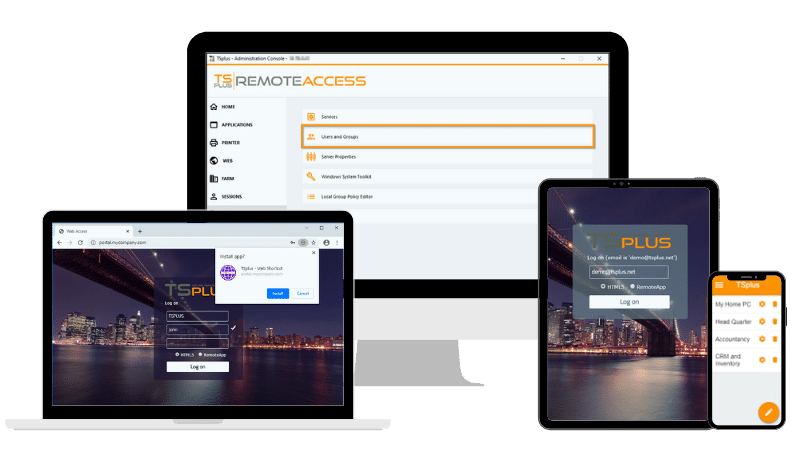
TSplus Remote Access Free Trial
Ultimate Citrix/RDS alternative for desktop/app access. Secure, cost-effective, on-premises/cloud
)
)
)
