





Why Access a Remote Desktop from an iPhone or iPad?
Modern work is mobile. As a freelancer, IT administrator or remote employee, having access to your work PC from your iPhone or iPad is a major productivity booster. But some remote access tools come with hurdles: complex configurations, apps you are loath to install, or user interfaces which refuse to adapt well to small touchscreens. All the opposite, TSplus offers a simple, seamless, HTML5-based Remote Desktop Protocol (RDP) experience directly from your iOS browser.
What Is Browser-Based Remote Desktop Access?
HTML5 remote access is a modern, browser-based solution that allows users to launch and control a full Windows desktop session from virtually any device, including iPhones and iPads, using only a web browser. It replaces traditional remote desktop software with a lightweight, flexible interface which requires no installation or configuration on the client device.
Here is why it is increasingly preferred:
- No apps or plugins required
Everything runs in the browser, no need to install or update separate remote desktop clients. - Cross-browser compatibility
Supports all major browsers such as Safari, Chrome, Firefox and Edge, making it truly platform-independent. - Touchscreen and display optimization
Interfaces are designed to scale with screen size, ensuring that controls and visuals remain usable on both smartphones and tablets. - Global access from any internet-connected location
Whether you're working from home, travelling or on-site at a client’s office, HTML5 access enables secure and instant connectivity to your Windows environment.
This approach removes traditional remote access barriers like software restrictions, installation permissions, and device compatibility. That makes HTML5-based RDP an ideal solution for mobile users, especially those on iOS devices who value speed, simplicity, and security.
How to Access a Windows Remote Desktop from iPhone or iPad?
Remote Desktop Protocol (RDP) allows users to connect to Windows desktops and applications remotely. On iPhones and iPads, two common connection methods are available.
1. Using Windows App
Microsoft Windows App, formerly Microsoft Remote Desktop, is available for iOS and iPadOS. It supports connections to compatible Windows PCs and Remote Desktop Services environments, allowing users to access remote desktops through an installed application.
After configuring the connection, users can navigate their Windows environment using touch gestures, an on-screen keyboard and supported external input devices.
2. Using Browser-Based Remote Desktop Access
Browser-based solutions allow users to open a remote Windows session directly through Safari or another compatible browser. Instead of installing a dedicated RDP client, users authenticate through a web portal that delivers the session to their device.
Solutions such as TSplus Remote Access use an HTML5 web client to provide this functionality. The remote connection is handled by the server-side infrastructure, while the user interacts with the desktop or published applications through the browser.
Both approaches provide remote access to Windows environments. The main differences concern client installation, administration, available features and the way users interact with their remote sessions.
What Are the Benefits of Browser Access on iPhone and iPad?
Using HTML5-based Remote Desktop Protocol (RDP) access on iOS devices provides a range of practical advantages for mobile users needing secure, real-time access to Windows systems:
No App Installation Required
Since HTML5 runs in the browser, there is no more need to download or manage a separate application. This is ideal for shared, restricted or corporate-managed iPhones and iPads.
Cross-Platform Compatibility
HTML5 works seamlessly across major browsers like Safari and Chrome, allowing users to connect from virtually any device without dependency on a particular OS or platform.
Touchscreen Optimization
HTML5 RDP interfaces are often responsive and designed to adapt to small screens, making navigation, input and gestures easier to use on iPhones and iPads compared to legacy remote tools.
Always Up to Date
With browser-based tools, users benefit from the latest security and feature updates without having to manually update a remote access app.
These benefits make HTML5 RDP an ideal method for users who require lightweight, responsive and accessible remote desktop sessions directly from their iOS devices.
RDP has been a critical technology in enterprise computing for over two decades. TSplus builds on that reliability with a mobile-friendly front-end.
How Secure Is Remote Desktop Access on iPhone and iPad?
Accessing a remote desktop from an iPhone or iPad introduces a unique set of security considerations. HTML5-based RDP clients offer several security benefits designed to protect both the user and the host system:
End-to-End Encryption
Most HTML5 remote access implementations use HTTPS (SSL/TLS) encryption to secure data transmitted between the mobile browser and the host system, preventing eavesdropping or interception over public networks.
Firewall Compatibility
Web-based RDP systems often require only a single open port (e.g., 443 for HTTPS), making them easier to secure and monitor compared to legacy VPNs or multi-port configurations.
Strong Authentication
Remote access should require secure login credentials. Ideally combine them with multi-factor authentication (MFA) to prevent unauthorized access, even in the event of passwords being compromised.
No Local Data Storage
Browser-based access can reduce the need for locally installed remote desktop software. However, downloaded files, browser caches and other device-level data may still be stored locally, depending on the solution and configuration.
Session Timeouts and User Controls
Browser sessions can be configured to expire automatically after a period of inactivity, minimizing the risk of unauthorized access if a device is left unattended.
Integration with Authentication Systems
Many HTML5-based platforms support integration with standard identity providers, including Active Directory or SSO tools, allowing enterprises to enforce existing security policies even on mobile access points.
By following these practices, organizations and individuals can leverage the flexibility of HTML5 and RDP on iPhones and iPads without compromising security.
Windows App vs Browser Access: Which Should You Choose?
Microsoft Windows App and browser-based remote desktop solutions both provide access to Windows environments from iPhones and iPads. The better choice depends on how users connect and how IT teams manage their devices.
When Windows App Makes Sense
Windows App is suitable for users who regularly connect to compatible Windows PCs, Remote Desktop Services environments or supported Microsoft cloud desktop services.
Because it is a native application, it provides dedicated remote desktop controls and supports mobile input methods. However, users must install the app and configure their connections.
When Browser Access Makes Sense
Browser access is useful when organizations want to provide remote desktops or Windows applications without installing dedicated software on each mobile device.
Users connect through a web portal, making access particularly convenient for occasional users, shared devices and environments where software installations are restricted.
With TSplus Remote Access, IT teams can centrally publish Windows applications and desktops through a browser-accessible portal.
Native App vs Browser Access: Key Differences
| Criteria | Windows App | Browser Access |
|---|---|---|
| Installation | Mobile app required | No dedicated mobile app required |
| Connection | Configured RDP connection or workspace | Web portal URL |
| Device compatibility | Supported mobile operating systems | Supported web browsers |
| Administration | Client and connection configuration | Centralized web portal configuration |
| User experience | Native remote desktop controls | Browser-based interface |
| Best suited for | Regular users of Microsoft remote environments | Flexible access to published apps and desktops |
Neither approach is automatically more secure. Security depends on authentication, encryption, network configuration, access policies and the infrastructure behind the connection.
How TSplus Remote Access Works on iPhone and iPad
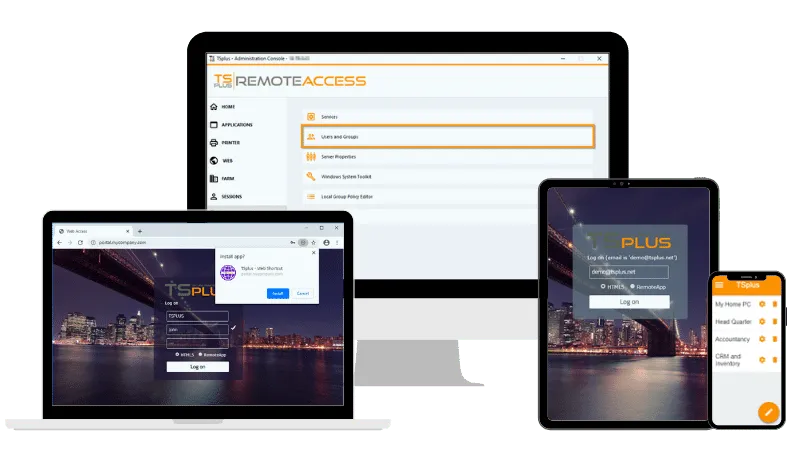
TSplus makes remote desktop access from iPhones and iPads as straightforward as opening a web page. Designed with simplicity and speed in mind, the solution requires no mobile installation and minimal server-side setup.
Here is how the process typically works:
- Install TSplus on your Windows machine (pro PC or server). The installation includes everything needed: the web server, HTML5 RDP gateway and security components.
- Launch the built-in web portal which serves as your access point.
- From your iPhone or iPad, open Safari, Chrome or your preferred browser.
- Navigate to the provided web address, usually in the form of https://yourcompany.tsplus.net.
- Log into the portal using your credentials and begin your session.
Access Windows desktops or applications in real time:
The remote session appears inside your browser window, fully interactive and optimized for touch gestures. Whether you aim to check a report in Excel, access Outlook or run internal applications, everything behaves as though you were sitting in front of your Windows machine.
This browser-based method is especially effective for mobile users needing quick access without having to manage software issues.
Who Benefits from Remote Desktop Access on iPhone and iPad?
TSplus Remote Access is used by a wide variety of professionals and industries requiring reliable desktop access from Apple devices; especially in environments where traditional VPNs or RDP apps fall short.
Common use cases include:
- Remote employees and digital nomads securely access their work PCs from anywhere, be it an airport, hotel or home office.
- IT support staff access internal tools, diagnostics or server infrastructure directly from their phones or tablets when away from their desks.
- Small business owners manage operations on the go without deploying full IT stacks or infrastructure.
- Field technicians or consultants connect to a back-office application while on a client site.
- Corporate teams obtain centralized access for dozens or hundreds of mobile users without managing software on every device.
The flexibility of a browser-based RDP session means that users across roles and technical expertise can all benefit, from solo entrepreneurs to enterprise IT departments.
How to Set Up Browser-Based Remote Desktop Access
One of the standout features of TSplus is its incredibly fast deployment process. It is ideal for businesses needing to scale remote access quickly or individuals preferring minimal configuration.
To start using TSplus with your iPhone or iPad:
- Download the TSplus Remote Access installer from the official website.
- Run the installation on your Windows PC or server. The installer configures the core components, but administrators should verify firewall settings and configure a valid SSL/TLS certificate before enabling external access.
- Set up user access, either using local Windows accounts or integrating with Active Directory for larger deployments.
- Once HTTPS and external access are properly configured, open the TSplus Web Portal from Safari or another compatible browser on your iPhone or iPad
- Login with your credentials to instantly access your desktop, files, or apps.
Once HTTPS and external access are properly configured, open the TSplus Web Portal from Safari or another compatible browser on your iPhone or iPad
Conclusion
Remote desktop access on iPhone and iPad no longer requires a single connection method. Windows App offers a native RDP experience for supported Microsoft environments, while browser-based access eliminates the need to install a dedicated mobile client. For IT teams delivering Windows desktops and applications across different devices, TSplus Remote Access provides a practical browser-based alternative with centralized administration.
TSplus Remote Access Free Trial
Ultimate Citrix/RDS alternative for desktop/app access. Secure, cost-effective, on-premises/cloud


