








)
)
Citrix DaaS remains one of the most capable desktop and application delivery platforms on the market. Yet many organisations evaluating renewals, cloud migrations or cost-reduction initiatives are asking whether they still need the complexity, licensing model and operational overhead associated with a full Citrix DaaS deployment.
This guide compares the best Citrix DaaS alternatives for different deployment models and business requirements. Rather than focusing solely on feature parity, we examine total cost of ownership (TCO), cloud dependence, administrative complexity and real-world application delivery needs.
What Is DaaS?
Desktop as a Service (DaaS) is a cloud-hosted model for delivering virtual desktops and applications to users over the internet.
Cloud-based services
Instead of managing desktop infrastructure on-premises, organisations consume desktop environments as a service from cloud providers or specialised vendors. DaaS can simplify remote work, improve scalability and centralise management.
Inherent costs
However, DaaS also introduces recurring cloud costs, consumption-based billing and dependency on external infrastructure providers.
For a deeper explanation, see our guide to Desktop as a Service and how DaaS platforms work .
Why Are Organizations Looking Beyond Citrix DaaS?
Citrix DaaS was designed to deliver enterprise-grade virtual desktops and applications across hybrid and multi-cloud environments. For large enterprises with complex requirements, it remains a powerful solution.
However, many IT teams are discovering that their actual needs are far narrower than the platform's capabilities.
Common drivers behind Citrix DaaS replacement projects include:
- Rising subscription and licensing costs
- Additional Azure or AWS infrastructure expenses
- Complex deployment and administration requirements
- Dependence on specialized Citrix expertise
- Long implementation timelines
- Overprovisioned environments supporting simple application delivery needs
For many organizations, the key question is no longer "Which platform matches Citrix feature for feature?" but rather "What is the simplest and most cost-effective way to deliver applications and desktops to users?"
Citrix DaaS, Citrix Virtual Apps and Desktops, Citrix Workspace, …
Before evaluating alternatives, it helps to clarify Citrix's product terminology.
|
Software |
Primary Purpose |
Typical Use Case |
|
Citrix DaaS |
Cloud-managed desktop and application delivery |
Hybrid and cloud-hosted VDI environments |
|
Citrix Virtual Apps and Desktops |
Application and desktop virtualization platform |
Enterprise virtual application delivery |
|
Citrix Workspace |
Unified user access portal |
Access layer aggregating applications and desktops |
In practice, many organizations use Citrix DaaS primarily to publish applications rather than provide full virtual desktops. This distinction becomes important when evaluating alternatives because application publishing often requires far less infrastructure than a complete DaaS deployment.
Quick Comparison of the Best Citrix DaaS Alternatives
|
Solution |
Best For |
Cloud Required |
Application Publishing |
Full Desktop Delivery |
SMB Fit |
|
TSplus Remote Access |
SMBs, application delivery |
No |
Excellent |
Optional |
Excellent |
|
Azure Virtual Desktop |
Microsoft-first organizations |
Yes |
Excellent |
Excellent |
Good |
|
Windows 365 |
Simplified cloud desktops |
Yes |
Limited |
Excellent |
Good |
|
Parallels RAS |
SMB and mid-market VDI |
Optional |
Excellent |
Excellent |
Very Good |
|
Omnissa Horizon Cloud |
Enterprise VDI |
Usually |
Excellent |
Excellent |
Moderate |
|
Amazon AppStream 2.0 |
Application streaming |
Yes |
Excellent |
Limited |
Good |
|
Inuvika OVD Enterprise |
Application publishing |
Optional |
Excellent |
Limited |
Good |
|
Dizzion Frame |
Cloud-native DaaS |
Yes |
Good |
Excellent |
Moderate |
Now, time to look at our alternatives to Citrix DaaS by deployment model:
TSplus Remote Access
)
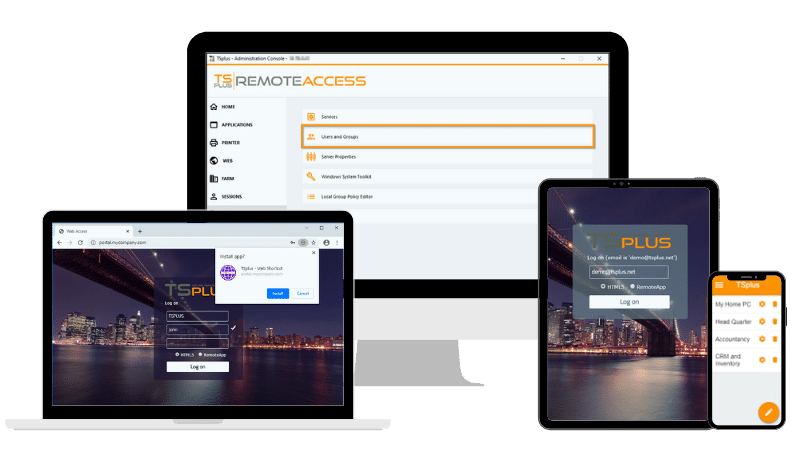
TSplus Remote Access takes a fundamentally different approach from Citrix DaaS.
Rather than replicating a full enterprise DaaS stack, TSplus focuses on secure application delivery, remote desktop access and web-based access to Windows applications. For many SMBs and mid-sized organisations, this approach eliminates the need for expensive VDI infrastructure altogether.
Organizations often discover that they are using Citrix primarily to publish ERP systems, accounting software, healthcare applications, manufacturing systems or other line-of-business applications. In such cases, a full DaaS platform may be unnecessary.
Pros
- Low acquisition and operational costs
- Rapid deployment
- Minimal training requirements
- Browser-based access via HTML5
- Works with existing Windows infrastructure
- Strong fit for MSP-hosted environments
- Excellent technical support and onboarding
Cons
- Not intended for VDI projects
- Fewer advanced enterprise virtualization features
- Smaller ecosystem than Citrix
When Does TSplus Remote Access Make the Most Sense?
TSplus is often the best choice when organizations need:
- Application publishing rather than full VDI
- Reduced cloud dependency
- Lower licensing costs
- Faster implementation
- Simpler administration
Need secure, affordable application publishing without Citrix complexity Start a free TSplus trial today.
Azure Virtual Desktop
)
Azure Virtual Desktop (AVD) has become one of the most common Citrix DaaS replacement options.
Built directly into the Microsoft Azure ecosystem, AVD appeals to organisations already invested in Microsoft 365, Entra ID and Azure infrastructure.
Pros
- Native Microsoft integration
- Flexible scaling
- Strong security controls
- Multi-session Windows support
Cons
- Azure cost management can be challenging
- Requires cloud expertise
- Operational complexity remains significant
Best For
Organizations already committed to Microsoft Azure and comfortable managing cloud infrastructure.
Windows 365
)
Windows 365 simplifies desktop delivery by providing dedicated Cloud PCs.
Compared with Azure Virtual Desktop, Windows 365 prioritises simplicity over flexibility.
Pros
- Predictable monthly pricing
- Easy deployment
- Familiar management experience
- Strong Microsoft integration
Cons
- Less flexible than AVD
- Can become expensive at scale
- Limited application publishing capabilities
Best For
Organizations seeking simple cloud desktop delivery with minimal infrastructure management.
Parallels RAS
)
Parallels RAS has long positioned itself as a simpler alternative to Citrix.
It offers application publishing, desktop delivery and multi-cloud integration while maintaining a lower administrative burden than traditional Citrix deployments.
Pros
- Easier administration than Citrix
- Strong application publishing capabilities
- Azure integration
- Good fit for SMBs and mid-market
Cons
- Smaller ecosystem than Citrix
- Less extensive enterprise feature set
Best For
Organizations seeking a familiar virtual application delivery platform without the complexity of Citrix.
Omnissa Horizon Cloud
)
Formerly VMware Horizon Cloud, Omnissa Horizon Cloud remains one of the leading enterprise VDI solutions.
Pros
- Mature enterprise capabilities
- Strong virtualization features
- Excellent scalability
- Hybrid deployment options
Cons
- Significant complexity
- Higher operational requirements
- Enterprise-focused pricing
Best For
Large organizations requiring advanced VDI functionality and extensive virtualization capabilities.
Amazon AppStream 2.0
)
Amazon AppStream 2.0 focuses on application streaming rather than traditional desktop virtualisation.
Pros
- Fully managed AWS service
- Elastic scalability
- Strong application streaming capabilities
Cons
- AWS dependency
- Application-focused rather than desktop-focused
- Requires AWS expertise
Best For
ISVs and organisations delivering applications through AWS infrastructure.
Inuvika OVD Enterprise
Inuvika OVD Enterprise focuses on application delivery using a streamlined architecture.
Pros
- Lower infrastructure requirements
- Linux and Windows support
- Strong application publishing
Cons
- Smaller market presence
- Fewer enterprise integrations
Best For
Organizations seeking cost-effective application publishing with reduced infrastructure complexity.
Dizzion Frame
Dizzion Frame is a cloud-native desktop virtualisation platform designed around simplicity and rapid deployment.
Pros
- Cloud-native architecture
- Fast deployment
- Multi-cloud support
Cons
- Reliance on cloud infrastructure
- Less suitable for highly customised environments
Best For
Organizations seeking cloud-first desktop delivery.
When Is a Full DaaS Platform Overkill?
This is often the most important question in a Citrix replacement project.
Many organizations initially assume they need another DaaS platform because they currently use Citrix DaaS. However, closer analysis frequently reveals that users access only a handful of applications.
A full DaaS environment may be excessive when:
- Users primarily need access to specific applications
- Existing Windows Server infrastructure already exists
- IT staffing is limited
- Cloud spending is under scrutiny
- Desktop virtualization is not a strategic requirement
- Less than 500 users require remote access
- Self-hosting, server security and data control are high on the agenda
In these situations, application publishing solutions such as TSplus Remote Access can deliver equivalent business outcomes with substantially lower cost and complexity.
Citrix DaaS Migration Checklist
Before selecting an alternative, organizations should evaluate their current environment carefully.
Current Workloads Inventory
Identify whether users consume full desktops or individual applications.
Map Application Requirements
Determine which applications actually require virtualization and which can be delivered through simpler publishing models.
Calculate Total Cloud Costs
Review Azure, AWS, storage, networking and licensing expenses.
Review Security Dependencies
Evaluate identity providers, MFA, compliance requirements and access controls.
Run Pilot Deployments
Test candidate platforms with representative user groups before committing to migration.
Comparing Total Cost of Ownership
The most meaningful comparison often extends beyond licensing.
|
Cost Factor |
Citrix DaaS |
TSplus Remote Access |
Azure Virtual Desktop |
Horizon Cloud |
|
Licensing Complexity |
High |
Low |
Moderate |
High |
|
Cloud Dependency |
High |
Low |
High |
Moderate |
|
Administrative Overhead |
High |
Low |
Moderate |
High |
|
Training Requirements |
High |
Low |
Moderate |
High |
|
Time to Deploy |
Moderate |
Fast |
Moderate |
Slow |
|
SMB Suitability |
Moderate |
Excellent |
Good |
Limited |
Organizations evaluating TCO should consider not only software costs but also implementation time, administration effort, training requirements and long-term cloud consumption.
Which Citrix DaaS alternative should you choose?
The answer depends primarily on your deployment model.
Choose TSplus Remote Access if:
- You need application publishing rather than full VDI.
- You want lower costs and simpler administration
- You prefer leveraging existing Windows infrastructure.
- You want rapid deployment and minimal training
Choose Azure Virtual Desktop if:
- Azure is already your strategic platform
- You still need flexible cloud-hosted desktops
Choose Windows 365 if:
- Simplicity is more important than customisation
- You prefer predictable cloud desktop pricing
Choose Parallels RAS if:
- You want Citrix-like capabilities with lower complexity
Choose Omnissa Horizon Cloud if:
- Enterprise VDI remains a core requirement
Choose Amazon AppStream 2.0 if:
- Application streaming is your primary objective
Choose Inuvika OVD Enterprise if:
- You need efficient application publishing with reduced infrastructure requirements.
Choose Dizzion Frame if:
- Cloud-native desktop delivery is your priority
Conclusion
Ultimately, many organizations replacing Citrix DaaS discover they do not need another DaaS platform at all. If the primary objective is secure application delivery, remote access and lower operational overhead , solutions such as TSplus Remote Access can provide a more practical path forward.
TSplus Remote Access Free Trial
Ultimate Citrix/RDS alternative for desktop/app access. Secure, cost-effective, on-premises/cloud
)
)
)
