





)
)
What Is a Remote Work Tool?
A remote desktop is a technology that allows a user to access and control a computer or server from another device over a network, as if they were physically present at that machine.
The user’s keyboard and mouse inputs are sent to the remote system, while the screen output is streamed back in real time, so applications run entirely on the host machine and data remains centralised.
From an IT perspective, remote desktop solutions are primarily about centralised execution and controlled access, rather than collaboration or file sharing. Not all remote desktop implementations are the same: some are designed for single-user access, while others support multi-user environments and application-level publishing.
Why Do Businesses Need Remote Work Tools?
Accounting firms use remote desktop solutions to support secure access to financial systems while maintaining control over sensitive data and regulated workflows. The drivers are often operational and compliance-related rather than convenience-focused.
Remote desktop solutions allow accounting businesses to:
- Provide staff with full access to accounting software without installing it on personal devices.
- Centralise financial data to simplify backup, audit, and regulatory compliance
- Support hybrid work, client-site work, and seasonal staffing without duplicating infrastructure
- Maintain consistent software versions and configurations across offices and users
Without a proper remote desktop setup, firms often fall back on unmanaged local installs, ad-hoc VPN usage , and manual file transfers, increasing both security risk and administrative overhead.
What to Look for When Choosing a Remote Work Tool?
When evaluating a remote desktop solution for accounting use, firms should look beyond basic connectivity. Security, operational control, and licensing flexibility are just as important as performance.
Key evaluation criteria include:
- Security and compliance : encrypted sessions multi-factor authentication, centralized logging, and hardened access paths
- Deployment control ability to host systems on-premises or in a controlled cloud environment to meet data residency requirements
- Performance and usability reliable experience over home connections, multi-monitor support, and stable printing and PDF workflows
- Multi-user capability support for concurrent users on shared servers and application publishing rather than full desktops only
- Licensing flexibility models that align with seasonal workloads and shared usage instead of fixed per-device licensing
A remote desktop solution should integrate cleanly into existing accounting IT environments, supporting established workflows rather than forcing firms to redesign how their teams work.
The Top 10 Remote Tools in 2026
TSplus Remote Access
)
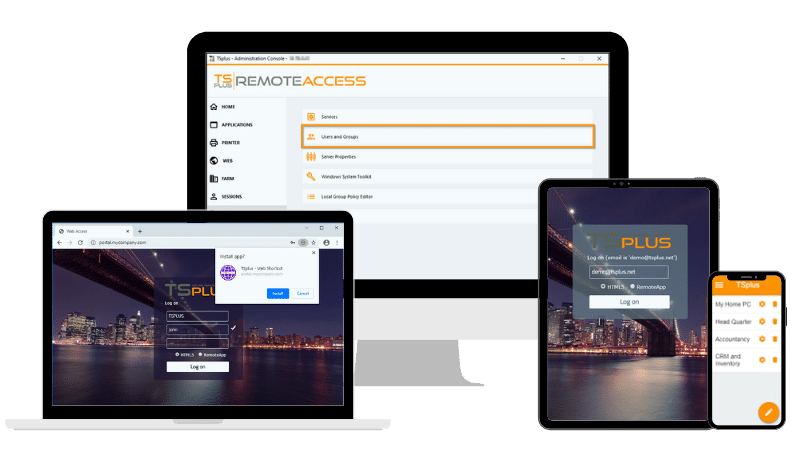
TSplus Remote Access, The Practical RDS Alternative for SMB App Publishing
TSplus Remote Access streamlines application publishing and browser-based access on top of familiar RDP. Administrators value fast setup, simple policies, and predictable operating costs. HTML5 access reduces client management while keeping user workflows consistent. Perpetual or subscription licensing allows finance teams to align spend with planning cycles. Small IT teams can move from pilot to production quickly with minimal overhead.
Pros
- Straightforward installation and administration that keep Windows Server maintenance predictable.
- HTML5 Web App enables secure access from managed and lightly managed devices.
- Perpetual or subscription licensing to align spending with budget preferences.
- Reverse proxy, file transfer, and RemoteApp-style sessions cover common SMB needs.
- Purposeful feature set that avoids the cost and sprawl of heavyweight VDI.
Cons
- The depth of edition features varies; upfront tier selection is important.
- Windows-centric architecture prioritises Windows apps over broad desktop virtualization .
- As with any RDS-based stack, hardening and ongoing patch hygiene remain essential.
- Highly specialized VDI workflows may require complementary tools.
Pricing
- Perpetual and subscription plans tailored to SMBs, with optional security and management add-ons.
- Transparent tiers scale economically as user counts and requirements grow.
Reviews/Ratings
- Customers highlight simplicity, stability, and fast deployments with minimal disruption.
- Ratings are strong for ease of use and administration, especially for browser access.
- Value versus large VDI suites is frequently cited for application-centric workloads.
Microsoft Teams
)
Microsoft Teams, The Unified Communication Solution Inside The Microsoft 365 Ecosystem
Microsoft Teams centralises chat, meetings, and document collaboration within Microsoft 365. IT teams benefit from native identity integration and compliance tooling, while users gain a single interface for daily communication. Teams works best when paired with Microsoft-native workflows and directory services. However, operational complexity increases as tenant size and feature usage expand.
Pros
- Native integration with Microsoft 365 identity, email, and document services.
- Broad feature set covering chat, video meetings, and collaboration.
- Enterprise-grade compliance, retention, and auditing capabilities.
- Familiar interface for organizations already using Microsoft tools.
Cons
- Administrative complexity grows quickly in large or multi-tenant environments.
- Performance and reliability depend on tenant configuration and network quality.
- Feature overlap with other tools can increase licensing and governance complexity.
- Less effective outside Microsoft-centric environments.
Pricing
- Included in most Microsoft 365 business and enterprise plans.
- Overall cost depends on licensing tier and bundled services beyond Teams itself.
Reviews/Ratings
- Widely adopted and generally well rated for functionality.
- Administrators frequently cite complexity and licensing opacity as drawbacks.
- End-user satisfaction is strong in Microsoft-standardised organisations.
Slack
)
Slack, the channel-based messaging solution for fast-moving teams
Slack is designed for real-time, channel-based communication with a strong focus on usability. Teams adopt Slack quickly due to its intuitive interface and extensive integration ecosystem. From an IT perspective, Slack excels at communication but offers limited native governance compared to enterprise suites. Costs can escalate as usage and compliance requirements grow.
Pros
- Intuitive user experience with minimal onboarding effort.
- Large ecosystem of third-party integrations and APIs.
- Strong support for asynchronous communication .
- Flexible workspace structure for team-based collaboration.
Cons
- Limited native compliance and data governance features.
- Costs scale rapidly with user count and feature requirements.
- Message sprawl can reduce signal-to-noise without strict usage policies.
- Relies on external tools for document management and access control.
Pricing
- Per-user, per-month SaaS subscription.
- Advanced security, compliance, and admin features require higher-tier plans.
Reviews/Ratings
- Highly rated for usability and team adoption.
- IT teams often flag governance and long-term cost as concerns.
- Popular with product, engineering, and startup environments.
Zoom
)
Zoom, The Reliable Video Conferencing Solution for Distributed Workforces
Zoom focuses on video meetings and webinars with an emphasis on reliability and ease of use. Its low barrier to entry makes it accessible across devices and locations. While Zoom excels at meetings, it does not attempt to replace broader collaboration or productivity platforms. Security outcomes depend heavily on configuration discipline.
Pros
- Consistent audio and video quality across networks.
- Simple deployment with minimal client configuration.
- Scales well for large meetings and webinars.
- Broad device and platform compatibility.
Cons
- Limited functionality beyond video communication.
- Security features require deliberate configuration to be effective.
- Fragmentation risk when combined with multiple collaboration tools.
- Not designed for application or desktop access.
Pricing
- Free tier available with meeting limits.
- Paid plans licensed per host, with add-ons for webinars and large events.
Reviews/Ratings
- Strong ratings for reliability and ease of use.
- Mixed feedback on security perception and feature sprawl.
- Frequently used as a standalone meeting tool rather than a platform.
Google Workspace
)
Google Workspace, The Cloud-Native Productivity Solution for Distributed Teams
Google Workspace provides cloud-based email, document creation, and collaboration tools built around real-time editing. IT teams benefit from simplified administration and minimal endpoint requirements. The platform works best for organisations that rely primarily on browser-based workflows rather than traditional desktop applications.
Pros
- Real-time collaboration across documents and spreadsheets.
- Minimal client-side management requirements.
- Straightforward administration for small and mid-sized teams.
- Strong availability and global accessibility.
Cons
- Limited support for legacy desktop applications.
- Offline functionality is restricted.
- Less granular control compared to traditional enterprise stacks.
- Dependency on continuous internet access.
Pricing
- Per-user, per-month subscription with tiered plans.
- Higher tiers add storage, security, and administrative features.
Reviews/Ratings
- Well regarded for collaboration and simplicity.
- IT feedback notes limitations for complex or regulated environments.
- Popular with cloud-first and distributed organisations.
Notion
)
Notion, The Flexible Knowledge Management Solution for Remote Teams
Notion combines documentation, internal wikis, and lightweight project tracking in a single workspace. Teams use it to centralise knowledge and reduce tool sprawl. While flexible and popular with users, Notion provides limited governance controls from an IT standpoint.
Pros
- Highly flexible content and workspace structure.
- Reduces dependency on multiple documentation tools.
- Strong user adoption for internal knowledge sharing.
- Supports asynchronous collaboration.
Cons
- Limited permission granularity and audit controls.
- Not designed for regulated or security-sensitive environments.
- Performance can degrade with very large workspaces.
- Not a system of record for operational data.
Pricing
- Per-user SaaS subscription with free and paid tiers.
- Advanced admin and security features require higher plans.
Reviews/Ratings
- Strong user satisfaction for flexibility and usability.
- IT teams express concerns about governance and control.
- Commonly used alongside, not instead of, core systems.
Asana
)
Asana, The Visual Task and Project Coordination Solution for Teams
Asana focuses on task tracking and project visibility across teams. Its visual approach makes it accessible to non-technical users while still supporting structured workflows. Asana is primarily an organisational tool rather than an IT control platform.
Pros
- Clear task ownership and accountability.
- Visual timelines and project views.
- Easy onboarding for non-technical users.
- Improves transparency across teams.
Cons
- Limited support for technical or IT service workflows.
- Reporting depth varies by pricing tier.
- Not designed for secure access or system integration.
- Can overlap with other project tools.
Pricing
- Per-user, per-month subscription model.
- Advanced reporting and automation available in higher tiers.
Reviews/Ratings
- Generally, well rated for usability and clarity.
- Some criticism around pricing and reporting limitations.
- Popular with operations and project management teams.
Jira
)
Jira, The Structured Workflow Management for IT and Development
Jira is designed for structured issue tracking, agile development, and IT service management. It offers deep customisation and control, making it a powerful but complex tool. Jira is best suited for technical teams with defined processes.
Pros
- Highly customizable workflows and issue types.
- Strong permission and role management.
- Scales well for large IT and development teams.
- Integrates with a wide ecosystem of tools.
Cons
- Steep learning curve for new users.
- Administrative overhead can be significant.
- Overkill for non-technical teams.
- Requires governance to avoid workflow sprawl.
Pricing
- Per-user, per-month pricing with tiered plans.
- Costs increase with user count and advanced features.
Reviews/Ratings
- Strong ratings among IT and development professionals.
- Frequently criticized for complexity and administration effort.
- Considered a standard tool in technical environments.
GitHub
)
GitHub, The Distributed Version Control for Remote Development
GitHub provides version control, collaboration, and automation for distributed software development. It is a foundational tool for remote engineering teams but is not intended for general workforce collaboration.
Pros
- Industry-standard version control platform.
- Strong support for code review and collaboration.
- Integrated automation and security tooling.
- Scales effectively for distributed teams.
Cons
- Developer-centric by design.
- Not suitable for non-technical collaboration.
- Requires complementary tools for project management.
- Learning curve for non-developers.
Pricing
- Free tier available.
- Paid plans licensed per user for private repositories and advanced security.
Reviews/Ratings
- Highly rated within the developer community.
- Considered essential infrastructure for remote software teams.
- Strong reputation for reliability and ecosystem support.
Dropbox
)
Dropbox, The Simple File Sharing Solution Across Locations
Dropbox focuses on file synchronisation and sharing with an emphasis on simplicity. It is often used to enable file exchange between remote users and external partners. From an IT perspective, Dropbox offers limited governance compared to full productivity suites.
Pros
- Simple and intuitive user experience.
- Cross-platform support across devices.
- Reliable file synchronization.
- Easy external sharing.
Cons
- Limited compliance and governance controls.
- Overlaps with other productivity platforms.
- Not designed for application or desktop access.
- Requires policy controls to prevent data sprawl.
Pricing
- Per-user, per-month subscription.
- Business plans add storage and basic admin controls.
Reviews/Ratings
- Generally positive feedback for ease of use.
- Mixed reviews regarding enterprise control and cost
How Do These Solutions Compare?
| Tool | Core Function | Security & IT Control | Best Fit |
|---|---|---|---|
| TSplus Remote Access | Secure app & desktop access | High | SMBs, MSPs |
| Microsoft Teams | Communication | Medium | Microsoft environments |
| Slack | Messaging | Medium | Agile teams |
| Zoom | Video conferencing | Low–Medium | Meetings |
| Google Workspace | Productivity | Medium | Cloud-first SMBs |
| Notion | Knowledge management | Low | Distributed teams |
| Asana | Task management | Low | Project coordination |
| Jira | IT & agile workflows | High | Dev & IT teams |
| GitHub | Code collaboration | High | Developers |
| Dropbox | File sharing | Low | External collaboration |
Conclusion
Remote work tools serve different purposes within an organization, and no single solution can address every requirement. Successful businesses build a balanced stack that combines secure access, collaboration, and productivity, with secure remote access forming the foundation. For IT teams, solutions like TSplus Remote Access address the core challenge of remote work by delivering controlled access to applications without unnecessary complexity.
Frequently Asked Questions
What is the most important remote work tool for businesses?
Secure remote access tools are the foundation of any remote work strategy, as they control how users reach business applications and data. Without secure access, productivity tools and collaboration platforms cannot operate safely or reliably.
Are collaboration tools enough to support remote work?
No. Collaboration tools improve communication but do not replace secure access to applications, desktops, or internal systems. Businesses still need controlled access solutions to ensure security and continuity.
Do all businesses need VDI for remote work?
Not necessarily. While VDI is useful in some environments, application publishing often meets business needs with lower cost, reduced complexity, and easier administration, especially for small and mid-sized organisations.
How can SMBs secure remote work without using VPNs?
SMBs can use controlled remote access solutions that publish applications or desktops without exposing the internal network. This approach reduces the attack surface while simplifying deployment and user access.
Can a single remote work tool cover all business needs?
In most cases, no. Successful remote work environments rely on a combination of tools, including secure access, collaboration, and management solutions, rather than a single all-in-one platform.
TSplus Remote Access Free Trial
Ultimate Citrix/RDS alternative for desktop/app access. Secure, cost-effective, on-premises/cloud
)
)
)
