





)
)
Healthcare organisations increasingly rely on remote access to support clinical workflows, telehealth, and distributed IT operations. At the same time, healthcare data remains one of the most targeted assets for cybercriminals, making remote access a high-risk but unavoidable requirement.
This article helps healthcare IT managers, sysadmins and MSPs evaluate the best remote access solutions for healthcare software , with a focus on HIPAA and global compliance , real-world security threats and operational practicality.
Comparison Table: Remote Access Solutions for Healthcare Software
As a sneak preview of where we are heading, here is a comparison table summarising the benefits for healthcare infrastructures of the product described later.
| Solution / Relevance | TSplus Remote Access | Citrix Virtual Apps & Desktops | Azure Virtual Desktop | Parallels RAS | Splashtop |
|---|---|---|---|---|---|
| HIPAA Alignment | Yes (configuration-dependent) | Yes | Yes | Yes (configuration-dependent) | Use-case dependent |
| GDPR / PIPEDA Alignment | Yes | Yes | Yes | Yes | Limited |
| Designed for Centralized Clinical Apps | Yes | Yes | Yes | Yes | No |
| BYOD Risk Mitigation | High (server-based execution) | High | High | High | Low |
| Deployment Options | On-premises, Cloud, Hybrid | On-premises, Cloud, Hybrid | Cloud (Azure only) | On-premises, Cloud, Hybrid | Cloud-mediated |
| Operational Complexity | Low | High | Medium–High | Medium | Low |
| Best Fit for SMB Healthcare | Yes | Rarely | Sometimes | Sometimes | Limited |
Why Is Remote Access a High-Risk Healthcare Decision?
Remote Access in Modern Healthcare Workflows
Remote access is no longer limited to occasional IT troubleshooting. Clinicians use remote access to reach Electronic Health Record systems, radiology and imaging platforms, laboratory applications and telehealth tools. In parallel, administrative staff rely on the same mechanisms for billing, scheduling and insurance workflows.
In most environments, these applications were not designed for cloud-native delivery. Securely extending access to them without increasing the attack surface is one of the defining challenges of modern healthcare IT.
The Healthcare Threat Landscape
Healthcare organisations are prime ransomware targets because of their operational urgency and data sensitivity. Exposed RDP services, poorly secured VPNs and unmanaged endpoints remain common entry points for attackers. Beyond actual data-privacy breaches or operational standstill, a single compromised account can result in lateral movement across clinical systems. In turn, these compromised systems trigger regulatory audit failures, fines and reputational damage.
Remote access decisions therefore sit at the intersection of security architecture, compliance and operational continuity .
Healthcare-Specific Selection Criteria for Remote Access Solutions
Compliance First: Healthcare Data Protection Obligations
Healthcare remote access cannot be evaluated using generic “remote work” criteria. Regulations, such as HIPAA (Health Insurance Portability and Accountability Act) in the United States, GDPR (General Data Protection Regulation) in Europe or PIPEDA (Personal Information Protection and Electronic Documents Act) in Canada, impose explicit expectations around access control, auditability and data confidentiality.
A remote access solution does not become compliant by default. Compliance depends on how authentication, session handling, encryption and logging are implemented and enforced in practice.
Security Architecture Requirements
Healthcare-ready remote access platforms share several architectural characteristics. Sessions must be encrypted end-to-end using modern TLS. Authentication must be identity-based and support multi-factor authentication. User access must follow least-privilege principles, with session isolation to prevent data leakage .
Equally important is reducing network exposure. Publishing applications or desktops through controlled gateways is fundamentally safer than exposing entire internal networks to remote endpoints.
Operational Requirements for Healthcare IT Teams
Healthcare IT teams often manage legacy clinical applications incompatible with browser-only or SaaS-only delivery models. A viable solution must support Windows-based applications without forcing costly rewrites or migrations.
Ease of deployment, centralised administration, predictable licensing and the ability to operate on-premises, in the cloud or in hybrid environments are critical factors, especially for resource-constrained teams.
HIPAA and Global Healthcare Compliance: What Must Remote Access Deliver?
HIPAA (United States): Technical Expectations
HIPAA does not certify software products. Instead, it defines security safeguards which healthcare organizations must implement. For remote access, this translates into controlled access mechanisms, strong user authentication, encrypted transmission of electronic protected health information, and detailed audit logs.
Remote access sessions must be traceable to individual users, and organizations must be able to demonstrate who accessed which systems and when.
GDPR, UK GDPR (Europe), PIPEDA (Canada) and other international equivalents
Outside the US, regulations such as GDPR and PIPEDA classify health data as highly sensitive. They emphasize accountability, data minimisation and breach notification. Remote access platforms must therefore support granular access control, logging and rapid incident investigation.
While terminology differs, the technical expectations converge with HIPAA in practice.
Common Technical Denominators Across Regulations
Across jurisdictions, compliant remote access solutions share common traits. Multi-factor authentication (MFA) is expected. Encryption in transit is mandatory. User-level accountability and centralised logging are essential for audits and forensic analysis.
This convergence allows healthcare IT teams to evaluate solutions against a shared technical baseline rather than jurisdiction-specific checklists.
Remote Desktop, VDI or Secure Access Platform? Understanding the Models
Remote Desktop and Application Publishing
Remote desktop and application publishing solutions centralise execution on servers while transmitting only screen updates, keyboard input and mouse activity. The model hence minimises data exposure on endpoints and works well with legacy healthcare applications.
When secured with gateways, MFA and session controls, RDP-based access can meet stringent healthcare requirements.
VDI and Cloud Desktop Platforms
VDI and cloud desktop platforms deliver full virtual desktops to end users. They offer flexibility and scalability but introduce heavier infrastructure complexity and cost. For many healthcare organisations, VDI is therefore operationally excessive for the core requirement of secure application access.
Remote Support Tools vs Healthcare Access Platforms
Remote support tools are designed for ad-hoc assistance, not sustained clinical workflows They often rely on agent-based access to endpoints and, though they serve the stack in an irreplaceable way, they alone would not provide a regulated healthcare environment. Indeed, though essential for certain tasks, remote assistance software rarely includes the same strong requirements as a well secured remote access solution: centralized control, audit depth and architectural isolation potential.
Best Remote Access Solutions for Healthcare Software
TSplus Remote Access – For Secure On-premises, Cloud and Hybrid Connections
)
TSplus Remote Access is a server-based remote desktop and application publishing platform built on Microsoft RDP. It is designed to provide secure access to Windows applications without the complexity of full VDI stacks but with great versatility.
)
Pros
- Secure-by-design RDP architecture with gateway patterns and optional Advanced Security and Server Monitoring
- Supports MFA (TSplus add-on or your own) and features device and time locking
- Features TLS encryption, IP filtering and granular session controls
- Web-enables legacy healthcare and clinical software
- Predictable licensing and lower total cost of ownership
Cons
- Windows-centric by design (though HTML5 frees that restraint)
- Does require proper configuration to meet compliance goals (full up-to-date guides online, live support available)
Healthcare fit: When to choose TSplus
Highly affordable, TSplus is well suited for healthcare organisations needing secure, compliant access to clinical and administrative software without deploying heavy VDI infrastructure.
Citrix Virtual Apps and Desktops – For All-encompassing Enterprise-grade Capability
)
Citrix Virtual Apps and Desktops is a long-standing enterprise platform for application and desktop virtualisation, commonly used in large healthcare systems.
Pros
- Mature enterprise feature set
- Extensive policy and security controls
- Proven at large scale
Cons
- High licensing and operational costs
- Significant infrastructure and skills requirements
- Often excessive for SMB healthcare needs
Healthcare fit
Best suited for large hospital networks with dedicated virtualisation teams and potential to retrain staff via external intervention.
Azure Virtual Desktop – For Cloud-hosted desktops and apps
)
Microsoft Azure Virtual Desktop delivers cloud-hosted desktops and applications on Microsoft Azure, with tight integration into the Microsoft ecosystem.
Pros
- Native Azure integration
- Scales well for distributed organizations
- Familiar identity and security tooling
Cons
- Ongoing cloud consumption costs
- Requires strong Azure expertise
- Data residency considerations
Healthcare fit
Appropriate for cloud-first healthcare organizations with established Azure operations.
Parallels RAS - For Simplified Application Publishing
)
Parallels RAS provides application and desktop publishing with a focus on simplified administration compared to traditional VDI.
Pros
- Easier to manage than enterprise VDI
- Supports hybrid deployments
- Competitive feature set
Cons
- Licensing costs higher than lightweight RDP solutions
- Still more complex than gateway-based access
Healthcare fit
A middle-ground option for mid-sized healthcare organisations.
Splashtop – For fast remote access and support
)
Splashtop positions its solution explicitly for healthcare use cases, focusing on secure remote access to endpoints.
Pros
- Easy to deploy
- Familiar remote access experience
- Healthcare-focused messaging
Cons
- Endpoint-centric model increases device exposure
- Less suitable for centralised application delivery
- Limited architectural isolation
Healthcare fit
Splashtop is useful for remote support and limited access scenarios rather than core clinical workflows.
Mapping Security Features to Healthcare Compliance Requirements
MFA, Identity Control and Access Policies
Healthcare remote access must integrate MFA to mitigate credential theft. Role-based access ensures clinicians, administrative staff and vendors only reach the systems they require.
Encryption, Session Security and Network Exposure
Encrypted sessions protect data in transit, while gateway-based architectures reduce the need to expose internal networks. Session isolation limits the blast radius of compromised accounts.
Audit Logs, Session Recording and Monitoring
Centralized logging and optional session recording support compliance audits and incident response. These capabilities are essential for demonstrating regulatory adherence.
Feature Provision of Our Top Software Pick
Bearing in mind that encryption in transit (TLS) and multi-factor authentication (MFA) are features of all the selected solutions, here is a set of compared features for each explored product of our list:
| Solution / Feature | TSplus Remote Access | Citrix Virtual Apps & Desktops | Azure Virtual Desktop | Parallels RAS | Splashtop |
|---|---|---|---|---|---|
| Primary Delivery Model | Remote Desktop & Application Publishing (RDP, Web-App, HTML5) | Enterprise VDI / App Virtualization | Cloud VDI / App Delivery | App Publishing & VDI | Endpoint Remote Access |
| Typical Healthcare Use Case | Secure access to EHRs and admin apps | Large hospital systems | Cloud-first healthcare IT | Mid-sized healthcare organisations | Remote clinician or IT access |
| Session Isolation | Yes | Yes | Yes | Yes | No |
| Centralized Audit Logs | Yes | Yes | Yes | Yes | Limited |
| Session Recording / Monitoring | Optional | Yes | Yes | Limited | No |
| Gateway-Based Access (Reduced Network Exposure) | Yes | Yes | Yes | Yes | No |
| Licensing / Cost Predictability | Transparent | Low | Medium | Medium | Medium |
BYOD, Confidentiality and Healthcare Remote Access
What Are Some Main Risks of BYOD in Clinical Environments?
Personal devices introduce variability in security posture. Lost or compromised endpoints can become vectors for data leakage. Additionally, theft of an external device can provide malevolent actors with an inroad if unprotected.
How Does Secure Remote Access Reduce Endpoint Risk?
Server-based remote access keeps data within controlled environments. Endpoints act as terminals rather than data stores, reducing exposure even in BYOD scenarios Moreover, certain software features the ability to lock user credentials to devices as well as other protection such as MFA and time constraints, further reducing the attack surface.
Cloud, On-Premises or Hybrid: Deployment Models in Healthcare
Cloud Benefits and Compliance Trade-offs
Cloud deployments offer scalability but require careful consideration of data residency and shared responsibility models. Indeed, maintaining high security standards without compromising on convenience can be a difficult balancing feat.
On-Premises Control and Data Residency
On-premises deployments provide maximum control and are often preferred by compliance-focused healthcare organisations.
Hybrid Models for Regulated Environments
Hybrid architectures combine centralized control with selective cloud flexibility, aligning well with healthcare constraints.
Choosing the Right Remote Access Solution
Small clinics benefit from lightweight, secure application access. Large hospitals may justify enterprise VDI investments. MSPs require solutions that are altogether secure, repeatable and cost-effective across multiple clients, especially when they serve healthcare organisations.
Elements such as organisational scale, compliance pressure and operational maturity are key in selecting the right platform .
Why Is TSplus Such a Strong Fit for Healthcare IT Teams?
Secure-by-Design RDP Versus Heavy VDI
TSplus builds on proven RDP technology while adding layers of security and control, avoiding the overhead of full VDI platforms.
Compliance Alignment Without Enterprise Complexity
By focusing on essential security controls , TSplus enables healthcare organizations to meet regulatory expectations without excessive cost or operational burden.
Cost Efficiency for Healthcare Providers and MSPs
Predictable licensing and modest infrastructure requirements make TSplus attractive for clinics, healthcare groups and MSPs supporting regulated clients.
Conclusion: Secure Remote Access as a Healthcare Enabler
Remote access is no longer optional in healthcare I It must therefore be implemented with security and compliance at its core. Solutions which centralise applications, enforce strong authentication, and provide auditability offer the best balance between access and risk.
For many healthcare organisations, TSplus Remote Access delivers this balance by enabling secure, compliant access to healthcare software without the complexity or cost of traditional VDI.
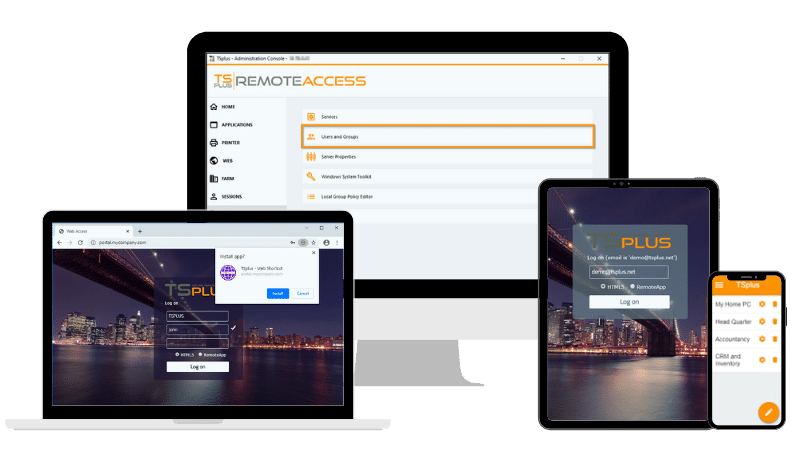
TSplus Remote Access Free Trial
Ultimate Citrix/RDS alternative for desktop/app access. Secure, cost-effective, on-premises/cloud
)
)
)
