








)
)
Introduction
Remote access can depend on identity services, connection brokers, logs, support operations and licensing systems outside the infrastructure an organization directly controls. For European IT teams, digital sovereignty therefore concerns the entire access chain, not only the datacentre location. This article explains how to assess those dependencies and build an architecture aligned with legal, operational and security requirements.
What Is Sovereign Remote Access in Europe?
Sovereign remote access is an architecture that gives an organization verifiable control over how users connect to applications, desktops and internal systems. This control extends beyond the servers delivering the service and includes the identities, administrative privileges, operational data and external dependencies involved in each session.
For a European organization, sovereign remote access usually means controlling:
- Where remote-access servers, gateways and application hosts run
- Where credentials, logs, backups and metadata are processed
- Which legal jurisdictions apply to providers and subcontractors
- Who can administer, maintain or support the platform
- Which external services are needed to establish a connection
- Whether the organization can migrate or continue operating independently
This makes sovereignty broader than data residency. An application may run in an EU datacentre while relying on a global identity provider, a vendor-operated connection broker or support personnel located outside Europe.
A complete sovereignty assessment must therefore examine several dimensions:
- Infrastructure location and ownership
- Identity and privileged-access control
- Logging, telemetry and diagnostic data processing
- Support operations and administrator location
- Technical dependencies and service continuity
- Reversibility and configuration portability
Sovereignty should not be confused with security or regulatory compliance. A customer-hosted system can still be poorly protected, while a non-European service may apply strong technical safeguards. The GDPR also permits transfers outside the European Economic Area when the appropriate safeguards and transfer conditions are met. European hosting can simplify some risk decisions, but it does not establish compliance by itself.
Why Did Digital Sovereignty Accelerate in Europe in 2026?
During spring 2026, digital sovereignty moved beyond broad political discussion and became a more concrete operational priority across Europe.
French government decisions, European Commission procurement programs and proposed EU legislation began defining sovereignty through practical criteria such as provider control, jurisdiction, reversibility, supply-chain transparency and technological dependency. The main developments were:
- On April 8, France announced measures to reduce public-sector dependency on extra-European technologies, including sovereign collaboration tools and dependency-reduction plans.
- On April 14, Decree No. 2026-272 introduced stronger requirements for sensitive public data hosted by private cloud providers.
- In April, the European Commission awarded sovereign cloud contracts worth up to €180 million over six years .
- On June 3, the Commission proposed the Cloud and AI Development Act, including a common framework for assessing sovereignty.
These initiatives mainly address cloud services and public procurement, but they also affect remote-access strategies. A workload may be hosted in Europe while its identities, logs, support operations or connection broker remain controlled through systems outside the organisation’s selected sovereignty model.
Why Is European Hosting Alone Not Enough?
An EU datacenter confirms where some servers are located, not how the complete service operates. Before reaching a European environment, a user may contact a global lookup service, authenticate through an external identity provider and generate telemetry or support data processed elsewhere.
Centralized vendor services may also control activation, updates, administration or session establishment. IT teams should therefore trace every component between the user and the application:
- The user device and access client
- DNS and certificate services
- Identity and multifactor authentication
- The web portal, gateway or connection broker
- The application or desktop host
- Session logs and monitoring systems
- Backups and disaster-recovery infrastructure
- Licensing, updates and vendor support systems
Third-country access also matters when administrators, support teams or subcontractors can view personal data. The CNIL advises organizations transferring data outside the EEA to assess whether the information continues to receive protection substantially equivalent to EU requirements, including safeguards against access by third-country authorities.
A credible sovereignty review therefore goes beyond asking where the server is hosted. It must establish who can reach the environment, which law applies, which systems are involved and which dependencies could affect continued operation.
The Layers That Define Sovereign Remote Access
Remote access sovereignty should be assessed layer by layer. Absolute autonomy is unnecessary for many organizations, but accepted dependencies should always be visible, documented and proportional to the workload.
Where Does the Remote Access Infrastructure Run?
The infrastructure layer includes the gateway, web portal, connection broker and Windows application or desktop servers. Common deployment models are:
- An organization’s own datacentre
- A private cloud
- A European hosting provider
- An EU region operated by a global provider
- Infrastructure managed by a European MSP
- A vendor-operated SaaS environment
Each model creates a different balance between control and operational effort. Customer-selected infrastructure usually provides greater freedom over network design, server configuration and data location. Managed services reduce day-to-day administration, but require closer examination of provider ownership, subcontractors, management platforms and support procedures.
Which Jurisdictions Apply?
Physical location and legal exposure are separate. A provider can operate an EU datacentre while remaining owned, controlled or administered from another jurisdiction.
Organizations should therefore examine the provider, its parent company, subcontractors and management systems. Foreign legal exposure does not automatically make a service unsuitable, but it should be identified rather than inferred from an EU hosting address.
The European Commission’s 2026 framework follows this distinction by separating basic EU data location from stronger levels involving independence, EU control and supply-chain transparency.
Who Controls Identities and Privileged Access?
Identity control determines who can enter the environment and who can change it. IT teams should document:
- The authoritative user directory
- The location where authentication requests are processed
- Responsibility for creating, disabling and reviewing accounts
- The assignment of administrative roles
- Any external dependency used for multifactor authentication
- The storage location of authentication events
- Controls applied to emergency and service accounts
Keeping Active Directory or another customer-selected identity system can avoid duplicating users in a vendor cloud. However, local control remains effective only when supported by strong access policies, account lifecycle management and multifactor authentication.
Who Can Administer and Support the Service?
Operational sovereignty depends on the people and procedures capable of modifying or accessing the platform. Providers should disclose:
- Where administrators and support personnel are located
- Whether subcontractors can enter customer environments
- How privileged interventions are requested and approved
- Whether support access is temporary or persistent
- Which administrative actions are logged
- Whether customers can deny or revoke provider access
- How emergency access is granted and reviewed
European data storage does not prevent routine administration from another region. Sensitive environments may therefore require EU-based personnel, explicit approval for each intervention or support sessions supervised by the customer.
Where do logs, metadata and diagnostic data go?
Remote access platforms generate usernames, source addresses, device details, session times, authentication failures, resource usage and administrative events. These records are essential for security and auditing but can also expose sensitive operational information.
A sovereignty review should identify the location, retention period and permitted users for each data category. It should also include crash reports, telemetry, configuration backups and support attachments. European storage of the primary application database offers limited protection when operational data follows another route.
Does the Customer Control the Technical Dependencies?
A gateway installed on customer infrastructure may still depend on an external platform for activation, configuration, session establishment or continued operation. Common dependencies include:
- Cloud-based management consoles
- Global connection brokers
- External identity services
- Vendor-hosted licensing platforms
- Proprietary update channels
- Certificate and DNS providers
- Third-party analytics
- Non-exportable configurations
Eliminating every external service is rarely necessary. The priority is to identify which dependencies are critical, what happens during an outage and whether the organization has an alternative or fallback procedure.
Can the Organization Exit or Continue Operating?
Sovereignty remains limited when an organization cannot leave a provider without unacceptable disruption. Customers should be able to retrieve data, logs and configurations in usable formats and understand the work required to move the service to another European provider, private cloud or on-premises environment.
France’s April 2026 decree explicitly includes reversibility, data recovery and applicable contract law among the requirements for sensitive public cloud services. These principles are equally relevant when remote access becomes essential to business continuity.
Which Remote-Access Architecture Provides the Most Sovereignty?
No architecture offers the best balance for every organization. Data sensitivity, internal skills, availability requirements and accepted dependencies should determine the selected model.
| Remote access model | Customer control | Main advantage | Main limitation |
|---|---|---|---|
| Global SaaS with an EU region | Limited to moderate | Rapid deployment and low infrastructure overhead | Control plane, support or metadata may remain globally operated |
| European-operated managed service | Moderate to high | Regional operations and simplified management | Customer still depends on the provider’s platform and procedures |
| Customer-hosted remote access | High | Control over hosting, networking, identities and logs | Customer assumes more security and operational responsibility |
| Private or isolated environment | Very high | Strong autonomy for sensitive or disconnected workloads | Greater cost, complexity and maintenance requirements |
| Hybrid deployment | Variable | Sensitive components stay local while other services remain managed | Dependencies can be difficult to map and govern |
A public cloud region may be sufficient for ordinary corporate workloads. Highly sensitive applications can justify customer-controlled or isolated infrastructure , while hybrid designs may preserve local control over selected components. In every case, the decision should follow a documented risk assessment rather than a general preference for cloud or on-premises deployment.
Organizations That Could Benefit from Sovereign Remote Access
Public administrations receive the most attention because strategic autonomy already influences their procurement rules. However, private organizations also need sovereign remote access when legal exposure, supplier dependency or business continuity affects their risk profile.
Public Sector and Government Organizations
Government systems can contain citizen data, policy documents and operational information with national significance. Procurement teams may need to examine provider ownership, supply-chain independence, administrator location and protection against foreign legal access before approving remote connectivity.
Healthcare and Research Organizations
Healthcare providers and research institutions manage sensitive records and intellectual property. They may need tighter control over where sessions, access logs and support data are processed, especially when clinicians, researchers or contractors connect externally.
Critical and Regulated Industries
Energy, transportation, finance, manufacturing and other critical sectors rely on systems whose disruption can affect essential operations. For these organizations, sovereignty supports resilience, supplier-risk management and continued operation during geopolitical, technical or commercial disruption.
European ISVs and MSPs
European software vendors can publish Windows applications through browser or desktop access without rebuilding them as web applications. Their customers may ask where the environment runs, who administers it and whether delivery requires a non-European SaaS broker.
MSPs face the same questions when they operate remote access services for several customers. Tenant separation, auditable support access and portable deployment models can become practical commercial differentiators.
SMBs Seeking Greater Control
An SMB may not require complete technological autonomy. Its objective may be limited to hosting business applications with a chosen European provider, retaining its own directory and avoiding an external SaaS platform in the session path.
Sovereignty can therefore be proportional. The required control level should match the organisation’s data, operational exposure and available IT resources without adding unnecessary complexity.
How Can You Build Sovereign Remote Access in Europe?
A sovereign remote-access project should begin with architecture and governance rather than the nationality of a vendor. The following steps help organizations turn a policy objective into a verifiable deployment model.
Classify the Applications and Data
List the applications being published and the information available during each session. Separate ordinary business workloads from systems containing health, financial, government, industrial or otherwise sensitive data.
This classification establishes whether EU residency is sufficient or whether the organization also needs stronger legal, operational and technical control.
Map the Complete Connection Path
Document every service involved from login to session termination. Include identity providers, gateways, DNS, certificates, telemetry, logging, backups, licensing, updates and support.
For each component, record the provider, processing location, jurisdiction and outage impact. This exercise often reveals dependencies that do not appear in the main architecture diagram.
Select an Appropriate Hosting Model
Match the infrastructure to the required degree of control. Customer-hosted software can run in a private datacentre or with a selected European cloud provider, while a managed service may suit organisations with limited operational capacity.
The review should cover primary systems, replicas, backups and disaster-recovery environments rather than the production server alone.
Retain Control of Identities
Use a customer-controlled directory where practical and apply role-based access. Separate standard and administrative accounts, then limit privileged users to the systems required for their responsibilities.
Multifactor authentication should protect exposed application portals. ENISA also recommends avoiding direct internet exposure of remote system interfaces such as RDP.
Place a Controlled Gateway Before Applications
Users should not connect directly from the internet to individual application servers. A controlled gateway or web portal can centralise authentication, HTTPS access, application assignment and connection rules.
Network segmentation should then restrict what a compromised account or session can reach beyond the published application.
Govern Logs and Administrative Sessions
Store authentication, connection and administrative logs in a location controlled by the organisation or an approved provider. Retention periods should reflect operational, security and legal requirements.
Privileged support sessions should require authorisation; use named accounts and create records that administrators can review after each intervention.
Document External Dependencies
List the features that stop working when vendor or third-party services become unavailable. Relevant tests may include licensing failures, identity outages, update interruptions and loss of internet connectivity.
The results allow the organization to classify each dependency as acceptable, replaceable or subject to a documented fallback procedure.
Test Reversibility and Continuity
Export configurations and logs before an emergency occurs. Maintain installation, backup, recovery and migration procedures that another administrator or provider could follow.
Contractual exit rights are useful, but technical portability must also be tested. Sovereignty requires the practical ability to recover or move the service, not only the permission to do so.
Questions to Ask a Remote Access Provider
A procurement or architecture review should request precise answers supported by technical and contractual evidence:
- Can the software run on infrastructure selected by the customer?
- Is a vendor-hosted connection broker required?
- Where are authentication and session metadata processed?
- Which subcontractors participate in service delivery?
- From which countries can support personnel access systems?
- Can the customer approve and audit privileged support access?
- Does the service remain operational when the vendor cloud is unavailable?
- Can identities remain in the customer’s existing directory?
- Where are telemetry, logs and configuration backups stored?
- Can all relevant data and settings be exported?
- Which legal entity signs the contract and which law applies?
- Can the deployment move to another European host without replacing the application delivery platform?
Claims such as “EU hosted,” “GDPR ready” or “European cloud” are useful starting points, but they should never replace a documented view of the architecture, support model and contractual responsibilities.
What Are the Trade-Offs of Sovereign Remote Access?
Greater sovereignty normally gives the customer more control while transferring more operational responsibility. The main trade-offs include:
- Customer-hosted deployments provide control over servers, network routes and logs, but require patching, monitoring, backups, capacity planning, certificate management and incident response.
- Highly isolated environments reduce external dependencies but may also limit integrations that rely on global cloud services.
- Controlled update processes can improve stability, but slow approval cycles may delay important security fixes.
- European or sovereign providers may offer less geographic coverage, fewer integrations or different economies of scale than global platforms.
These constraints should be weighed against jurisdictional exposure, supplier dependency and continuity requirements. The objective is not maximum sovereignty at any cost, but an intentional balance between control, security, functionality, resilience and operational effort.
How Can TSplus Support Digital Sovereignty?
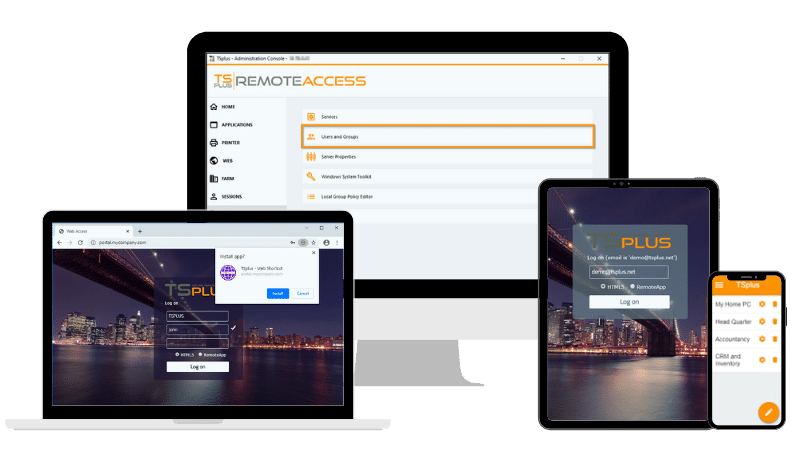
TSplus Remote Access publishes Windows applications and desktops through a web portal installed on customer-selected Windows infrastructure. Organizations can therefore retain control over the hosting location, application servers, user access and deployment architecture, whether the environment runs on premises or with a chosen European provider.
TSplus is privately held and headquartered in France. However, the sovereignty of each installation still depends on the customer’s wider hosting, identity, security and operational design.
Conclusion
Sovereign remote access in Europe requires more than hosting a server inside the EU. Organizations need appropriate control over infrastructure, jurisdictions, identities, support operations, logs, connection services and technical dependencies. Mapping the complete access chain helps each organization select a deployment model that strengthens digital autonomy without imposing unnecessary isolation on every workload.
TSplus Remote Access Free Trial
Ultimate Citrix/RDS alternative for desktop/app access. Secure, cost-effective, on-premises/cloud
)
)
)
