





)
)
Introduction
Remote access has shifted from a convenience feature to a critical component of day-to-day IT operations, supporting hybrid work, external access, and business continuity. As security expectations rise and usage patterns evolve, many organizations assume that modernizing remote access requires a full infrastructure rebuild or a move to complex cloud platforms. In practice, most environments can be modernized incrementally by improving access control, security layers, and session management while preserving existing systems.
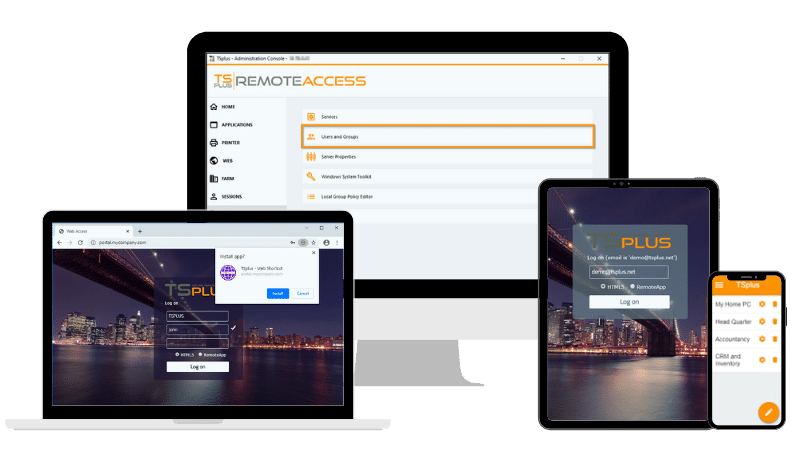
TSplus Remote Access Free Trial
Ultimate Citrix/RDS alternative for desktop/app access. Secure, cost-effective, on-premises/cloud
Why Full Remote Access Rebuilds Often Fail?
Cost and Timeline Overruns Are Systemic
For many organizations, a full rebuild appears attractive on paper. Clean architectures, cloud-native platforms, and simplified diagrams promise a fresh start. In practice, however, rebuilding Remote Access from scratch introduces significant cost, risk, and operational disruption.
User Disruption Is Often Underestimated
From a financial perspective, rebuilds often require new licensing models, parallel infrastructure during migration, and extensive consulting or internal project time. These costs are difficult to justify when existing systems remain functional and business critical. From an operational standpoint, replacing Remote Access affects every user, every day. Even small changes in login flows, clients, or performance can generate friction, support tickets, and productivity loss.
Rebuilds Solve Technology, Not Access Problems
There is also a strategic risk. Many rebuilds focus on technology replacement rather than access outcomes. Organizations may end up with a newer platform that still exposes too much network access, lacks proper session visibility, or shifts complexity from on-premises systems to cloud management layers. As a result, the return on disruption is often lower than expected.
How Incrementing Remote Access Modernisation Can Be a Good Solution?
Incremental modernization focuses on improving how access is granted, controlled, and monitored rather than replacing where applications run. This approach recognises that most environments already have stable servers, applications, and workflows that do not need to change in order to become more secure or scalable.
Preserve What Works, Address What Creates Risk
In most environments, the issue is not the remote access protocol or server, but how access is exposed and managed. Common pain points include:
- Weak authentication
- Direct internet exposure of services
- Overly broad user permissions
- Limited session visibility
Incremental modernization addresses these weaknesses first, improving security without destabilising production systems. This approach also fits real-world IT constraints, allowing changes to be planned around maintenance windows, budgets, and available resources instead of forcing a single high-risk transformation.
How Can You Modernize Access Control and Security Layers?
One of the most effective ways to modernise remote access is to improve what sits in front of existing systems. Strengthening access control layers delivers immediate security benefits without touching application servers or user workflows.
Strengthening Authentication and Entry Points
Modernisation often begins with identity. Common access control improvements include:
- Enforcing multi-factor authentication
- Centralising identity policies
- Eliminating shared or local credentials
Consolidating access through gateways or brokers further limits exposure and standardises how users connect. This improves visibility and policy enforcement without changing backend systems.
Improving Session Visibility and Accountability
Another critical layer is session control. Logging connection attempts, tracking session duration, and recording user activity where appropriate allows IT teams to detect anomalies, support audits, and investigate incidents more effectively.
These capabilities are often missing in legacy remote access setups, yet they can be added without replacing the underlying systems users rely on.
How Can You Move Away from Network-Level Access Models?
Traditional remote access models are built around network extension. VPNs effectively place remote devices inside the corporate network, which increases both exposure and complexity. Modernisation does not require abandoning VPNs entirely, but it does require reconsidering when and how they are used.
From Broad Network Access to Application-Level Access
Application-level access limits users to only the desktops or applications they actually need. This approach:
- Reduces lateral movement opportunities
- Simplifies firewall rules
- Makes access policies easier to reason about
From a user perspective, application publishing often improves the experience by removing the need for manual VPN connections and complex client configurations.
For IT teams, this shift supports a more principle-based access model. Permissions become explicit, access paths are easier to audit, and the impact of a compromised credential is significantly reduced compared to full network access.
Why Is Application-Level Access Safer Than Broad Network Access?
Application-level access restricts users to only the desktops or applications they need, rather than exposing entire network segments. This approach:
- Reduces lateral movement opportunities
- Simplifies firewall and routing rules
- Makes access policies easier to define and audit
For users, application publishing often removes the need for manual VPN connections and complex client configurations. For IT teams, it supports a more principle-based access model where permissions are explicit and the impact of compromised credentials is significantly reduced compared to full network access.
How Extending and Securing Legacy Systems Can Be A Good Solution?
Legacy applications are often cited as blockers to modernization. In reality, they are one of the strongest arguments for an incremental approach.
Applying Modern Controls to Non-Modern Applications
While older applications may not support modern authentication or cloud-native deployment, they can still be protected through external access layers. These layers can:
- Enforce modern authentication
- Encrypt application sessions
- Provide centralized access logging
This approach allows organizations to extend the usable life of critical systems while still meeting modern security and compliance expectations. It also avoids forcing costly application rewrites purely for access reasons.
How Can Modern Access Controls Protect Legacy Applications?
Even when older applications lack support for modern authentication or cloud-native deployment, they can still be secured through external access layers. These layers can:
- Enforce modern authentication
- Encrypt application sessions
- Provide centralized access logging
This approach extends the usable life of critical systems while meeting modern security and compliance expectations. It also avoids forcing costly application rewrites solely for access-related reasons.
How Endpoint and Session Security as Modernisation Levers Are Good Options?
Remote access security is only as strong as the endpoints connecting to it. Many incidents attributed to remote access actually originate from compromised or unmanaged user devices.
Reducing Risk Without Touching Servers
Endpoint posture checks, device trust policies, and integration with endpoint detection solutions allow IT teams to enforce minimum security standards before granting access. These controls typically include:
- Endpoint posture checks (OS version, encryption, security agents)
- Device trust or compliance policies
- Integration with endpoint detection and response tools
Combined with session controls such as idle timeouts and activity monitoring, these measures significantly reduce exposure without requiring changes to servers or applications.
Focusing on endpoints and sessions also align modernization efforts with real-world threat models, which increasingly target credentials and user devices rather than infrastructure vulnerabilities.
How do endpoint and session controls reduce risk without infrastructure changes?
Endpoint posture checks, device trust policies, and integration with endpoint detection solutions allow IT teams to enforce minimum security standards before granting access. Typical controls include:
- Endpoint posture validation (OS version, encryption, security agents)
- Device trust or compliance policies
- Integration with endpoint detection and response tools
Combined with session controls such as idle timeouts and activity monitoring, these measures reduce exposure without requiring changes to servers or applications. This focus also aligns modernization efforts with real-world threat models that increasingly target credentials and user devices.
How Can You Modernize at Your Own Pace with Modular Upgrades?
A key advantage of incremental modernization is flexibility. Organizations are not forced into a predefined sequence of changes and can prioritise improvements based on risk, business impact, and available resources.
Aligning Technical Progress with Organizational Reality
Some teams may start with identity and authentication, while others focus first on reducing exposed services or improving session visibility. Common modular starting points include:
- Identity and authentication hardening
- Reduction of exposed services and access paths
- Improved session visibility and control
Modular upgrades allow each improvement to stand on its own, delivering value immediately rather than only at the end of a long project.
Over time, these layered improvements create a remote access architecture that is more secure, more manageable, and better aligned with modern work patterns, without ever requiring a disruptive rebuild.
How Do Modular Upgrades Align with Business and IT Constraints?
Different teams naturally start in different places. Common modular entry points include:
- Identity and authentication hardening
- Reduction of exposed services and access paths
- Improved session visibility and control
Each improvement delivers value on its own, rather than only at the end of a long project. Over time, these layered upgrades create a remote access architecture that is more secure, more manageable, and better aligned with modern work patterns, without requiring a disruptive rebuild.
How Can You Modernize Access Control Without Changing Core Systems?
Modernising remote access often starts by improving how access is governed rather than replacing servers or applications. In many environments, core systems remain stable, but access rules have grown inconsistent over time, creating unnecessary exposure. Addressing these issues at the access layer delivers immediate security and operational benefits without disrupting production.
Standardising Authentication, Entry Points, and Permissions
Access modernization begins by reducing fragmentation. Consolidating entry points allows IT teams to enforce consistent authentication methods, apply uniform security policies , and centralise logging, making access behaviour easier to predict and secure.
Strengthening authentication is typically the first control to mature. Common improvements include:
- Enforcing multi-factor authentication
- Replacing locally managed or shared credentials with centralized identity
- Narrowing permissions to application- or role-specific access
These changes reduce the risk of unauthorized access and prevent users from inheriting broad access by default.
How Does Centralised Access Governance Improve Visibility and Control?
Once authentication and entry points are standardised, access governance becomes easier to enforce and audit. Centralised policies provide clearer insight into who can connect, from where, and to which resources. This visibility supports faster incident response, more consistent policy enforcement, and smoother compliance reporting, all without requiring changes to underlying servers or applications.
When Does A Full Rebuild Actually Make Sense?
There are situations where rebuilding remote access infrastructure is justified. End-of-life platforms, major organisational mergers, or regulatory mandates may require deeper architectural change that incremental adjustments can no longer address safely or efficiently.
Conditions That Legitimately Justify a Rebuild
A full rebuild is typically driven by structural constraints rather than performance optimisation. Common triggers include:
- Unsupported or end-of-life operating systems
- Incompatible identity models following a merger or acquisition
- Compliance frameworks requiring strict architectural separation
In these scenarios, attempting to extend legacy systems can increase risk instead of reducing it.
That said, organizations that have already modernised access controls, identity enforcement, and session management are far better positioned to rebuild efficiently. Incremental modernisation does not delay transformation; it reduces risk, shortens rebuild timelines, and provides a stronger foundation for whatever comes next.
What Conditions Legitimately Justify a Full Rebuild?
A rebuild is typically required when existing systems can no longer be extended safely. Common triggers include:
- Unsupported or end-of-life operating systems
- Incompatible identity models following a merger or acquisition
- Compliance frameworks requiring strict architectural separation
In these scenarios, attempting to preserve legacy systems can increase risk instead of reducing it. Organizations that have already modernised access controls, identity enforcement, and session management are far better positioned to rebuild efficiently when it becomes unavoidable.
How Does TSplus Support Incremental Modernisation?
TSplus Remote Access is designed for organisations that want to modernise remote access without rebuilding their infrastructure. It enables secure application and desktop publishing over existing RDP environments, adds strong access controls and session management, and integrates cleanly with current identity and security models. This allows IT teams to improve security, usability, and scalability while preserving proven systems and workflows.
Conclusion
Modernising remote access is not about chasing the newest platform or redesigning infrastructure for its own sake. It is about improving how users authenticate, how access is limited, and how sessions are monitored and controlled.
By focusing on layered improvements rather than wholesale replacement, organizations can enhance security, improve user experience, and maintain operational stability. In most cases, the smartest path forward is not rebuilding everything but rethinking how existing systems are exposed and protected.
TSplus Remote Access Free Trial
Ultimate Citrix/RDS alternative for desktop/app access. Secure, cost-effective, on-premises/cloud
)
)
)
